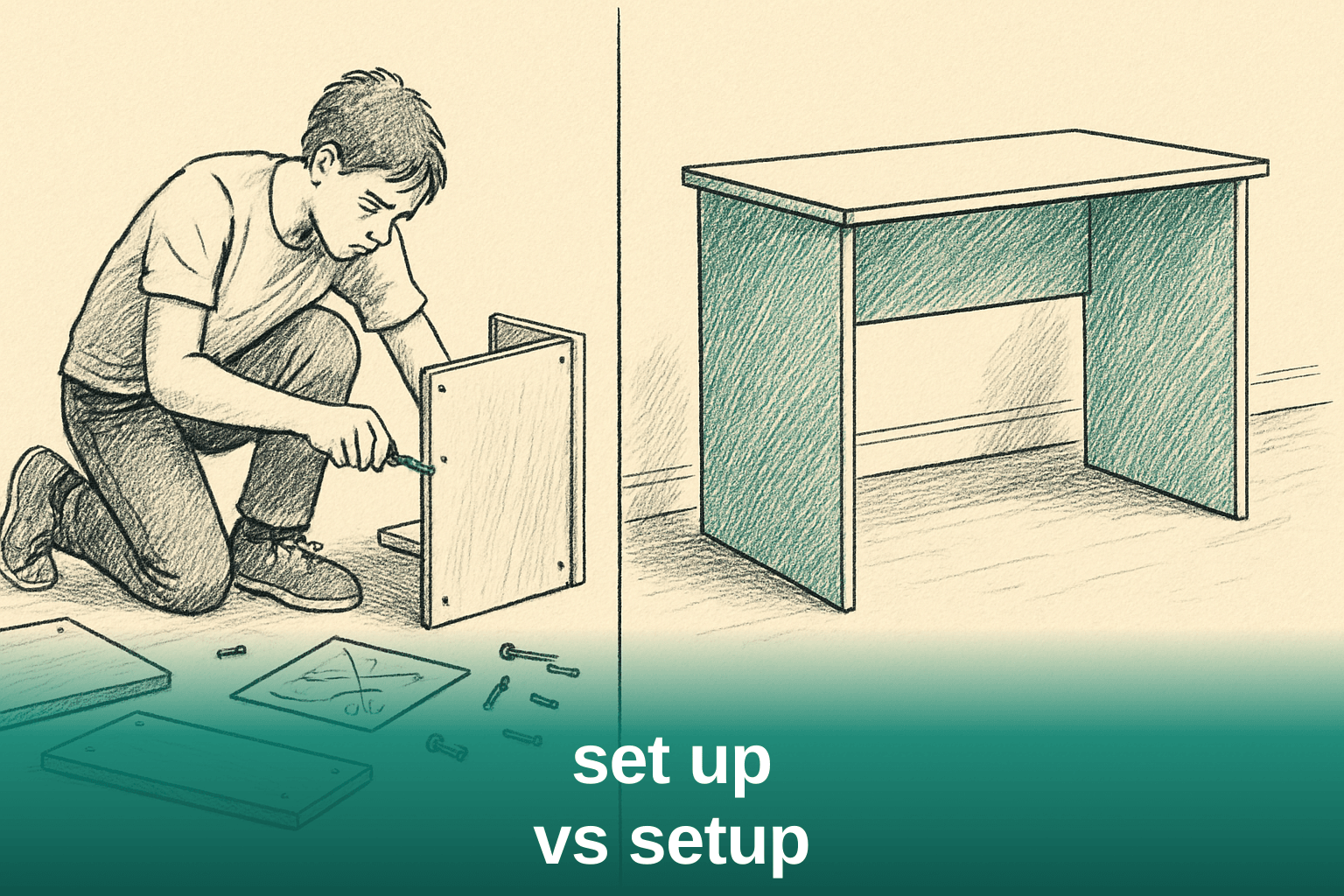

Set up (two words) is the verb form meaning to arrange, install, or establish. Setup (one word) is the noun or adjective describing an arrangement, configuration, or preparatory state. British English sometimes hyphenates the noun as set-up, but the verb is never hyphenated.
Set up (two words) is a verb; setup (one word) is a noun or adjective. You set up a computer, and then you admire the tidy setup. A hyphenated set-up appears mostly in British English, but the verb is never hyphenated. This distinction solves nearly every doubt about set up vs setup in daily writing.
The confusion is natural because both forms sound identical when spoken. Many writers freeze when drafting an email or editing a colleague’s report, unsure whether to leave a space. Below, you will find the one-sentence rule, a side-by-side comparison table, twenty real-world examples, copy-paste templates for work emails, and a quick quiz to lock the habit in place.
Set up functions as a phrasal verb describing the action of arranging, installing, or establishing something. Setup functions as a closed compound noun or adjective that names the resulting configuration, process, or arrangement. British English and some formal style guides accept set-up with a hyphen for the noun or adjective, but the verb form is always two separate words, and consistency within a single document remains essential.
Set Up vs Setup: The Rule in One Sentence
If you are describing an action, write set up as two words; if you are naming a thing or quality, write setup as one word. This single distinction anchors every decision you will make. The phrase “set up” is a phrasal verb that carries tense and describes what someone does; when that same concept becomes an object, it solidifies into the closed compound “setup.” Once you frame the choice as action versus object, hesitation disappears.
Set Up (Two Words): The Verb
When you need a verb meaning to arrange, assemble, or establish something, always use two words: set up. This phrasal verb conjugates freely: you set up a desk yesterday, she sets up meetings every Monday, and they are setting up the new software now. You can set up a computer, set up a conference call, or set up a small business from a kitchen table. Whenever you spot an infinitive like “to set up” or a progressive form like “setting up,” the two-word spelling is non-negotiable.
Examples
- Please set up the chairs before the guests arrive.
- She will set up the new laptop this afternoon.
- Can we set up a meeting for next Tuesday?
- They decided to set up a nonprofit after the flood.
- The police set up a sting operation to catch the thieves.
Setup (One Word): The Noun and Adjective
Use setup as one word whenever you need a noun or an adjective. As a noun, it names the resulting arrangement or configuration: the office setup, a stage setup, or an elaborate criminal setup. As an adjective, it modifies another noun, as in a setup screen, a setup fee, or setup time. The word can be countable or uncountable, and it captures a static concept rather than an action.
Examples
- The setup of the new router took less than ten minutes.
- The banquet hall had an elegant table setup.
- The heist movie featured an elaborate setup from the very first scene.
- There is a one-time setup fee for new accounts.
- Factor in at least thirty minutes of setup time before the presentation.
What About “Set-Up” With a Hyphen?
The hyphenated form set-up still appears in many British dictionaries and formal business documents as a noun or adjective. However, this is never a verb: writing “set-up the tent” is always wrong. Dictionaries vary, so follow your organization’s style guide rather than a single source. In American English, the hyphenated noun is fading, and setup dominates.
Set Up vs Setup: Side-by-Side Comparison Table
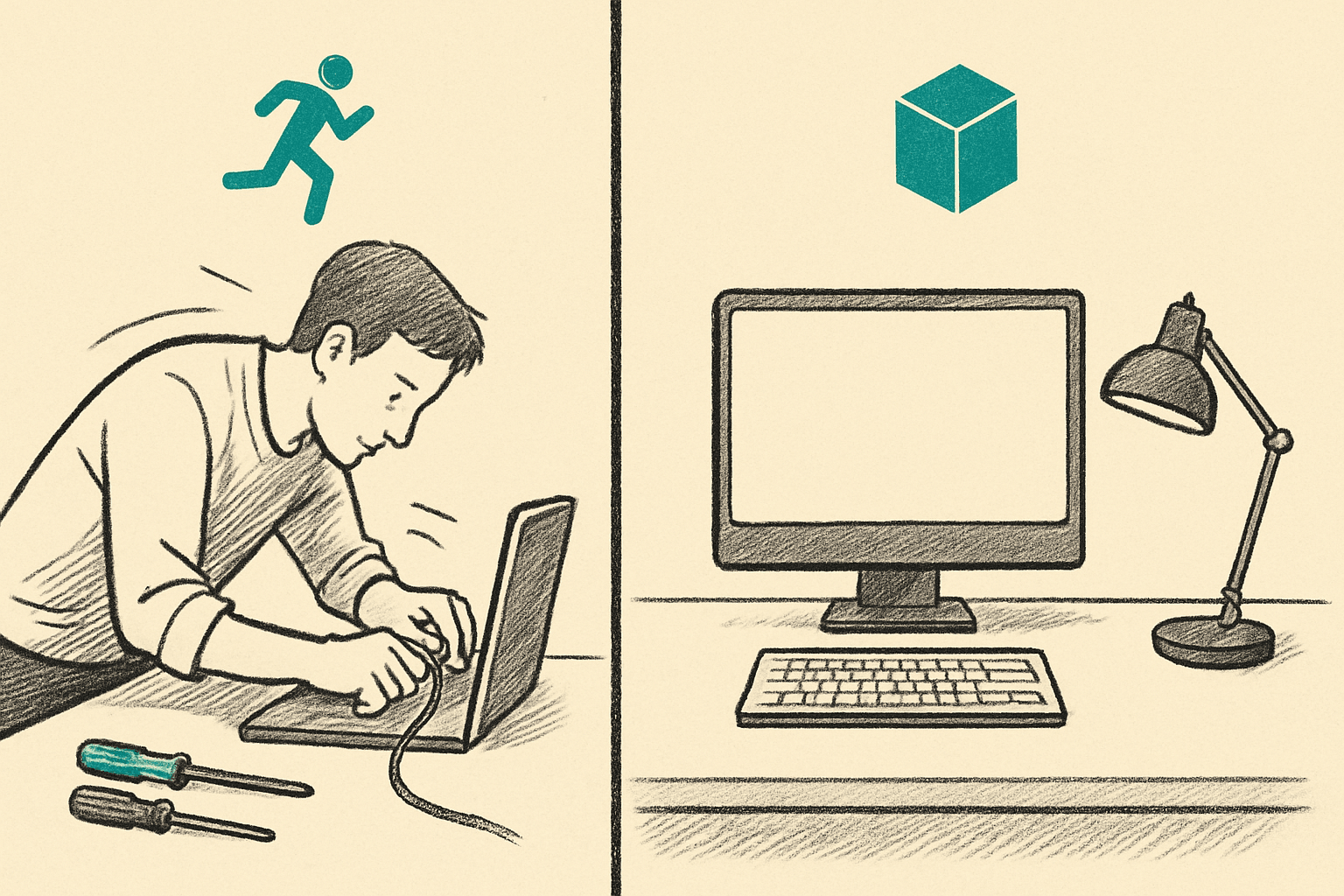
Sometimes a single glance resolves what paragraphs of explanation cannot. The table below distills the core differences into four rows, showing how spelling shifts with grammar. Keep it open for quick reference while you edit, or copy it directly into your team’s style guide. Once you see the forms lined up, the pattern becomes almost impossible to forget.
| Form | Part of Speech | Spelling | Example |
|---|---|---|---|
| set up | Verb | Two words | We need to set up the projector. |
| setup | Noun | One word | The setup took an hour. |
| setup | Adjective | One word | Check the setup menu. |
| set-up | Noun / Adjective (British, style-dependent) | Hyphenated | There is a £10 set-up fee. |
Bookmark this table and refer to it whenever you pause at the keyboard.
20 Example Sentences That Show the Difference
Rules stick best when they meet real sentences drawn from everyday work and life. The twenty examples below cover ten different contexts for the verb and ten for the noun or adjective. Read them aloud so your ear learns the grammar alongside your eye.
Set up (verb)
- We need to set up the equipment before the keynote.
- She set up a crowdfunding page last night.
- He will set up the interview in the morning.
- They are setting up a popup shop downtown.
- Can you set up the tent while I gather firewood?
- The manager set up strict guidelines for remote work.
- I forgot to set up the auto-reply before my vacation.
- The coach set up a rigorous training schedule.
- We should set up a dedicated channel for this project.
- The detective set up surveillance outside the warehouse.
Setup (noun/adjective)
- The studio setup cost more than expected.
- Have you seen the ergonomic desk setup?
- The setup of the board game is surprisingly quick.
- There is no setup fee for the basic plan.
- The setup instructions are inside the box.
- His home office setup inspires serious envy.
- The setup time for the machine is under five minutes.
- The wedding setup looked magical at sunset.
- Navigate to the setup screen and click “Restart.”
- The convict claimed the drugs were a police setup.
If any sentence still feels unclear, run it through the checklist in the next section.
Set Up or Setup a Meeting? Set Up or Setup Time?
Three phrases cause constant second-guessing: “set up a meeting,” “setup time,” and “set-up time.” When scheduling a discussion, use the verb: “Let’s set up a meeting for Thursday.” Writing “setup a meeting” collapses the verb into a noun. When describing preparation duration, use the one-word noun: “The setup time is two days.” British writers might prefer “set-up time,” but memorizing these templates removes hesitation.
Set Up or Setup in British vs American English
American English strongly prefers setup for every noun and adjective use. British English still tolerates the hyphenated set-up in formal and non-technical contexts, though computer-related usage increasingly follows the closed American spelling. The verb never changes: whether in New York or Edinburgh, set up remains two words for an action. Pick one noun form, document it in your style guide, and apply it consistently.
The Same Rule Works for Login, Breakdown, and Workout
The pattern is a systematic feature of English phrasal verbs. You log in to a system, but your login credentials grant access. Engineers watch a machine break down, and then they analyze the breakdown to prevent recurrence. Once you see that motion equals two words and objects equal one, hesitation turns into certainty.
Examples
- Please log in before noon. Your login expires at midnight.
- Did the printer break down again? We need a breakdown of the repair costs.
- I work out every morning. Yesterday’s workout was brutal.
- They decided to break up the partnership. The breakup made headlines.
The “Action = Space” Mnemonic Trick
Your brain wants to close compounds because it loves tidy packages. Fight that instinct with a simple image: actions need space to move. If you can substitute “arrange,” you need the open verb; if you can substitute “arrangement,” you need the closed noun. This two-second test removes ninety percent of doubt.
Mnemonic
Action = Space. If you can substitute “arrange,” write set up (two words). If you can substitute “arrangement,” write setup (one word).
Set Up as a Past-Participle Adjective
There is one construction that looks like an exception but is not: the past-participle adjective. When you write “The room is set up for the meeting,” the phrase stays open because it derives directly from the verb. Contrast this with “The setup is ready,” where setup is a pure noun. If you can insert “arranged” and the sentence still makes sense, keep the phrase open.
Common Mistakes With Set Up and Setup
Even experienced writers slip into predictable traps. The most widespread error is using setup as a verb: “I will setup the computer tomorrow” should be “I will set up the computer tomorrow.” Another frequent mistake is splitting the noun: “The set up is complete” should be “The setup is complete.” A third trap is inserting a hyphen into the verb. Always pause to ask “thing or action?” before your fingers hit the keys.
- Wrong: I will setup the computer. → Right: I will set up the computer.
- Wrong: The set up is complete. → Right: The setup is complete.
- Wrong: Please set-up the tent. → Right: Please set up the tent.
- Wrong: Mixing setup and set-up on the same page. → Right: Pick one and stay consistent.
- Wrong: Trusting autocorrect without checking grammar. → Right: Verify the part of speech before accepting.
Quick Decision Checklist: Verb or Noun?
When you are staring at a blinking cursor, run through this five-step algorithm. It takes less time than rereading this article and works in any context. The goal is to identify the grammatical job before your fingers decide the spelling. Print this checklist and tape it to your monitor if necessary.
- Step 1: Locate the word in your sentence and read the full clause aloud.
- Step 2: Ask: is this describing an action someone performs, or a thing/state/quality?
- Step 3: If it is an action, write two words: set up.
- Step 4: If it is a thing, state, or quality, write one word: setup.
- Step 5: Check your style guide—if it requires a hyphen for nouns/adjectives, use set-up; otherwise, stay with setup.
Following this sequence transforms hesitation into muscle memory.
Test Yourself: 5-Question Quiz
You have read the rule, studied the table, and seen twenty examples. Now it is time to prove you have mastered the difference. Below are five real sentences with the target word removed. Click each question to reveal the answer and a brief explanation.
1. We need to ______ the microphones before the panel starts.
Answer: set up. This is a verb describing an action.
2. The entire stage ______ looks professional from the back row.
Answer: setup. This is a noun naming the arrangement.
3. The conference room is ______ for the keynote address.
Answer: set up. Here it functions as a past-participle adjective derived from the verb.
4. Their London office uses a hyphen, so they charge a ______ fee.
Answer: set-up. British style sometimes hyphenates the noun or adjective form.
5. Please navigate to the ______ wizard on the main screen.
Answer: setup. This is an adjective modifying “wizard.”
If you answered four or five correctly, the rule is already yours.
Frequently Asked Questions
Both forms are correct, but they serve different grammatical roles. Use set up (two words) when you need a verb describing an action, and setup (one word) when you need a noun or adjective. For example, you set up a camera, and then you admire the neat setup.
Correctness depends on whether the word functions as a verb or as a noun and adjective. Set up is the verb phrase, while setup is the closed compound for things and descriptors. No single dictionary invalidates either form because the spelling is tied to grammar, not to a right-or-wrong authority.
Setup (one word) is a noun or adjective that names a configuration, arrangement, or preparatory phase. Set up (two words) is a phrasal verb that describes the action of arranging, installing, or establishing something. The difference is static object versus dynamic action.
Yes, set-up with a hyphen is an accepted variant for the noun or adjective, particularly in British English and some formal style guides. However, you should never hyphenate the verb form. Choose either setup or set-up for nouns and stay consistent.
The verb is always set up in both varieties. The only difference lies in the noun and adjective: American English strongly prefers setup, while British English still uses set-up with a hyphen in many non-technical contexts.
It is always set up a meeting because the phrase functions as a verb. You can test this by substituting “arrange”: “I will arrange a meeting” makes sense, so the two-word verb is required.
Use setup time (one word) when the term acts as a noun or adjective describing the duration required for preparation. Use set up time only if the phrase functions as a verb within a clause, such as “Please set up time for a review next week.”
Final Verdict on Set Up vs Setup
The boundary between set up and setup is cleaner than it first appears. If the word describes an action, leave it open; if it names a thing or quality, close it into one word. The hyphenated set-up survives mainly in British contexts, but consistency matters more than the hyphen itself. Trust the action-versus-object test, and you will never pause at the keyboard over this pair again.