
The phrase of course is always written as two words and functions as an adverb meaning agreement, permission, or obviousness. Ofcourse is not a real word in standard English and should be avoided in all formal and informal writing. Commas are required after of course at the beginning of a sentence and on both sides when it appears in the middle.
The correct spelling is of course — always two separate words. Ofcourse is a misspelling and is not recognized in standard English. Use of course to show agreement, permission, or something obvious, and add a comma when it starts a sentence or sits in the middle of one.
You stare at the screen before hitting send, wondering whether that quick reply looks professional. Many writers merge the phrase into one word without thinking, then hesitate when the spell-checker underlines it—or worse, stays silent. This article settles the ofcourse or of course dilemma for good, walking you through comma rules, real sentence examples, and the common mix-ups that even native speakers make.
Ofcourse or Of Course — The Short Answer
You need a fast, reliable answer before you send that email or submit that essay. The correct spelling is of course as two separate words, and ofcourse is simply a misspelling that no major dictionary recognizes. Unlike words such as therefore or anymore, which started as two separate terms and eventually merged into compounds over centuries, of course has remained distinct because it functions as a prepositional phrase that became an idiom rather than a single lexical item. Spell-checkers in programs like Microsoft Word and Google Docs will usually flag ofcourse with a red underline, but autocorrect on phones sometimes misses it when you are typing quickly. In formal writing, academic papers, business proposals, and professional correspondence, writing it as one word instantly signals carelessness. Even in casual text messages to colleagues, merging the two words can create a subtle impression that you do not proofread. Keep the space between of and course, and you are already ahead of thousands of writers who merge them by habit.
Examples
- Correct: Of course, I can help you.
- Incorrect: Ofcourse I can help you.
| Version | Correct? | Why |
|---|---|---|
| of course | ✅ | Standard spelling in all English varieties. |
| ofcourse | ❌ | Misspelling; not recognized by dictionaries. |
| Of Course | ✅ | Capitalized correctly at the start of a sentence. |
Why “Ofcourse” Is Always Wrong
The misspelling ofcourse creeps into writing for several understandable reasons, yet none of them make it acceptable. When people speak quickly, the two words blur together into a single rhythmic unit, so fingers typing at speed often treat them as one compound. Autocorrect systems and phone keyboards learn from your habits, meaning if you have merged the words before, the device may silently suggest the error again. Social media and instant messaging reward speed over accuracy, creating an environment where ofcourse spreads through repetition rather than grammar rules. Some writers assume the phrase follows the same path as nevertheless or moreover, guessing that formal English has simply lagged behind everyday usage. That assumption is wrong. No authoritative dictionary—Oxford, Merriam-Webster, Cambridge, or Macmillan—lists ofcourse as a valid entry. It is not a dialect variant, a British alternative, or a casual shorthand. It is an orthographic error, plain and simple, and it undermines your credibility every time it appears in a professional document.
The Grammar Behind the Two-Word Phrase
To understand why the phrase stays separate, look at its grammatical skeleton. Of works as a preposition, and course functions as a noun meaning path, progression, or sequence. Together they form a prepositional phrase that solidified into an adverbial idiom, but English does not fuse prepositions to nouns without a compelling historical reason. You would never write infact or atleast, and the same logic applies here. The phrase follows the same pattern as in fact, for sure, and at least—all remain two words because each component retains its individual grammatical identity.
Examples
- in fact
- at least
- for sure
Why the Mistake Is So Common
Even fluent English speakers produce ofcourse when they are tired, rushed, or typing on small screens. The error is mechanical, not intellectual. Four forces drive it: phonetic blending in speech, autocorrect that learns bad habits, the visual similarity to legitimate compounds like therefore, and the informal register of chat apps that punishes slow typing. In a friendly text, the mistake passes unnoticed. In a resume, cover letter, or client proposal, it plants a seed of doubt about your attention to detail.
What “Of Course” Actually Means
At its core, of course is a chameleon phrase that shifts its exact meaning depending on the surrounding sentence and the speaker’s intent. It can grant permission with enthusiasm, state an obvious fact with patience, or reassure a worried friend with warmth. Because it carries multiple payloads, many non-native speakers overuse it or place it in contexts where a simpler word would work better. Recognizing the three dominant shades—agreement and permission, obviousness and expectation, and reassurance and sympathy—lets you deploy the phrase precisely rather than sprinkling it randomly through your paragraphs. In business writing, it often softens a refusal or strengthens a commitment. In everyday conversation, it can signal that you take a request for granted in a positive way. Mastering these nuances separates robotic textbook English from writing that actually sounds like a natural speaker, so studying each meaning pays off immediately.
| Usage Type | Example Sentence |
|---|---|
| Agreement | “Of course, I agree with your proposal.” |
| Permission | “You can, of course, use my laptop.” |
| Obviousness | “Of course water boils at 100°C.” |
| Reassurance | “Of course you can trust me.” |
Agreement and Permission
Of course works as a strengthened “yes” when someone asks for consent or confirmation. It feels warmer and more generous than a flat yes because it implies the request was never a burden. A colleague might ask, “Can I borrow your charger?” and a reply of “Of course!” signals genuine willingness. In customer service, this usage builds goodwill fast.
Examples
- “Can I use your phone?” — “Of course!”
- “Would you mind reviewing this?” — “Of course, I’d be happy to.”
- “May we extend the deadline?” — “Of course, no problem.”
Obviousness and Expectation
In this sense, the phrase points to something the listener should already know or expect. It can sound patient or slightly exasperated depending on context. When you say, “Of course the train is late,” you are commenting on a predictable outcome. When you write, “Of course, demand rises during the holidays,” you are stating a recognized pattern. The commas here matter: mid-sentence placement usually demands them on both sides.
Examples
- “I forgot my umbrella, so of course it rained.”
- “The solution is, of course, to restart the server.”
- “Of course water freezes at 0°C.”
Reassurance and Sympathy
Here the phrase acts as emotional support, telling someone that their feelings or actions are valid. A manager might say, “Of course you were frustrated by the delay,” validating an employee’s reaction without assigning blame. It creates psychological safety because it removes the stigma of surprise or wrongdoing.
Examples
- “Of course you can trust me.”
- “Of course you did the right thing.”
- “Of course you’re nervous before the interview.”
How to Use “Of Course” in a Sentence
Positioning of course correctly inside a sentence changes both its rhythm and its politeness level. When you place it at the beginning, you frame the rest of the statement as something the reader should already expect, which can feel confident or condescending depending on punctuation and context. In the middle of a clause, it acts as a parenthetical aside that softens a request or admission, often surrounded by commas to create breathing room. At the end of a sentence, it lands with a gentler, almost apologetic tone, as if you are confirming something the listener hoped to hear. Because English word order is relatively rigid compared to some languages, moving this phrase around is one of the few ways you can fine-tune your attitude without changing the vocabulary. Choose the placement deliberately, and always pair it with the correct comma pattern so the reader feels your intended tone rather than guessing it.
Placement: Beginning, Middle, End
Each placement carries a distinct social signal. At the beginning, the phrase sets the stage and asserts confidence. In the middle, it tempers a statement with modesty. At the end, it softens the entire message into a friendly confirmation. Match the position to the relationship you have with your reader.
| Placement | Example | Tone |
|---|---|---|
| Beginning | “Of course, we will meet the deadline.” | Confident, direct |
| Middle | “We will, of course, meet the deadline.” | Modest, formal |
| End | “We will meet the deadline, of course.” | Warm, reassuring |
Comma Rules You Must Know
Commas act as traffic signals for this phrase, and omitting them creates jams in your reader’s mind. The rule is simple once you visualize the phrase’s relationship to the rest of the clause. When of course leads the sentence, it functions as an introductory element and demands a comma immediately after it. When it interrupts the grammatical flow between subject and verb or between verb and object, it needs commas on both sides to show it is parenthetical. When it stands alone as a complete answer to a direct question, no comma is necessary because there is no following clause to separate.
Of Course vs Off Course — Don’t Mix Them Up
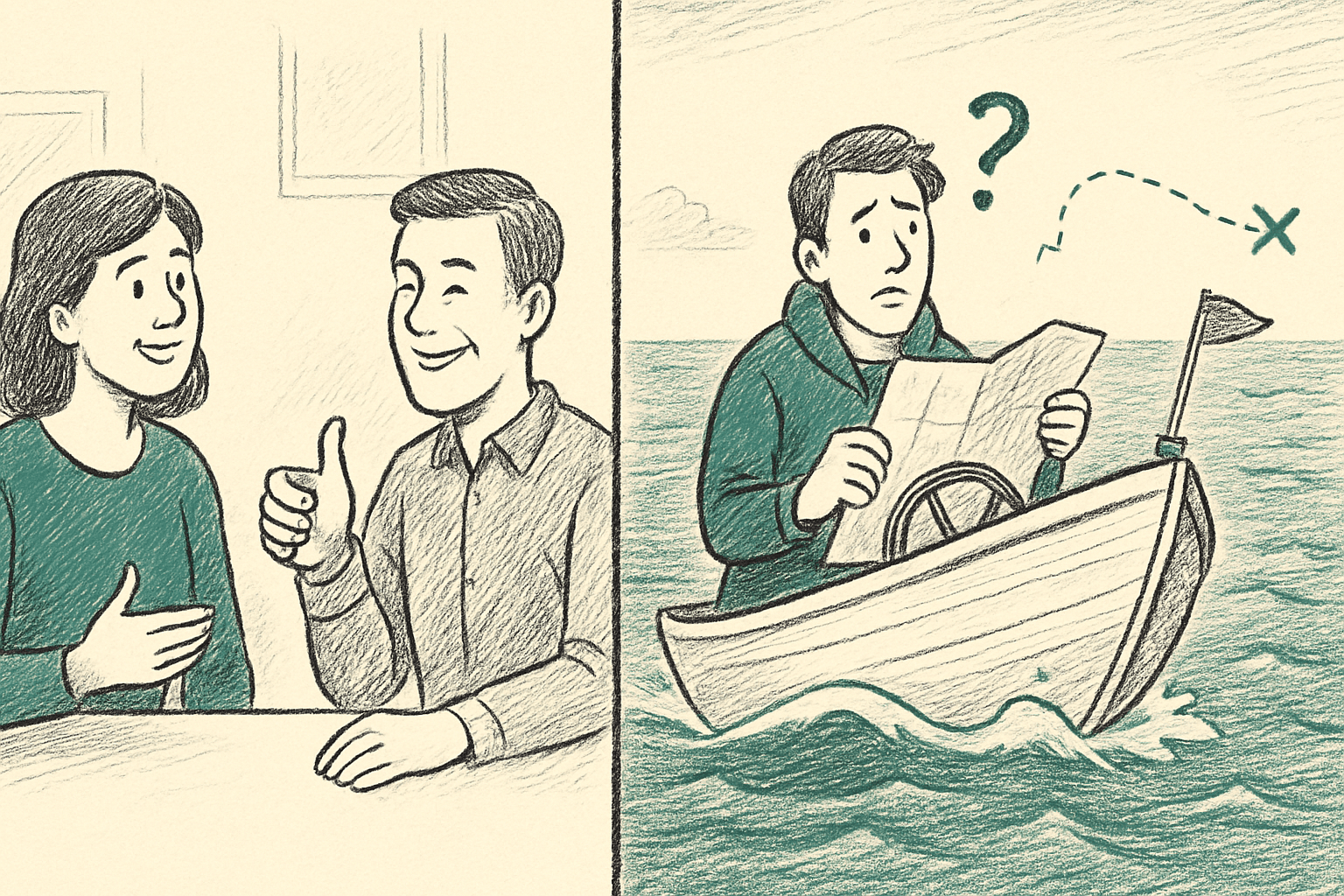
These two phrases sound almost identical when someone speaks quickly, yet their meanings diverge sharply, and confusing them can derail an entire sentence. Of course expresses agreement, certainty, or something expected, while off course describes a literal or figurative deviation from a planned route or intended direction. A pilot who flies off course misses the runway; a colleague who says of course accepts your proposal. The phonetic overlap causes problems because dictation software and fast note-taking rely on sound rather than spelling logic. If you write off course when you mean of course, you accidentally accuse someone of going astray. If you write of course when you mean off course, you claim that getting lost was obvious. The context usually reveals the error to a careful reader, but in high-stakes emails, that first impression of confusion can damage your professionalism.
| Phrase | Meaning | Example |
|---|---|---|
| of course | certainly / obviously | “Of course the ship arrived on time.” |
| off course | deviated from route | “The ship went off course during the storm.” |
Of Course vs Ofcourse vs Of-course: All Three Compared
Writers sometimes hesitate between three visual forms: the standard two-word version, the fused misspelling, and the hyphenated hybrid that looks like a compound adjective. Only one of these is correct in standard English. Of course stands alone as the universally accepted spelling across all registers, from academic journals to text messages. Ofcourse represents the most frequent error, born from fast typing and phonetic blending, and it should be eliminated from any text you care about. Of-course with a hyphen is less common but still incorrect; English does not hyphenate this particular phrase, even when it modifies a noun, because it functions as an adverbial idiom rather than a compound modifier. You might see hyphens in expressions like well-known author, but of-course author makes no grammatical sense. When you proofread, treat any deviation from the two-word form as a red flag that demands an immediate fix.
| Spelling | Status | Notes |
|---|---|---|
| of course | ✅ correct | Standard in all contexts. |
| ofcourse | ❌ misspelling | Caused by fast typing; never use in prose. |
| of-course | ❌ hyphen not used | Not a compound adjective; hyphen is wrong. |
Is “Ofcourse” Ever Acceptable? (Usernames, Domains, Branding)
Strict grammar rules sometimes bend in the face of technical constraints, and ofcourse finds shelter in exactly those narrow corridors. Domain names, social media handles, hashtags, and certain brand names cannot contain spaces, so a company might register ofcourse.com or use @ofcourse as an Instagram handle. In those contexts, the fused form is not a spelling choice but a workaround dictated by software limitations. Similarly, programmers naming variables or database fields often concatenate words to avoid parsing errors. However, this practical necessity does not grant ofcourse any legitimacy in standard prose. The moment you return to normal sentences, emails, reports, or essays, you must restore the space. Think of the single-word version as a zip code abbreviation: useful on an envelope label, but never written that way inside a formal letter. Your readers will judge the text by standard conventions, not by URL constraints, so keep your prose clean.
Of Course in UK vs US English
British and American English disagree on plenty of spellings—colour versus color, centre versus center, organise versus organize—but of course is not one of them. In both varieties, the phrase is always written as two separate words, with no hyphenation and no merger. The Oxford English Dictionary and Merriam-Webster record identical orthographic treatment, and both bodies classify ofcourse as an error rather than a regional variant. If you are writing for an international audience, this consistency is a relief: you do not need to maintain two versions of your document or worry that one region prefers a fused form. Whether your reader is in London, New York, Sydney, or Mumbai, the two-word form is the only correct form every single time. That stability makes it one of the few expressions you can use confidently across borders without checking a style guide first.
Tone Matters: Polite, Neutral, or Sarcastic
The same two words can sound like a warm blanket or a cold slap depending on context, punctuation, and the relationship between writer and reader. In spoken English, pitch and facial expression carry the emotional load, but in writing you must rely on surrounding words and comma placement to steer interpretation. A quick Of course! followed by an exclamation mark reads as enthusiastic agreement, while a flat Of course. with a period can signal reluctant acceptance. When you embed the phrase in a longer sentence with obvious frustration nearby—Of course the meeting was cancelled again—it transforms into sarcasm that implies the outcome was predictable and annoying. In professional settings, this tonal ambiguity is dangerous. A client who receives Of course we can do that may feel brushed off if they read it as dismissive rather than eager. Calibrating your tone means choosing your punctuation carefully and adding enough surrounding context that the reader cannot mistake your intent.
| Tone | Sentence | Meaning |
|---|---|---|
| Friendly | “Of course! Happy to help.” | Enthusiastic agreement |
| Neutral | “Of course, I understand.” | Calm acknowledgment |
| Sarcastic | “Of course he forgot again.” | Expected disappointment |
Alternatives to “Of Course”
Overusing of course flattens your writing and can make you sound like a customer-service script rather than a human being. Native speakers vary their responses constantly, swapping in alternatives that match the formality of the moment. When you want to grant permission, feel free or go ahead feel warmer and less robotic than another of course. For stating obvious facts, naturally or clearly carry a more academic weight. If you need to reassure someone, trust me or no doubt about it add a personal touch that builds rapport. Each replacement shifts the register slightly, giving your paragraphs texture and preventing the repetition fatigue that makes readers tune out. The key is matching the synonym to the social context: absolutely works beautifully in a chat message to a teammate, while certainly fits better in a formal letter to a senior executive. Keeping a small arsenal of replacements ready will make your English sound more natural and more confident.
| Meaning | Alternative | Best For |
|---|---|---|
| Agreement | Absolutely / Definitely | Casual or enthusiastic contexts |
| Permission | Feel free / Go ahead | Professional emails |
| Obviousness | Naturally / Clearly | Academic or formal writing |
| Reassurance | Trust me / No doubt | Personal conversations |
Common Mistakes That Make “Of Course” Look Wrong
Even when you spell the phrase correctly, five predictable errors can still sabotage your sentence and make you look careless in the eyes of a careful reader. The first and most frequent is fusing the two words into ofcourse, which instantly marks the text as unpolished. The second is adding an unnecessary comma after a short, standalone answer like Of course. when it functions as a complete sentence. The third is forgetting the comma when the phrase opens a sentence, leaving the reader to crash into the main clause without warning. The fourth is confusing of course with off course, a mistake that changes your meaning from agreement to navigation. The fifth is inserting a hyphen to create of-course, a form that has no standing in standard English. Proofreading for these five specific problems takes ten seconds and protects the professional impression you have worked so hard to build.
Quick Self-Check Before You Hit Send
Before you submit an email, publish a post, or hand in an essay, run through a five-point inspection that catches every common error associated with this phrase. First, verify that you have written two separate words rather than one fused block. Second, check your comma placement: if the phrase starts the sentence or sits in the middle of the clause, commas are mandatory; if it stands alone as a one-word answer, leave the comma out. Third, confirm that you meant of course rather than off course, especially if your text involves travel, schedules, or project plans. Fourth, read the surrounding sentences aloud to ensure your tone sounds helpful rather than sarcastic. Fifth, scan for any rogue hyphens that autocorrect may have inserted. This brief ritual takes less time than rereading the entire document, yet it eliminates the embarrassment of discovering a basic error only after your audience has already seen it.
- Step 1: Confirm you wrote two separate words, not “ofcourse.”
- Step 2: Check commas: after the phrase at the start, on both sides in the middle, none when alone.
- Step 3: Verify you meant “of course” rather than “off course.”
- Step 4: Read aloud to catch an unintended sarcastic tone.
- Step 5: Remove any hyphen that autocorrect inserted.
Understanding “Of Course Not”
The negative form of course not carries its own etiquette rules that trip up even advanced learners. You use it to give an emphatic “no” that also softens the refusal, making it sound less blunt than a bare no or never. When someone asks, “Do you mind if I open the window?” replying “Of course not” actually means “I do not mind at all”—a polite agreement rather than a rejection. This double-negative politeness layer confuses many non-native speakers, who sometimes assume the phrase expresses disagreement. In reality, it functions as a reassurance that the requested action is perfectly acceptable. Like its positive counterpart, of course not always remains three separate words, and it usually stands alone without commas because it acts as a complete sentence. Mastering this form helps you navigate requests gracefully in both social and professional settings without accidentally sounding rude or dismissive.