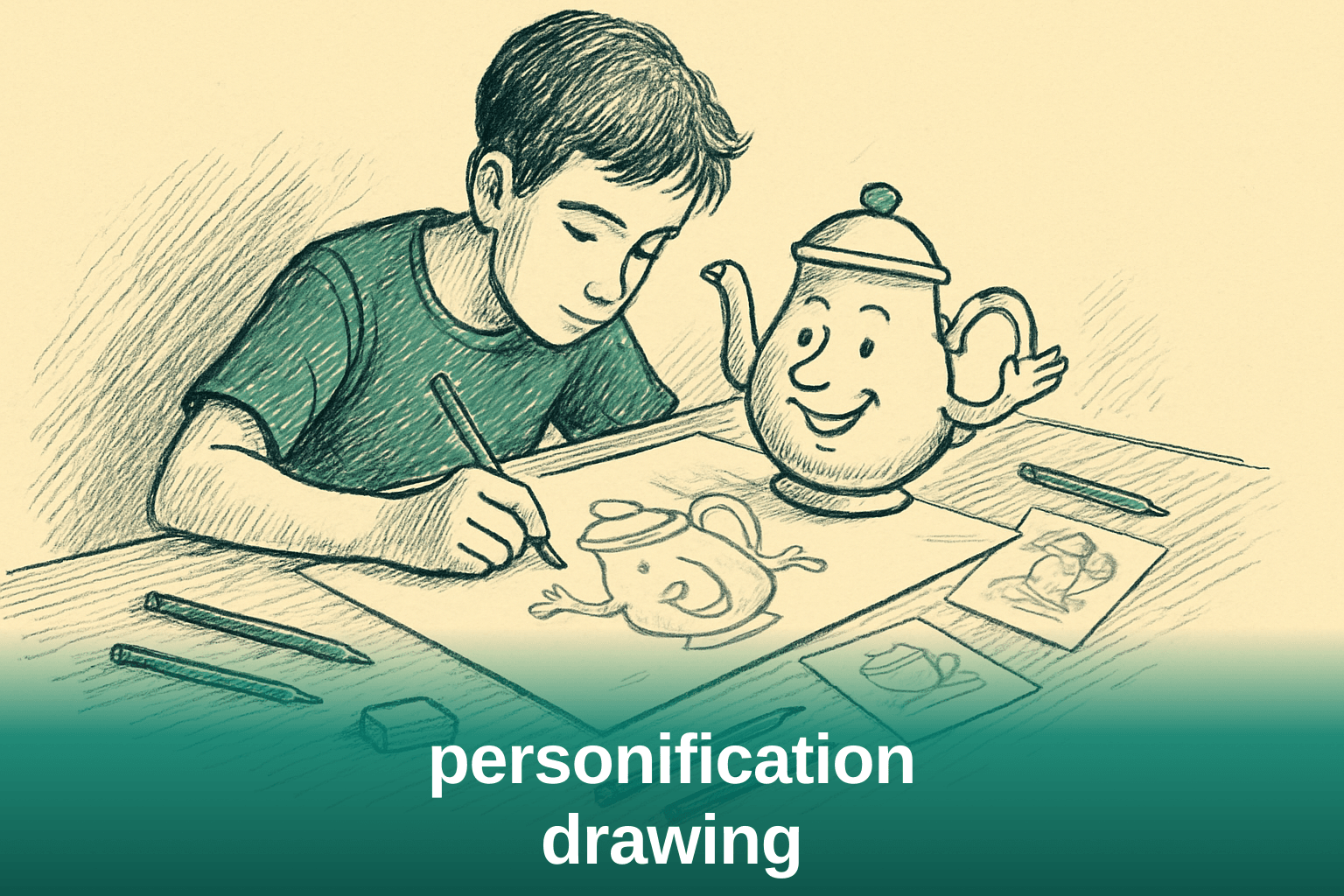

A personification drawing is a picture that shows a non-human object performing a human action or feeling a human emotion while keeping its true shape. The goal is to turn a figurative sentence such as “The wind howled” into a visible image so students can see the language device in action. By preserving the object’s real form and adding just one human trait, the drawing proves that the learner understands the difference between literal and figurative meaning.
Teachers often face blank stares when they say, “The wind howled.” Students hear the words, but they do not see the picture. Below, you will find a clear definition, easy and advanced personification drawing examples, a five-step method, twenty-five ready prompts, a printable worksheet layout, and a simple rubric for grading. This article is written for third- through eighth-grade ELA teachers, homeschooling parents, tutors, and any student searching for easy personification drawing ideas that can be finished in one class period.
Let us start with the definition and the single most important distinction you will teach.
A personification drawing makes figurative language visible. Here is what you need to know before you start.
- A personification drawing is a visual interpretation of figurative language that gives one human quality to a non-human object while preserving its original form.
- Every drawing should contain the original object, one clear human trait, a supporting setting, and a written explanation of the figurative line.
- This method works across elementary and middle grades, with adaptations for ELL learners and special education settings.
- The article includes twenty-five unique prompts, a four-box worksheet template, and a four-criterion rubric for immediate classroom use.
What Is a Personification Drawing?
A personification drawing is a visual translation of figurative language that shows a non-human object performing a human action or displaying a human emotion while still remaining itself. The object in the drawing keeps its original form—a candle stays a stick of wax, a tree keeps its trunk—but it gains one clear human trait such as dancing, whispering, or sulking. The goal is to make the language device visible so a student can point to the picture and say, “That is how the wind howled.” Teachers use this approach in grades three through eight because it bridges reading comprehension and visual learning, turning an abstract grammar concept into a concrete image that students can discuss, revise, and assess. When a learner draws the trait, they must first identify it in the text, which deepens their understanding of the author’s craft far beyond simple memorization.
Key takeaway: A personification drawing keeps the object’s true shape and adds just one human trait so the viewer can spot the figurative language at a glance.
Personification Drawing Definition in One Sentence
A personification drawing is an illustration that translates a figurative sentence into a visible image by attaching a single human quality to a non-human subject. The picture cements the concept in visual memory and builds an emotional link to the object. The term personification entered English in the mid-1700s, though the device itself is ancient.
Examples
- “The candle danced in the dark” — Human quality: danced. Draw a candle with thin legs mid-step.
- “The wind howled in the night” — Human quality: howled. Draw wind with an open mouth and swirling breath.
- “The leaves danced on the wind” — Human quality: danced. Draw leaves with outstretched arms spinning in the air.
Personification vs Anthropomorphism: What Belongs in a Drawing
Personification is figurative description. The object remains itself: a candle stays a candle, and the human trait is only imagined. Anthropomorphism is literal attribution of human characteristics to create characters that behave like people, such as Winnie the Pooh or Simba. In a drawing, this distinction is critical because the two techniques produce completely different images.
When a student creates a personification drawing, the candle must still look like a candle. If the student instead draws a wax-shaped person wearing clothes, the image has crossed into anthropomorphism. Catching this difference early prevents the most common misconception in figurative language art projects.
| Feature | Personification | Anthropomorphism |
|---|---|---|
| Object keeps its shape | Yes | No |
| Human trait is figurative or literal | Figurative | Literal |
| Example sentence | “The candle danced in the dark” | “Winnie the Pooh ate honey” |
| Example drawing | A candle with tiny legs mid-step | A bear walking on two legs wearing a shirt |
| Typical grade use | Grades 3–8 ELA | Art, character design, early readers |
Personification Drawing Examples (Easy to Advanced)
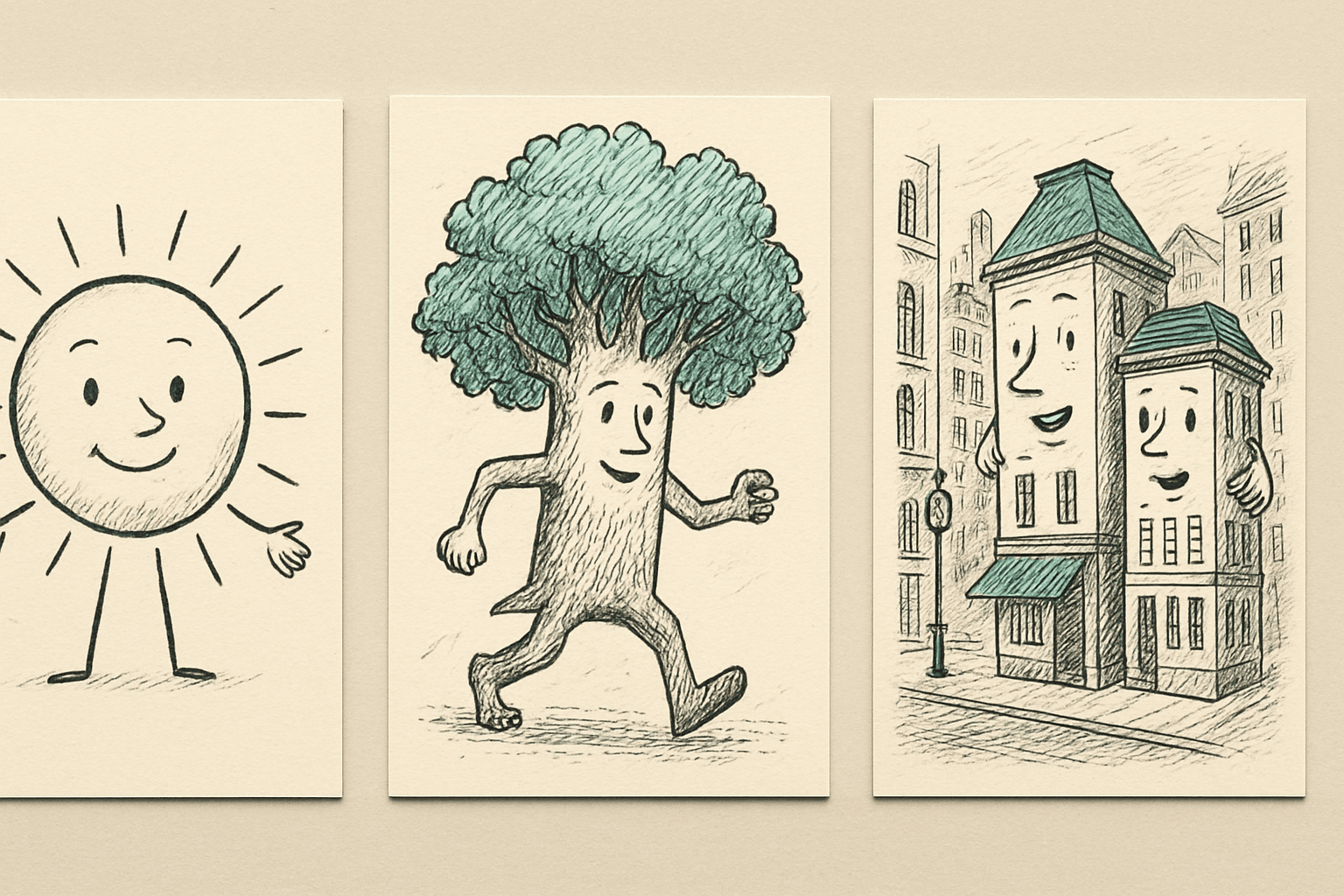
The best way to teach a personification drawing is to show students exactly what the final product looks like before they pick up a pencil. Every example in this section follows the same three-part structure: the figurative sentence, the human quality hidden inside it, and a clear description of what belongs on the page. Younger students in grades three to five should start with concrete objects and obvious actions, such as a smiling sun or a dancing candle, because the human trait is easy to spot and quick to sketch. Older students in grades six to eight can tackle abstract ideas like fear or time, where the object is less visible and the composition requires more planning. Literature-based examples from Shakespeare, Hemingway, and Hawthorne round out the set, proving that personification is not just a grammar exercise but a living technique used by professional writers. By studying these samples, students learn to separate a true personification from a literal anthropomorphic character.
Easy Personification Drawing Examples for Grades 3–5
Examples
- “The candle danced in the dark” — Human quality: danced. Draw a candle with tiny legs and a happy face, mid-leap on a table.
- “The wind whispered through the trees” — Human quality: whispered. Draw thin lines of wind with a finger to its lips beside bent branches.
- “The sun smiled down on the park” — Human quality: smiled. Draw a round sun with a wide grin and warm rays like outstretched arms.
- “The rain tapped on the window” — Human quality: tapped. Draw raindrops with fingertips knocking against a glass pane.
- “The tree waved its branches goodbye” — Human quality: waved. Draw a sturdy trunk with a waving branch that looks like an arm.
- “The clock refused to move” — Human quality: refused. Draw a wall clock with crossed arms and a stubborn frown.
Personification Picture Examples for Grades 6–8
Examples
- “Time crept through the empty house” — Human quality: crept. Draw a shadowy clock figure tiptoeing down a hallway, floorboards creaking beneath it.
- “Fear crouched behind the door” — Human quality: crouched. Draw a dark mist with bunched shoulders and glowing eyes peering from behind a bedroom door.
- “The city never sleeps” — Human quality: sleeps. Draw skyscrapers with wide-open windows for eyes and streetlights blinking like eyelids.
- “The ocean roared with anger” — Human quality: roared with anger. Draw towering waves shaped like a shouting mouth, foam flying like spit.
- “Memory faded into the background” — Human quality: faded. Draw a translucent figure stepping backward into a gray mist, losing color at the edges.
Personification Examples in Poetry and Literature to Draw
Examples
- Shakespeare, Romeo and Juliet: “The envious moon…” — Human quality: envious. Draw a pale moon with narrowed eyes and a green tint, glaring at the sun.
- Virginia Woolf, To the Lighthouse: “Airs that questioned and wondered…” — Human quality: questioned. Draw curtains shaped like leaning faces with raised eyebrows.
- Hemingway, The Old Man and the Sea: “The ocean made love…” — Human quality: made love. Draw gentle waves with soft arms cradling a small boat.
- Hawthorne, The Scarlet Letter: “The rose-bush offered its fragrance…” — Human quality: offered. Draw a wild rose bush with cupped hands presenting a glowing scent cloud.
How to Draw Personification in 5 Steps
Turning a sentence into a picture does not require artistic talent; it requires a logical sequence that any student or teacher can repeat. The five-step method below works for every grade level because it separates the thinking process from the drawing skills. First, the reader hunts for the human word inside the sentence. Next, the artist decides which object receives that trait and how to keep it recognizable. Then comes the sketch itself, limited to one human feature so the image does not drift into cartoon territory. After that, the student adds a setting and a single sensory detail that proves the figurative line fits the mood. Finally, the drawing earns its academic value through a written label and a short explanation that connects the picture back to the text. When students follow this path, the result is not merely a cute picture but evidence that they can parse figurative language and prove their understanding visually.
- Step 1: Find the human quality in the sentence.
- Step 2: Choose the object and the action.
- Step 3: Sketch the human trait using face, hands, or posture.
- Step 4: Add the setting and one sensory detail.
- Step 5: Label the figurative line and explain it.
Step 1 — Find the Human Quality in the Sentence
Before any pencil touches paper, the student must become a detective. Hand out the sentence and ask them to underline the one word that normally belongs to a person. In “The wind howled,” the human quality is howled because wind cannot open a mouth. In “The rain was indifferent to their plans,” the quality is indifferent because weather does not have feelings. If a student underlines “wind” or “rain,” they have found the object, not the trait. Remind them that the object is already named; their job is to find the stolen human behavior.
Step 2 — Choose the Object and the Action
The object must remain instantly recognizable, or the viewer will think the drawing is about a monster rather than a metaphor. Decide on the scale next. A close-up works best when the human trait is facial, such as a smiling sun. A mid-shot or wide shot works better when the trait is a whole-body posture, such as a dancing candle. In “The ocean roared,” filling the frame with one massive wave shaped like a shouting mouth keeps the ocean primary and the human action secondary. The action should feel dynamic, but the object should never disappear inside it.
Step 3 — Sketch the Human Trait (Face, Hands, Posture)
This is the step where artistic confidence matters least and decision-making matters most. Instruct students to add exactly one human feature. If the trait is stubborn, draw the clock with a frown and folded arms, yet keep its round face and numbered dial clearly visible. If the trait is whispering, give the wind a single pair of lips pressed against the tree trunk, but do not also add eyes, hands, and shoes. The discipline of choosing one trait forces the student to identify the precise word that carries the figurative meaning, which is exactly the reading skill the standard demands.
Step 4 — Add the Setting and One Sensory Detail
A floating candle with a face is confusing; a candle dancing on a cake in a dark room tells a story. The background proves that the human trait belongs to a specific moment. Ask students to add one sensory detail that matches the sentence’s mood: sparks for excitement, fog for mystery, or steam for impatience. In “The rain tapped on the window,” show streaks on the glass and a sleepy cat on the sill so the viewer hears the sound without reading the words. The setting is not decoration; it is evidence that the student understands context.
Step 5 — Label the Figurative Line and Explain It
Turn the sketch into a literacy artifact by writing the original sentence beneath the drawing. Beneath that, add one or two sentences explaining the choice: “The candle is dancing because the flame flickers quickly, like feet moving to music.” This caption separates a personification drawing from a random doodle. It also gives the teacher a direct line into the student’s thinking. When the explanation matches the picture, the assessment is almost complete before the rubric ever appears.
25 Personification Drawing Ideas and Prompts
A blank page intimidates young artists, so a ready-made prompt removes the pressure of invention and lets students focus on interpreting language. This bank contains exactly twenty-five personification drawing ideas, sorted into three categories that match typical curriculum units. Nature prompts use wind, rain, trees, and sun to reinforce science connections and seasonal vocabulary. Everyday object prompts rely on household items such as candles, clocks, pencils, and kettles, making them perfect for homework or a quick classroom warm-up. Emotion and abstract idea prompts challenge middle-schoolers to visualize invisible concepts like fear, joy, hope, and time, which builds the bridge toward literary analysis. Each prompt includes a single sentence of figurative language and a one-sentence drawing direction so that teachers, parents, or tutors can assign the work without additional explanation. Copy them onto index cards, project them on a screen, or paste them directly into a worksheet.
Nature Prompts (Wind, Rain, Trees, Sun)
Prompts
- “The wind whispered to the trees” — Draw wind with lips pressed to a tree’s ear-like knot.
- “The rain tapped on the window” — Draw raindrops with fingertips drumming on glass.
- “The sun stretched its arms over the hills” — Draw golden rays as long arms pulling a blanket of light.
- “The river argued with the rocks” — Draw white water splashing upward with an angry pointing finger.
- “The thunder grumbled across the valley” — Draw dark clouds with a downturned mouth and shaking fists of lightning.
- “The fog crept through the streets” — Draw a low mist on tiptoe, slipping between parked cars.
- “The snow wrapped the town in silence” — Draw soft flakes as hands placing a white muffler around houses.
- “The flames licked the side of the house” — Draw fire with a long tongue tasting the wooden walls.
Everyday Object Prompts (Candle, Clock, Pencil, Kettle)
Prompts
- “The candle danced in the dark” — Draw a candle mid-pirouette, wax skirt flaring.
- “The clock refused to move” — Draw a clock with crossed arms and a turned-up nose.
- “The pencil complained about the homework” — Draw a pencil with a sweating face and tiny hands rubbing its sore tip.
- “The kettle screamed with impatience” — Draw a red kettle with an open mouth and steam shooting upward like a shout.
- “The door groaned on its hinges” — Draw a wooden door with a wrinkled forehead and a gaping mouth.
- “The stairs creaked a warning” — Draw staircase steps with lips shaped like an “O” calling out.
- “The mirror lied about my reflection” — Draw a mirror with a sly wink and a crooked smile.
- “The book begged to be read” — Draw an open book with puppy eyes and hands pressed together in prayer.
- “The shoe sulked in the corner” — Draw a lone sneaker with a pouty lip and arms crossed over its laces.
Emotion and Abstract Idea Prompts (Time, Fear, Joy, Hope)
Prompts
- “Time flies when you have fun” — Draw a clock with wings mid-flight, dropping feathers.
- “Fear crept under the bed” — Draw a shadow with spider legs sliding across a bedroom rug.
- “Joy burst through the door” — Draw a bright figure made of confetti kicking a door open.
- “Hope waited at the bus stop” — Draw a glowing silhouette sitting patiently on a bench under streetlights.
- “Anger boiled in the room” — Draw red steam rising from a teapot-shaped radiator with clenched teeth.
- “Boredom stretched across the afternoon” — Draw a long, yawning shadow covering an empty classroom.
- “Curiosity peeked around the corner” — Draw a pair of wide eyes on stalks rising from behind a brick wall.
- “Pride stood on the rooftop” — Draw a tall figure with a chin lifted high, wearing a cape made of flags.
Personification Drawing Worksheet: What to Put on the Page (NEW)
Teachers searching for a personification worksheet often find generic lined paper that leaves too much room for confusion. A purpose-built page solves that problem by giving students a repeating structure that scaffolds both the art and the analysis. The worksheet should start with a one-sentence definition at the top so learners can check the concept while they work. Below that, each box needs four distinct zones: the quoted figurative sentence, a labeled blank for the human quality, a generous drawing area, and two ruled lines for explanation. This layout transforms the activity from a free-draw session into a literacy task that produces graded evidence. The design also saves planning time because once the template is made, it can be reused with any sentence bank. In the next two sections, you will see exactly how to arrange the four-box layout and which sentences to pre-fill for different ability levels.
The 4-Box Worksheet Layout
The most effective worksheet uses a repeating four-box grid that students can complete independently once they have seen a model. At the very top, leave a banner line for the student to write the definition in their own words. Each box then contains four zones stacked vertically: the quoted figurative sentence, a labeled blank reading “Human quality: _______,” a square drawing area at least three inches wide, and two ruled lines for explanation. For younger students, enlarge the drawing area and provide handwriting guides. For older students, shrink the art space and expand the explanation lines to encourage analysis. You can vary the number of boxes by grade, but the four-zone structure inside each box should remain constant so students internalize the thinking pattern.
| Worksheet section | What students write or draw |
|---|---|
| Top banner | One-sentence definition of personification in their own words. |
| Box 1–4 (repeat) | The figurative sentence copied at the top of the box. |
| Inside each box | A labeled line: “Human quality: _______” |
| Drawing area | A sketch showing the object with one human trait. |
| Bottom lines | Two lines explaining why the object behaves that way. |
Sentence Bank for the Worksheet
Sentence Bank
- Easy: “The sun smiled at the children.”
- Easy: “The wind whispered through the trees.”
- Easy: “The candle danced on the cake.”
- Easy: “The rain tapped on the roof.”
- Easy: “The flowers waved in the breeze.”
- Medium: “The old car groaned up the hill.”
- Medium: “The city swallowed the horizon.”
- Medium: “The shadows crept across the floor.”
- Medium: “The clock nagged me to hurry.”
- Medium: “The silence hung in the air.”
Grading a Personification Drawing: A Simple Rubric (NEW)
Grading art-based language assignments feels subjective until you break the task into observable parts. A clear rubric protects both the student and the teacher by naming exactly what counts as mastery. The four-criteria model below assigns up to four points per category, for a total of sixteen possible points. The first criterion checks whether the student can isolate the human quality in the original sentence. The second checks whether the drawn object still looks like itself rather than a cartoon character. The third evaluates how clearly the single human trait appears through face, hands, or posture. The fourth and final criterion measures the written explanation, because a caption reveals whether the learner understands why the object behaves like a person. Together these four categories reward reading comprehension, visual clarity, and metacognitive reflection without punishing imperfect sketching skills.
| Criterion | 4 points | 2 points | 0 points |
|---|---|---|---|
| Human quality correctly identified | Student underlines or names the exact word that gives the object a human trait. | Student names a human trait but misses the exact word. | No human trait identified or wrong word chosen. |
| Object keeps its identity | The original object is instantly recognizable. | Object is somewhat unclear but guessable. | Object looks like a human or animal character instead. |
| Visual clarity of the trait | One human trait is clearly shown through face, hands, or posture. | Trait is present but hard to read or mixed with others. | No human trait visible or too many traits muddy the image. |
| Written explanation matches the drawing | Caption explains the figurative line in 1–2 complete sentences. | Caption is vague or only restates the sentence. | No caption or explanation contradicts the drawing. |
Adapting Personification Drawing by Grade Level
The same personification drawing activity works across a wide age range if you adjust the complexity of the object, the number of human traits, and the depth of written explanation. In primary grades, the task is recognition: can the child spot the human verb and show it in a picture? In middle school, the task shifts to analysis: can the student explain why an author chose to give an abstract idea a human action? English language learners and students in special education settings need extra scaffolds such as sentence banks, bilingual captions, and anchor charts that model one finished example. By calibrating the worksheet length, the prompt difficulty, and the rubric expectations, a single lesson format can serve third graders working on basic figurative language and eighth graders preparing for literary essays. The following three sections show precisely how to scale the activity up or down.
Grades 3–5
At this level, success means recognition and joy. Choose concrete objects such as candles, suns, and clocks that children see every day. Require only one obvious human trait and a single-sentence caption. Use a three-box worksheet so the task feels manageable within twenty minutes. This format matches the standard layout found in grades 3–5 ELA resources and keeps the focus on identifying the figurative word rather than producing elaborate art.
Grades 6–8
Middle-school students are ready for abstraction. Assign concepts like time, fear, or memory, and expect a thoughtful composition with background details and a two- to three-sentence explanation. Use a six-box worksheet to compare multiple examples side by side. This depth aligns with CCSS.ELA-LITERACY.L.5, which asks students to demonstrate understanding of figurative language, and with W.3 standards for creative expression.
ELL and Special Education Adjustments
Lower the language barrier by providing a printed sentence bank so students start with ready-made figurative sentences rather than inventing their own. Allow captions in both the home language and English to reduce anxiety and deepen comprehension. Cut the worksheet down to two boxes, and display a personification anchor chart with one completed sample so learners can check their work against a model at any moment. These adjustments respect processing time while preserving the rigor of the standard.
Is Personification Imagery? How Drawing Makes the Device Visible (NEW)
No—personification is not the same thing as imagery, though the two terms are related in every poetry lesson. Imagery is the broad category of words that create sensory experiences for the reader; it includes sight, sound, touch, taste, and smell. Personification is a specific figurative device that produces imagery by giving human traits to non-human things. You can think of personification as the engine and imagery as the exhaust: one creates the other. When a student draws “the wind howled,” the sketch is a literal piece of visual imagery that the device of personification made possible. Drawing therefore serves as a perfect bridge between grammatical analysis and sensory reading because it forces the learner to decide exactly which human feature produces the image. Without that decision, students often repeat the definition without ever feeling the effect.
Common Mistakes in Personification Drawings
Even with a clear prompt, students often slip into habits that turn a personification exercise into a literal cartoon or a muddled image. The most frequent error is replacing the object with a human character, which is anthropomorphism rather than figurative description. Another common problem is piling on five or six human traits at once, which buries the original sentence beneath visual noise. Some learners draw an object so transformed that peers cannot name it, while others forget to label the figurative line and leave the teacher guessing which sentence inspired the art. Finally, advanced students sometimes choose an abstract concept like time and draw a clock with wings, but they fail to show the human action in a concrete scene. Catching these mistakes early keeps the focus on language comprehension instead of artistic style, and it prevents misconceptions from solidifying into bad habits.
A 10-Minute Personification Drawing Warm-Up That Needs Zero Prep
When the lesson is running short or energy is low, you can still teach figurative language without photocopying a worksheet. Project one sentence on the board and ask every student to spend five minutes sketching the human trait on a scrap of paper. Spend another three minutes letting volunteers post their sketches under a “Figurative” column and a “Literal” column, then vote as a class on which column fits best. This single move reinforces the core concept of personification drawing because students must prove they know which trait is human and which part is object. Keep a rotating list of five emergency prompts taped to your desk: “The chair sighed when he sat down,” “The homework glared from the backpack,” “The stairs groaned in protest,” “The refrigerator hummed a lullaby,” and “The backpack dragged its feet.” Any adult can run this warm-up with no art background because the goal is recognition, not gallery-ready work.
Frequently Asked Questions
The questions below come straight from search queries, parent emails, and classroom conversations that stall the moment personification appears on the weekly plan. Each answer is short enough to quote in a lesson but detailed enough to settle the confusion that sends students back to their desks unsure of whether they drew the right thing. If you need a crisp definition, a fast example for a reluctant artist, a distinction between personification and anthropomorphism, or a clear rule for grading without bias, you will find the exact wording here. Teachers can copy these responses onto an anchor chart, tutors can paste them into a homework help forum, and parents can use them to reassure a child that figurative language is far easier to see than it is to spell.
A personification drawing is a picture that gives one human trait to a non-human object while keeping the object recognizable, such as drawing a candle with legs mid-dance for the sentence “The candle danced in the dark.”
Easy ideas use everyday objects with obvious actions: a candle that dances, the wind that whispers, or the sun that smiles. Each idea requires only one human trait and a simple background.
In a personification drawing, the object keeps its real shape and gains one figurative human trait, like a clock with a frown. In anthropomorphism, the object becomes a literal character, like a bear wearing clothes and walking on two legs.
No. Imagery is the broad category of sensory details. Personification is a specific figurative device that creates imagery by giving human traits to non-human things.
The worksheet works for grades 3–8. Use three boxes for grades 3–5 and four to six boxes for grades 6–8, adjusting the sentence difficulty to match the age group.
Use the four-criterion rubric above: identify the human quality, keep the object recognizable, show the trait clearly, and write a matching explanation. Each category earns up to four points.
Final Verdict on Personification Drawing
A personification drawing turns abstract language into something a student can see, evaluate, and remember. By keeping the object recognizable and adding just one human trait, the picture proves that the learner understands the difference between literal and figurative meaning. Use the five-step method, pick from the twenty-five prompts, and print the four-box worksheet for your next ELA lesson. Start with one sentence—”The wind howled”—and watch the concept click.