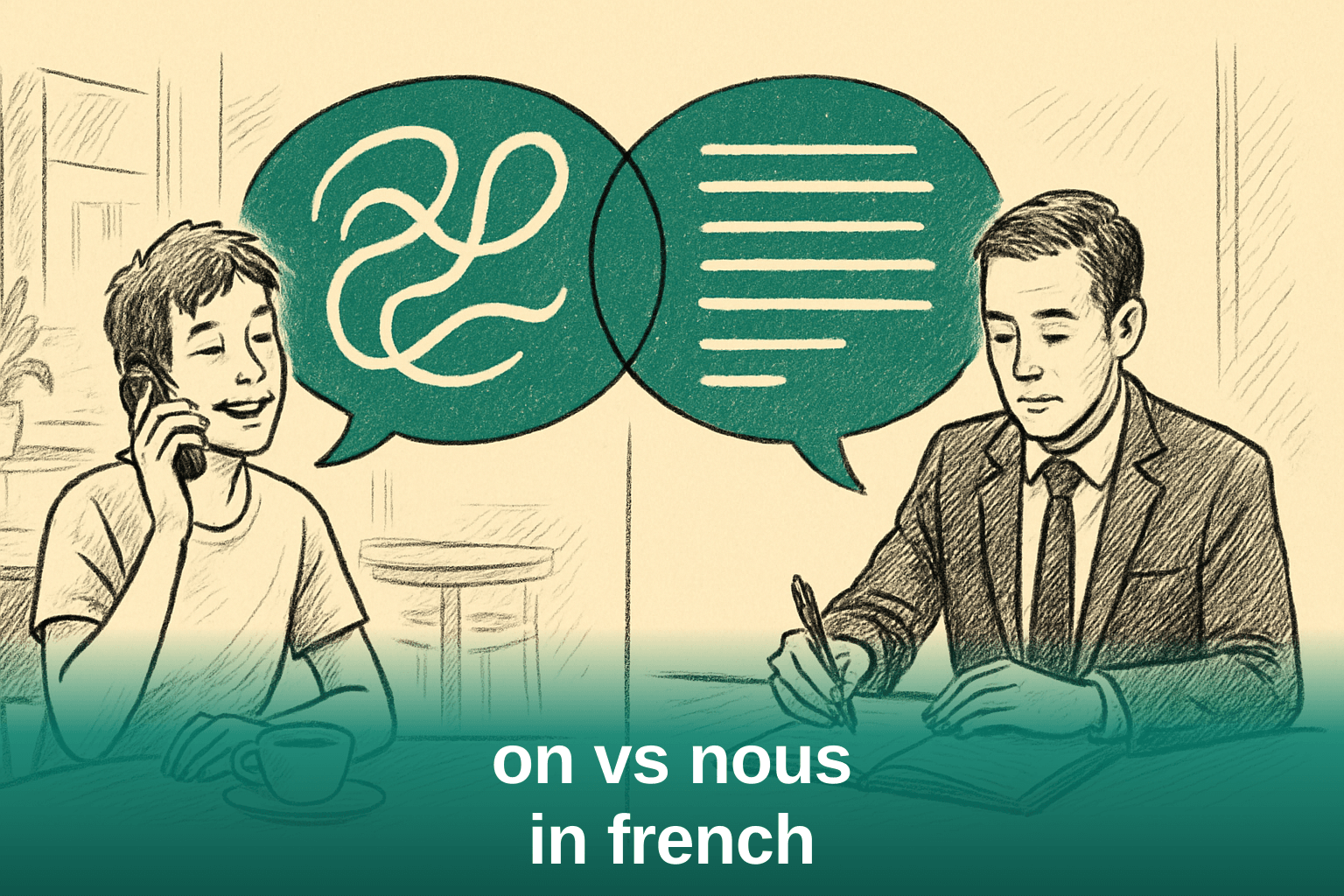

On is the everyday spoken “we” in French and takes the third-person singular verb form, while nous is the formal and written “we” that conjugates in the first-person plural with the -ons ending. Adjectives used with on must agree with the actual group of people, not the singular verb. Even when on is the subject, the object pronoun “us” stays nous. The difference is almost entirely about register, not meaning.
In French, both on and nous translate to “we,” but they occupy different registers. On functions as a third-person singular pronoun used in casual speech to mean “we,” while nous serves as the first-person plural pronoun reserved for formal writing and official contexts. Verbs with on conjugate like il or elle, yet any adjectives must agree with the real-world number and gender of the speakers. Object pronouns referring back to the group remain nous regardless of whether the subject is on or nous.
You walk into a Parisian café and hear a friend say, “On prend un café?” Your textbook taught you nous, yet nobody seems to use it. This moment captures the single most common gap between classroom French and real life. Both on and nous mean “we,” but they live in completely different worlds of register and sound. In the next few minutes, you will learn exactly when to choose each pronoun, how to conjugate them, and why your ear already knows the answer.
On vs Nous in French: The Short Answer
When you need a fast rule for on vs nous in French, remember this simple split. In everyday spoken French, native speakers reach for on about ninety-five percent of the time they want to say “we.” It sounds shorter, flows faster, and feels natural in cafés, metro rides, and text messages between friends. In contrast, nous remains the safe, standard choice for formal emails, academic essays, business presentations, and official speeches where precision matters. The meaning never changes; only the social temperature and rhythm of the sentence shifts. If you are chatting with a neighbor or making weekend plans, on is your best friend. If you are writing a cover letter or a complaint to your bank, nous shows professionalism and polish. Both pronouns are grammatically correct, and neither is slang. Think of them as two outfits for the same idea: one casual and relaxed, the other sharp and formal.
Examples
- Nous allons au cinéma ce soir. → “We are going to the cinema tonight.” (formal/written)
- On va au cinéma ce soir. → “We are going to the cinema tonight.” (casual/spoken)
- Nous sommes prêts à partir. → “We are ready to leave.” (formal)
- On est prêts à partir. → “We are ready to leave.” (casual)
The Core Difference: Register, Not Meaning

The biggest myth about on vs nous in French is that they carry different meanings. They do not. In roughly ninety percent of situations, both words translate to the exact same English “we,” and the real difference is register. The level of formality and the context in which you are speaking or writing determines your choice. Native speakers choose on in casual conversation because it is phonetically lighter and quicker to pronounce; nous demands more mouth movement and sounds heavier in rapid speech. This is why movies, podcasts, and street conversations overflow with on, while legal documents and corporate memos stay loyal to nous. Even in modern France, the so-called Nous de majesté or Royal We survives as a cultural footnote: kings and high-ranking figures once used nous to refer to themselves alone. Today, that quirk lives on mainly in historical films and political jokes.
Why Nous Quietly Vanished from Casual Speech
It is not an accident that on dominates modern spoken French. Over the last three centuries, the pronoun gradually absorbed the social role of nous in everyday dialogue, driven largely by phonetic economy. French speakers naturally prefer syllabic efficiency, and on est or on va rolls off the tongue far more easily than nous sommes or nous allons. Linguists call this process analogy: a simpler, more frequent form replaces a heavier one in high-frequency contexts. By the twentieth century, on had become the unmarked choice for “we” in conversation, while nous retreated into writing, oratory, and situations demanding deliberate distance. This shift mirrors similar patterns in other languages, but French codified the split so neatly that learners often feel whiplash between textbook grammar and café reality. Understanding this history helps you stop seeing on as a shortcut and start treating it as the living standard of contemporary speech.
How to Conjugate On vs Nous
Grammar books treat conjugation as the first gate you must unlock, and with good reason. On and nous belong to different grammatical persons, so their verb forms never overlap. Nous always triggers first-person plural endings, most recognizably -ons, while on borrows the third-person singular form used for il and elle. Once you memorize this split, you stop hesitating at the verb stem. The sections below show exactly how each pronoun behaves with the same set of common verbs.
Nous + first-person plural (-ons)
With nous, you step into the first-person plural, and the verb almost always ends in -ons. Take the verb être: nous sommes means “we are.” For aller, you get nous allons (“we go” or “we are going”). The pattern holds for regular verbs too: nous aimons (“we love”), nous parlons (“we speak”), and nous finissons (“we finish”). Even irregular verbs like avoir respect the ending: nous avons (“we have”). This consistency makes nous easier to conjugate in writing, where you have time to think. In fast speech, however, those extra syllables add weight, which partly explains why speakers often sidestep nous in favor of on.
Examples
- Nous sommes à Paris. → “We are in Paris.”
- Nous allons au marché. → “We are going to the market.”
- Nous avons deux chats. → “We have two cats.”
- Nous aimons le jazz. → “We love jazz.”
On + third-person singular (il/elle form)
On demands the exact same verb form you would use for il or elle. That means third-person singular across every tense. On est parallels il est, on va mirrors elle va, and on a matches il a. Even compound tenses follow this rule: on a acheté (“we bought”) uses the auxiliary a, not avons. Regular verbs are equally straightforward: on parle, on finit, on attend. This singular coating is what confuses beginners, because the pronoun clearly refers to a group. Remember that the verb agrees with the grammatical person of the pronoun, not with the headcount of the people involved. Once you accept that on grammatically behaves like il, the conjugation becomes automatic.
Examples
- Nous sommes → On est → “We are”
- Nous allons → On va → “We go / We are going”
- Nous avons → On a → “We have”
- Nous aimons → On aime → “We love”
- Nous avons acheté → On a acheté → “We bought”
Adjective Agreement with On (The Tricky Part)
Here is the rule that trips up even advanced learners. The verb with on stays stubbornly singular, but the adjective almost always agrees with the actual people you are talking about. If on means “we” and the group contains men or mixed company, you need the masculine plural form: On est contents (“We are happy”). If the group is all women, the adjective becomes feminine plural: On est contentes. Only when on carries the impersonal meaning of “one” or “people in general” does the adjective remain singular: Quand on est jeune, on est optimiste (“When one is young, one is optimistic”). This dual behavior forces you to pause and ask: am I using on as “we” or as an impersonal subject? Most of the time in conversation, the answer is “we,” so you will reach for the plural adjective. Write this distinction in your mental notebook, because examiners love testing it, and native speakers notice when it is wrong.
Mnemonic
The verb is a solo costume, but the adjective matches the crowd. Mixed or male crowd: add s. All female crowd: add es.
Reflexive Verbs: Nous Nous Levons vs On Se Lève
Reflexive verbs add a wrinkle because the reflexive pronoun must match the subject, not the meaning. With nous, you get the stacked pair nous nous: Nous nous levons à huit heures (“We get up at eight”). With on, the reflexive pronoun drops to se, exactly as it would for il or elle: On se lève à huit heures. The same pattern appears across the reflexive lexicon. Nous nous appelons becomes On s’appelle; nous nous lavons becomes on se lave; nous nous voyons becomes on se voit. The grammar is relentless: if the subject is grammatically third person, the reflexive pronoun follows suit. This rule never bends, so once you see on, your reflexive radar should automatically flash me / te / se rather than nous.
Examples
- Nous nous levons tôt. → On se lève tôt. → “We get up early.”
- Nous nous lavons les mains. → On se lave les mains. → “We wash our hands.”
- Nous nous appelons demain. → On s’appelle demain. → “We will call each other tomorrow.”
Object Pronouns: Why Nous Never Disappears
This section saves you from one of the most embarrassing mistakes in spoken French. Even when on replaces nous as the subject, the object pronoun “us” remains stubbornly nous. You cannot invent a nonexistent se to match the subject. For example, On nous a dit la vérité means “They told us the truth” or “Someone told us the truth,” and never uses se. Likewise, Ils nous ont invités stays identical whether the subject was originally nous or on. The phrase C’est pour nous does not become C’est pour on. This rule extends to double-object constructions and questions. The object pronoun nous survives because it refers to the people themselves, not to the grammatical subject pronoun you selected. Keep your ears open for the difference between On nous a vu (“Someone saw us”) and On s’est vu (“We saw each other”). That tiny pronoun swap changes everything.
Beyond “We”: The Other Meanings of On
On is a shapeshifter. Although this article focuses on on vs nous in French as rival translations for “we,” you cannot master on without meeting its other identities. Depending on context, it can mean “one,” “people,” “someone,” or even a gentle “shall we?” These meanings share the same third-person singular conjugation, but they alter adjective agreement and translation. The sections below map each identity with clear examples.
On = one / people in general
When on steps back from a specific group and speaks for society at large, it behaves like the English “one” or the generic “you.” En France, on mange tard does not mean “We eat late” as a personal confession; it means “In France, people eat late.” Similarly, On ne sait jamais translates to “One never knows,” and On peut être beau et intelligent à la fois means “One can be beautiful and intelligent at the same time.” In these sentences, adjectives stay singular because there is no concrete group. Recognizing this impersonal mode prevents you from forcing a plural adjective onto a general statement about life.
Examples
- En France, on mange tard. → “In France, people eat late.”
- On ne sait jamais. → “One never knows.”
- On peut être beau et intelligent à la fois. → “One can be beautiful and intelligent at the same time.”
On = someone / they (unknown subject)
Sometimes on hides the identity of the doer entirely, acting as an indefinite subject much like “someone” or “they” in English. On a frappé à la porte means “Someone knocked at the door.” If your car disappears, you exclaim On a volé ma voiture! (“Someone stole my car!”). This usage carries a passive, almost mysterious flavor because the speaker genuinely does not know or does not wish to name the agent. Telephone calls and unexpected noises invite this construction constantly: On m’a appelé ce matin (“Someone called me this morning”). Remember that even here the verb stays singular, and the adjective follows the impersonal rule unless you later reveal the subject.
Examples
- On a frappé à la porte. → “Someone knocked at the door.”
- On a volé ma voiture ! → “Someone stole my car!”
- On m’a appelé ce matin. → “Someone called me this morning.”
On = suggestions (“Shall we…?”)
French speakers rarely issue rigid commands when making plans; they soften the proposal with on. On va au cinéma ? sounds like a laid-back “Shall we go to the cinema?” On s’appelle ? means “Shall we call each other?” or “Let’s stay in touch.” The exclamation On y va ! is the universal “Let’s go!” This suggestive usage thrives on rising intonation in questions and energetic delivery in statements. It feels inclusive without being pushy, which is why you will hear it at dinner tables, metro platforms, and office break rooms across the francophone world.
Examples
- On va au cinéma ? → “Shall we go to the cinema?”
- On s’appelle ? → “Shall we call each other?”
- On y va ! → “Let’s go!”
When to Use Nous in French (Formal and Written)
Reserve nous for situations where distance and decorum matter. Formal emails, business letters, academic papers, and official reports all expect the first-person plural. A typical opening might read, Monsieur, nous vous prions de bien vouloir régler votre facture (“Sir, we kindly ask you to settle your invoice”). Public speeches, press releases, and courtroom language also favor nous because it projects authority and clarity. You can additionally use nous for contrast or emphasis, as in Nous, nous sommes prêts (“As for us, we are ready”). This doubled structure highlights your group against another. Finally, remember the Royal We, or Nous de majesté, which survives in historical reenactments and theatrical portrayals of monarchy. In every case, nous signals that the speaker is wearing a formal hat. If you are taking the DELF or TCF exams, defaulting to nous in the writing section protects your score.
When to Use On in French (Spoken and Casual)
Drop nous the moment you enter a friendly kitchen, a noisy bar, or a family WhatsApp chat. On is the heartbeat of contemporary spoken French. It powers weekend plans, gossip sessions, and quick logistical updates. When François Mitterrand won the presidency in 1981, the crowd chanted On a gagné! (“We won!”), choosing phonetic punch over grammatical weight. Generalizations about culture also rely on on: En Espagne, on se couche tard. Suggestions, complaints, and casual observations all flow more naturally with this pronoun. Text messages between friends almost never contain nous as a subject. Even in semi-professional contexts where everyone is on a first-name basis, on slips in comfortably. The only genuine risk is overusing it in a formal email, where it can read as sloppy or childish. Trust your context: if ties are loose and smiles are frequent, on is almost certainly the right key.
On vs Nous: Side-by-Side Comparison Table
A single glance at a comparison table locks the concept into memory better than paragraphs ever could. The table below sorts common situations by register, showing whether nous or on wins, and giving you a concrete sentence to hear in your head. Print it, screenshot it, or bookmark this page for the next time you freeze mid-sentence.
| Situation | Use nous | Use on | Example |
|---|---|---|---|
| Formal writing (letters, reports) | Yes | No | Nous vous prions d’accepter… |
| Casual speech (friends, family) | Rarely | Yes | On prend un verre ? |
| General truths (“people”) | No | Yes | On vit une fois. |
| Emphasis / contrast | Yes | Sometimes | Nous, on est prêts. |
| Official speeches | Yes | No | Nous remercions le public. |
| Informal messaging | No | Yes | On se voit à 18h ? |
| Reflexive verbs | Nous nous… | On se… | On se lève tôt. |
| Object pronoun “us” | Nous | Nous (still) | On nous a dit oui. |
Common Mistakes with On and Nous (NEW)
Even diligent students stumble over the same six pitfalls. First, never conjugate on with first-person endings: On sommes and On avons are impossible. Second, when on means “we,” pluralize the adjective: On est contents, not content. Third, resist the urge to match the object pronoun to the subject; On s’a dit is a fantasy, while On nous a dit is correct. Fourth, inserting nous into casual café chatter creates unnecessary stiffness; say On va, not Nous allons, when inviting a friend for coffee. Fifth, do not confuse On nous a vu (“Someone saw us”) with On s’est vu (“We saw each other”); the reflexive pronoun shifts the meaning entirely. Sixth, peppering a formal business letter with on makes you sound like you never learned professional register. Each error stems from forgetting that on grammatically behaves like il even when it socially means “we.” Drill these corrections until they become reflex.
On vs Nous in Real Sentences: 30 Examples (NEW)
Watching the same idea wear two different outfits cements the habit. The thirty sentence pairs below cover everyday verbs, reflexive constructions, and idiomatic expressions you will actually hear in France. Each row shows the nous version, the on version, and the English meaning. Read them aloud to feel the rhythmic difference: nous sommes sounds measured and deliberate, while on est bounces off the tongue. As you move through the three groups, pay special attention to reflexive pronouns and adjective endings. They are the silent signals that separate textbook precision from street fluency. Try covering one column and guessing the other before you look. Active recall beats passive reading every time.
Examples
| Nous version | On version | English |
|---|---|---|
| Nous sommes fatigués. | On est fatigués. | We are tired. |
| Nous allons à la plage. | On va à la plage. | We are going to the beach. |
| Nous avons faim. | On a faim. | We are hungry. |
| Nous faisons la cuisine. | On fait la cuisine. | We are cooking. |
| Nous aimons voyager. | On aime voyager. | We love to travel. |
| Nous prenons le bus. | On prend le bus. | We take the bus. |
| Nous voyons le film. | On voit le film. | We see the film. |
| Nous savons la réponse. | On sait la réponse. | We know the answer. |
| Nous pouvons attendre. | On peut attendre. | We can wait. |
| Nous voulons du café. | On veut du café. | We want some coffee. |
| Nous nous réveillons tôt. | On se réveille tôt. | We wake up early. |
| Nous nous habillons vite. | On s’habille vite. | We get dressed quickly. |
| Nous nous parlons souvent. | On se parle souvent. | We talk to each other often. |
| Nous nous sommes perdus. | On s’est perdus. | We got lost. |
| Nous nous en souvenons. | On s’en souvient. | We remember it. |
| Nous nous sommes dit oui. | On s’est dit oui. | We said yes to each other. |
| Nous nous aimons. | On s’aime. | We love each other. |
| Nous les avons vus. | On les a vus. | We saw them. |
| Nous leur parlons. | On leur parle. | We talk to them. |
| Nous en voulons plus. | On en veut plus. | We want more. |
| Nous ne pouvons pas tout savoir. | On ne peut pas tout savoir. | One can’t know everything. |
| Nous, nous sommes d’accord. | Nous, on est d’accord. | We agree. |
| Nous apprenons le français. | On apprend le français. | We are learning French. |
| Nous nous levons à six heures. | On se lève à six heures. | We get up at six. |
| Nous avons rendez-vous. | On a rendez-vous. | We have an appointment. |
| Nous trouvons ça bizarre. | On trouve ça bizarre. | We find that strange. |
| Nous nous en allons. | On s’en va. | We are leaving. |
| Nous rentrons tard. | On rentre tard. | We come home late. |
| Nous cherchons nos clés. | On cherche nos clés. | We are looking for our keys. |
| Nous espérons le meilleur. | On espère le meilleur. | We hope for the best. |
How to Choose in 10 Seconds: A Decision Checklist (NEW)
Analysis paralysis wastes precious seconds in conversation and exams alike. You do not need to diagram the sentence every time you open your mouth in French. Instead, run through five rapid checkpoints. These questions filter context through register, grammar, and intent, pushing you toward the right pronoun before your listener notices any hesitation. The checklist works because it mimics how native speakers intuitively feel out a situation: they sense formality, count heads, and choose the path of least resistance. With enough repetition, this internal process becomes unconscious and automatic. Until then, keep these five steps visible on a sticky note or your phone wallpaper. You will be surprised how often step one or step two ends the debate immediately.
- Step 1: Is this writing or an official situation? → Choose nous.
- Step 2: Are you chatting with friends or family? → Choose on.
- Step 3: Is this a general truth about people? → Choose on.
- Step 4: Do you need emphasis or contrast? → Choose nous (or Nous, on…).
- Step 5: Is there an object pronoun meaning “us”? → Always use nous for the object.
Practice: Test Yourself on On vs Nous (NEW)
Passive reading builds recognition, but active practice builds lasting fluency. The exercises below challenge you to fill in blanks, convert sentences between registers, and spot adjective agreement errors. Each item targets a specific rule from this article, so mistakes become valuable learning signals rather than mere frustrations. Work through them in order, then unfold the answers to check your reasoning carefully. If you get more than one wrong, revisit the corresponding section above before moving on. Consistent self-testing is the only reliable bridge between knowing a rule in theory and wielding it naturally in a noisy Parisian bistro.
1. Fill in the blank: ______ va au restaurant ce soir. (Casual context)
Show answer
On va au restaurant ce soir. In casual speech, use on.
2. Convert to casual: Nous nous levons à huit heures.
Show answer
On se lève à huit heures. The reflexive pronoun changes from nous to se.
3. Choose the correct adjective: On est très ______ (content / contents) de te voir. (Group of male friends)
Show answer
On est très contents de te voir. When on means “we,” the adjective agrees with the group.
4. Fill in the blank with the object pronoun: On ______ a donné un cadeau. (They gave us a gift)
Show answer
On nous a donné un cadeau. The object pronoun “us” is always nous.
5. Convert to formal: On ne sait jamais ce qui va se passer.
Show answer
Nous ne savons jamais ce qui va se passer. In formal writing, replace on with nous and adjust the verb.
6. Correct the mistake: On avons acheté du pain ce matin.
Show answer
On a acheté du pain ce matin. On takes the third-person singular a, not avons.
Frequently Asked Questions
Use on for casual speech and nous for formal writing. For example, On va au cinéma ? is perfect among friends, while Nous allons au cinéma fits a school essay.
No. On is not slang and it is not a mistake. It is the standard way modern French speakers express “we” in everyday conversation.
Historically, on meant “one,” so it kept the third-person singular conjugation. Even though it now often means “we,” the grammar stayed the same: On va, not On allons.
Yes. When on means “we,” adjectives agree with the real group: On est contents (mixed/male group) or On est contentes (all female). When on means “one,” they stay singular.
Yes. The object pronoun “us” is always nous, even if the subject is on. Example: On nous a dit la vérité (“Someone told us the truth”).
On nous a vu means “Someone saw us,” where nous is the object. On s’est vu means “We saw each other,” where se is the reflexive pronoun matching on.
Use nous in formal emails. For example: Nous vous remercions pour votre message (“We thank you for your message”).
Final Verdict on On vs Nous
The choice between on and nous is not a battle between right and wrong; it is a question of wardrobe. In speech, on is the comfortable, natural default that native speakers wear ninety-five percent of the time. In writing, especially formal contexts, nous remains the tailored suit of professional French. Master the conjugation difference, respect adjective agreement, and never let on steal the object pronoun nous. Then try narrating your own day aloud using on: On se réveille, on prend un café, on sort. Your fluency will thank you.