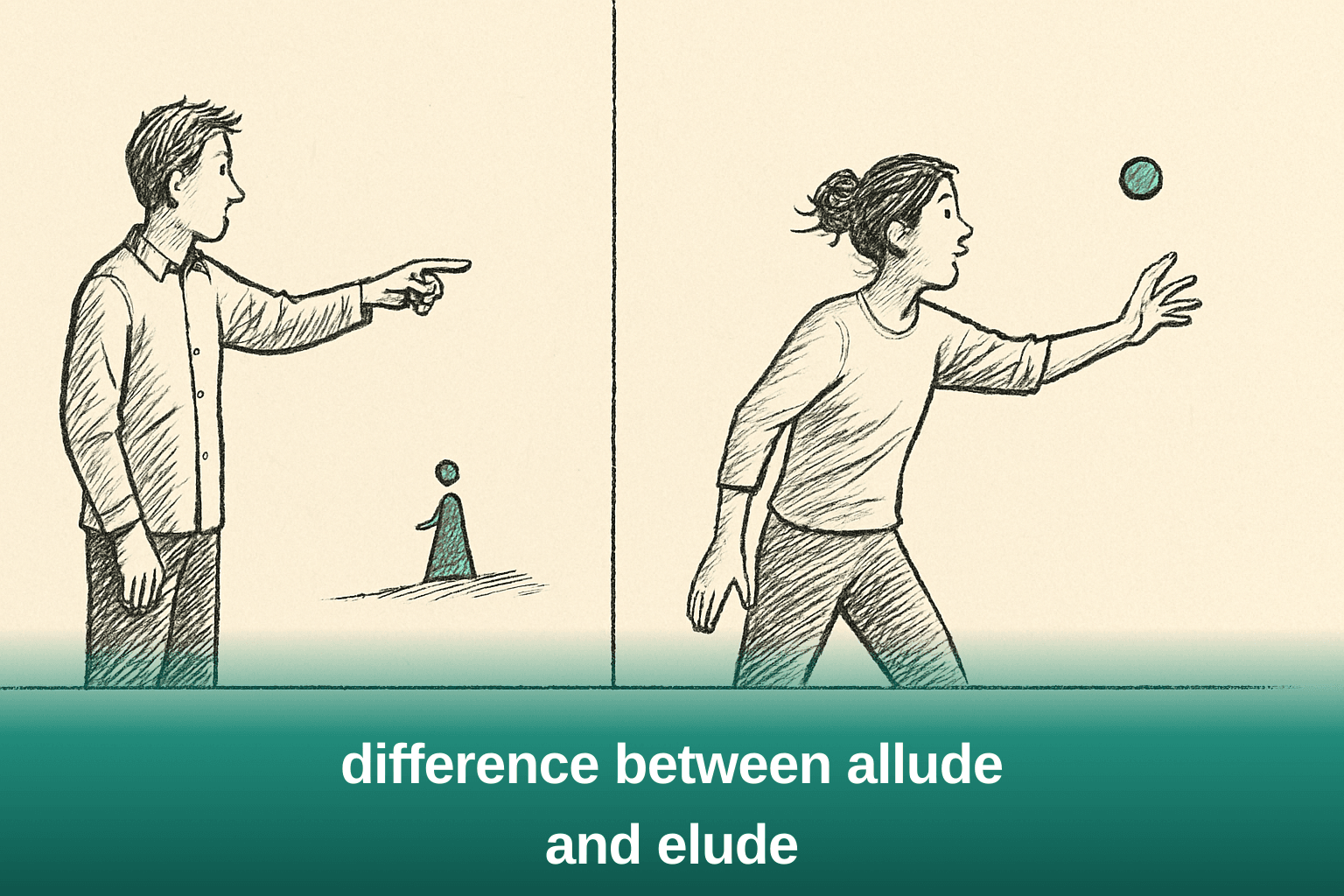

Allude means to hint at something indirectly or to mention it briefly without going into detail. Elude means to escape, avoid, or fail to be grasped by the mind or memory. The two verbs share a similar sound but carry completely unrelated meanings and grammatical patterns.
The difference between allude and elude is simple: allude means to hint at something indirectly, while elude means to escape, avoid, or fail to be understood. A poet might allude to Greek mythology without naming a specific hero. A criminal might elude the police for weeks.
These two words confuse writers and speakers because they are classic homophones. They share the same pronunciation but differ sharply in spelling, grammar, and sense. This article breaks down each verb, shows how they behave in real sentences, and gives you practical ways to keep them straight on exams, in essays, and at work.
Allude vs Elude: The Short Answer
“Allude” is a verb that means to suggest or hint at something without stating it outright. It almost always appears with the preposition “to,” as in “she alluded to his past mistakes.” “Elude” is also a verb, but it means to escape capture, avoid a threat, or remain beyond someone’s understanding. You can say “the suspect eluded authorities” or “the correct formula eludes me.” Because these words sound identical in spoken English, writers often mix them up, yet their meanings never overlap. If you replace one with the other, the sentence collapses into nonsense. Consider the contrast: a speaker alludes to a scandal to plant an idea in the listener’s mind, while a fugitive eludes a roadblock to stay free. One deals with language and suggestion; the other deals with avoidance and flight. Remembering this fundamental split is the first step toward using both words with confidence.
Allude means to hint at something indirectly, usually followed by the preposition “to.” Elude means to escape, avoid, or fail to be understood. They are not interchangeable because one concerns verbal suggestion and the other concerns physical or mental escape. Allude is followed by “to,” while elude can take a direct object or act as a subject.
What Does “Allude” Mean?
“Allude” comes from the Latin “alludere,” which means to play with or jest at something. In modern English, the verb describes the act of referencing a person, event, or idea without discussing it directly. Speakers and writers allude when they want to evoke a shared cultural reference or hint at a sensitive topic without explicit detail. You will find it in literary criticism, journalism, and polite conversation. The word rarely stands alone; it typically needs the preposition “to” in order to connect the hint to its target. Without that preposition, the sentence feels incomplete to native readers. Whether a novelist alludes to Shakespeare or a colleague alludes to an earlier email, the pattern remains the same: a brief, indirect signal that asks the audience to fill in the gaps. Understanding this behavior prevents the most common error writers make with this verb.
Allude Definition and Core Meaning
Allude carries two closely related shades of meaning. First, it means to hint at something in an indirect manner, letting the audience infer the connection. Second, it means to mention a subject briefly without exploring it in depth. This sets it apart from “refer” and “mention,” which are usually straightforward and direct. When you mention a book, you name it. When you allude to it, you drop a clue and move on. The verb demands the preposition “to” in standard usage. Writers who drop the preposition create ungrammatical phrases such as “he alluded the problem,” which native readers instantly reject. Keeping the preposition in place is as important as choosing the correct verb.
Allude in a Sentence: 5 Examples
Examples
- The professor alluded to several studies that contradicted the mainstream theory. (Indirect reference to academic sources)
- During the meeting, she alluded to budget cuts without giving specific numbers. (Hinting at financial reductions)
- The film alludes to classic noir through its lighting and shadow play. (Cinematic reference to a genre)
- In his email, he alluded to a previous conversation about deadlines. (Mentioning an earlier talk indirectly)
- The poet alludes to autumn as a metaphor for aging. (Symbolic hint without explicit explanation)
Allude Synonyms and Related Words
Several synonyms overlap with allude, though each carries a distinct nuance. “Hint at” suggests a subtle clue. “Imply” focuses on meaning that arises from context rather than direct statement. “Suggest” is broader and more neutral. “Refer to” and “touch on” are more direct than allude. “Mention in passing” emphasizes brevity. “Intimate” and “insinuate” can carry a slightly negative or secretive tone that allude usually lacks.
- hint at — a subtle clue
- imply — meaning that emerges from context
- suggest — a broader, neutral option
- refer to — more direct and explicit
- touch on — brief contact with a topic
- mention in passing — emphasizes brevity
- intimate — formal, often secretive
- insinuate — implies something negative indirectly
What Does “Elude” Mean?
“Elude” traces back to the Latin “eludere,” meaning to escape from a game or mockery. Today, the verb covers three distinct territories: physical escape from a pursuer, avoidance of duty or penalty, and failure to be grasped by the mind or memory. Many writers remember the first meaning easily, but they forget the third. When someone says “the answer eludes me,” they are not running away from anything; the understanding itself remains out of reach. Elude can function as a transitive verb with a direct object, as in “elude capture,” or it can appear in constructions where the subject is the thing that escapes, as in “sleep eluded him.” This flexibility makes it useful in everything from detective fiction to scientific papers. Knowing all three senses stops you from defaulting to “escape” every time you see the word.
Elude Definition and Core Meaning
Elude operates across three main domains. The first is physical flight: a fugitive eludes the police, or an animal eludes a trap. The second is avoidance of obligation or consequence: a corporation might elude taxes, or a suspect might elude prosecution. The third, and most overlooked, is cognitive slip: a name eludes you, a concept eludes understanding, or a solution eludes researchers for decades. In legal writing, elude can specifically mean to avoid compliance with a law or penalty. Unlike allude, elude does not need a preposition to connect to its object. It can be transitive (“elude the guard”) or intransitive in structure (“the meaning eludes me”). This grammatical freedom makes it versatile, but it also means you must check whether the subject or the object is doing the escaping.
Elude in a Sentence: 5 Examples
Examples
- The escaped prisoner eluded search teams for three days. (Physical escape)
- For years, the company eluded regulators by shifting profits overseas. (Avoidance of legal oversight)
- The thief eluded the security cameras by sticking to the blind spots. (Physical evasion)
- The correct translation eludes me no matter how many dictionaries I check. (Mental slip)
- A universal theory of quantum gravity continues to elude physicists. (Failure to be grasped intellectually)
Elude Synonyms and Related Words
Synonyms for elude vary by context. “Evade” suggests deliberate trickery or legal dodging. “Avoid” is neutral and does not imply cleverness. “Dodge” and “sidestep” suggest quick, physical movement. “Escape” and “flee” emphasize getting away from a threat. “Get away from” and “shake off” are more colloquial. While “evade” often appears in discussions of law and responsibility, “elude” carries a sense of cleverness or intangibility that “avoid” lacks.
- evade — deliberate avoidance, often of duty or law
- avoid — neutral, no implication of cleverness
- dodge — quick, physical movement
- escape — getting away from confinement or danger
- flee — running away from a threat
- sidestep — stepping around an obstacle
- get away from — colloquial escape
- shake off — losing a pursuer
Difference Between Allude and Elude: Side-by-Side Comparison
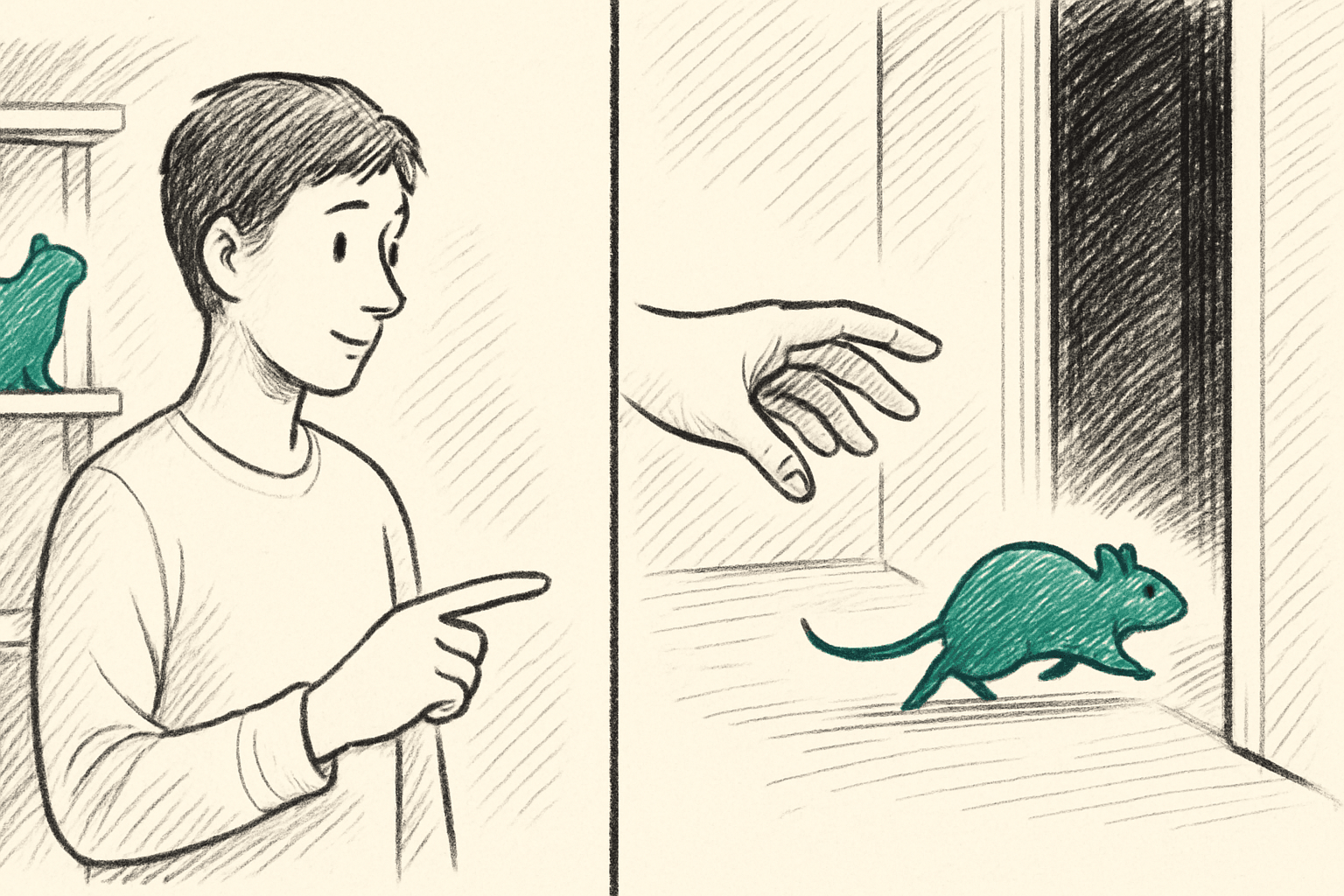
When you place these verbs side by side, their differences become unmistakable. Allude concerns language: it is the tool of poets, politicians, and professors who want to hint rather than declare. Elude concerns evasion: it belongs to fugitives, forgotten names, and scientific problems that resist solution. The grammatical patterns reinforce the split. Allude almost always travels with “to,” while elude stands alone with a direct object or flips to let the escaped thing become the subject. Their synonyms do not overlap; you cannot replace “elude” with “hint” or “allude” with “escape” without destroying the sentence. Spelling offers a final signal: allude carries two Ls, like the multiple layers of meaning in a hint, whereas elude carries one, like a single clean break from capture. Keeping these distinctions in mind protects your writing from one of the most common homophone errors in academic English.
| Feature | Allude | Elude |
|---|---|---|
| Meaning | To hint indirectly; mention briefly | To escape, avoid, or fail to be understood |
| Part of speech | Verb | Verb |
| Typical pattern | allude to + noun | elude + noun / noun + eludes + object |
| Common object | a text, event, idea, past incident | captors, detection, taxes, understanding |
| Synonyms | hint at, imply, suggest, refer to | evade, escape, avoid, dodge |
| Memory hook | Two Ls = all the hints layered | One L = one clean escape |
Grammar Patterns: How Allude and Elude Behave in a Sentence
Grammar separates these homophones as clearly as meaning does. The verb “allude” demands the preposition “to” before its object. You allude to a problem, to a myth, or to an earlier remark. Dropping the preposition produces a sentence that native speakers instantly flag as wrong. In contrast, “elude” behaves like a standard transitive verb: it takes a direct object without any preposition. You elude a question, elude a patrol, or elude suspicion. There is a second, equally valid pattern for elude: the thing that escapes becomes the grammatical subject, and the person trying to grasp it becomes the object. In this construction, “elude” looks intransitive even though the meaning stays active. For example, “sleep eluded him” follows the same logic as “the answer eludes me.” Recognizing these two distinct frameworks prevents the typical mistake of forcing “to” after elude or omitting it after allude. Writers who memorize these patterns spend less time second-guessing themselves during exams and revisions.
- Allude to + noun: The report alludes to climate data from the 1990s.
- Elude + noun: The suspect eluded detection for months.
- Noun + eludes + object pronoun: The significance of the finding eluded everyone.
Spelling and Pronunciation: Why Allude and Elude Sound Alike
Both words are perfect homophones. They share the pronunciation /əˈluːd/, which means listeners cannot tell them apart without context. Writers must therefore rely on spelling and syntax to signal the intended meaning. The spelling difference is small but consistent: “allude” contains a double L, while “elude” contains a single L. You can use this visual cue as a memory aid. Think of the double L in “allude” as “all the hints” the word hides inside a sentence. The single L in “elude” mirrors a single, swift escape. In rapid speech, the distinction vanishes entirely, so readers depend on the surrounding words. If they see “to” nearby, they expect “allude.” If they see a direct object or a subject flip, they expect “elude.” Pronunciation guides cannot rescue a misspelled homophone; only attention to context and spelling can.
Allude and Elude in Academic and Professional Writing
In academic and professional contexts, choosing between these verbs affects your credibility. Scholars allude to prior research when they want to situate a study within an ongoing debate without summarizing every source. Overusing “refer to” can make prose feel mechanical; “allude” signals a lighter, more sophisticated touch. On the other hand, “elude” appears in scientific literature when a phenomenon resists explanation or when a technical solution remains undiscovered. Medical papers might note that a cure still eludes researchers, while legal briefs describe how a defendant eluded jurisdiction. In business emails, “allude” helps you mention a sensitive issue diplomatically, and “elude” warns that a goal or benchmark has not yet been reached. Using the wrong word in these settings does more than confuse meaning; it marks the writer as careless. Precision here signals attention to detail.
Allude vs Elude vs Illude: The Third Word Most Guides Skip
Most handbooks stop at two words, but a third homophone-like verb exists in English: “illude.” It comes from the Latin “illudere,” meaning to mock or deceive. In modern usage, “illude” means to trick someone or to delude them with false impressions. It is rare today, yet it still appears in older literary texts and specialized vocabularies. Because it sounds so similar to “allude” and “elude,” readers sometimes mistake it for a misspelling of one or the other. It is not. When a character illudes another, they are engaging in deception, not hinting at a fact or running from a threat. Understanding this third member of the family helps you recognize why the first two cause so much confusion: three Latinate verbs with nearly identical endings crowd the same phonetic space. If you read classic fiction or literary criticism, you may encounter “illude” in its natural habitat.
“Illude” functions as a transitive verb meaning to deceive or mislead. A mirage might illude a traveler. A con artist illudes his marks. Unlike “allude,” it does not require “to.” Unlike “elude,” it does not involve escape. It simply means to play a trick on someone’s perception.
Examples
- The flickering lights illuded the sailors into believing the shore was near. (Deception)
- Do not let nostalgia illude you into thinking the past was perfect. (Self-deception)
- The novelist alluded to ancient myths while the villain eluded the hero, yet pride illuded them both into believing the struggle would end quickly. (Integrated use of all three)
Allude vs Allusion: The Verb and the Noun
Many writers stumble not on the allude vs elude question, but on the related noun “allusion.” The verb “allude” describes the action of hinting; the noun “allusion” names the hint itself. When a poet mentions Icarus without telling the whole myth, the poet alludes to the story, and the poem contains an allusion. Mixing the parts of speech creates a recognizable error: “an allude to Shakespeare” is grammatically impossible, while “an allusion to Shakespeare” is standard. This distinction matters in academic grading, where such errors cost marks. Elude, by contrast, forms the noun “elusion,” but that form is far less common and rarely confuses readers. If you can keep “allude” as an action and “allusion” as a thing, you will avoid one of the most frequent mistakes that appear in student essays and editorial feedback.
- The essay contains several allusions to post-war politics. (Noun)
- The speaker alluded to the scandal without naming names. (Verb)
- That painting is an allusion to Renaissance ideals. (Noun)
Elude vs Evade: Which One Do You Need?
Because “elude” and “evade” both suggest avoidance, writers often treat them as exact synonyms. They are not. “Evade” emphasizes deliberate cunning or legal circumvention. You evade taxes, evade a direct question, or evade responsibility. The word carries a judgmental tone that implies the subject knows exactly what they are doing and chooses to sidestep it. “Elude” emphasizes slipperiness or intangibility. A dream eludes you not because you refuse to catch it, but because it floats beyond your grasp. A suspect eludes police through luck and speed, while a white-collar criminal evades prosecution through legal maneuvering. Both words describe avoidance, yet “evade” points to moral or legal choice, and “elude” points to outcome and ability. Choosing the wrong one can soften an accusation or, conversely, make an innocent forgetfulness sound like a crime. Writers often ask about the difference between elude and evade because both verbs feel similar, but their connotations diverge sharply.
| Word | Best used for |
|---|---|
| Elude | Physical escape, mental slip, remaining out of reach |
| Evade | Deliberate avoidance of duty, law, or direct questioning |
Common Mistakes with Allude and Elude (and How to Fix Them)
Even advanced writers make predictable errors with these homophones. The most frequent mistake is dropping the preposition after “allude,” producing phrases like “she alluded the problem” instead of “she alluded to the problem.” Another common slip is using “elude” when the context calls for a hint: “he eluded to the issue” confuses the two verbs entirely. Some writers choose “allude” when they mean physical escape, as in “the robber alluded the guards,” which reverses the intended sense. A fourth error involves the noun “allusion”: students sometimes write “an allude” instead of “an allusion,” mixing parts of speech. Finally, many people select “elude” in contexts where “evade” is the more precise choice, particularly when describing tax fraud or legal dodging. Each mistake follows a clear pattern, and each pattern has a straightforward fix. Recognizing these five errors in your own drafts will sharpen your editing eye faster than memorizing definitions alone.
- Allude without “to”: Incorrect: “The article alluded several sources.” Correct: “The article alluded to several sources.” The preposition is mandatory.
- Elude instead of allude: Incorrect: “She eluded to his mistake.” Correct: “She alluded to his mistake.” Elude never takes “to” in this sense.
- Allude instead of elude: Incorrect: “The cat alluded the dog.” Correct: “The cat eluded the dog.” Allude has nothing to do with physical escape.
- Allude vs allusion confusion: Incorrect: “The poem contains an allude to Homer.” Correct: “The poem contains an allusion to Homer.” Use the noun form.
- Elude instead of evade: Incorrect: “He eluded his taxes.” Correct: “He evaded his taxes.” Financial and legal avoidance usually calls for evade.
How to Remember the Difference: 4 Memory Tricks
Memory tricks turn abstract rules into concrete images. Because “allude” and “elude” share a sound, your brain needs an extra anchor to keep them apart. The first and simplest anchor is the initial letter. The second involves the double L. The third and fourth play with the concepts themselves. These four devices work together to create a safety net that catches errors before they reach the page. You do not need to use all four; pick the one that feels most natural and test it on a few sentences. Once the correct spelling and grammar start to feel automatic, you will stop pausing over these words entirely. The goal is not to perform linguistic acrobatics but to build a reflex that chooses the right verb in under a second.
- Step 1: Elude = Escape. Both start with the same letter. If the sentence involves getting away, reach for the E.
- Step 2: Allude = A hint. The first letter links the word to its core action: an indirect reference.
- Step 3: Count the Ls. Allude has two Ls, like “all the hints” layered inside a remark. Elude has one L, like a single clean break.
- Step 4: Check for “to.” If the sentence needs the preposition “to,” the word is almost certainly allude. Elude never requires it.
Quick Practice Test: Allude or Elude?
The best way to lock in the difference is to test yourself with original sentences. Below are five contexts drawn from literature, news, academia, conversation, and law. Each sentence has a blank where either “allude” or “elude” belongs. Read the context carefully, decide which verb fits the meaning and grammar, and then reveal the answer to see if your reasoning holds. If you miss one, return to the memory tricks above and note which pattern tricked you. Consistent practice builds the reflex that stops these homophones from slipping through in your own essays, emails, and reports. Treat this as a diagnostic tool rather than a final exam; the point is to train your eye to spot the difference in real time.
1. In her keynote, the professor ______ to the ethical concerns surrounding artificial intelligence without naming specific companies.
Answer: alluded. The context involves an indirect reference during a speech, and the preposition “to” signals the correct verb.
2. Despite an international manhunt, the fraudster continued to ______ authorities by crossing borders under false names.
Answer: elude. The fraudster is physically escaping capture, which requires “elude.”
3. The translator admitted that the subtle humor of the original poem ______ her, making a faithful rendering impossible.
Answer: eluded. The humor escaped her understanding, a classic cognitive use of the verb.
4. During the negotiation, the diplomat ______ to a prior treaty that both nations had signed in the 1980s.
Answer: alluded. The diplomat hinted at a historical agreement indirectly.
5. A practical, low-cost cure for the disease still ______ medical researchers, though funding has tripled in the past decade.
Answer: eludes. The cure remains out of reach intellectually and practically.
FAQ About Allude and Elude
Writers, students, and test-takers tend to ask the same questions about these two verbs. The confusion is understandable: identical pronunciation, similar length, and Latin roots create a perfect storm of uncertainty. The following answers address the most common points of doubt, including the difference between allude and elude with examples drawn from law, literature, and everyday language. Each response is short enough to read quickly but precise enough to settle the question. If you are preparing for an exam or polishing an essay, these quick clarifications can save you from the errors that proofreaders and graders notice immediately. Keep them in mind as a checklist whenever you encounter either word in your own drafts.
Frequently Asked Questions
Allude means to hint at something indirectly, as in “she alluded to his past.” Elude means to escape or avoid, as in “the suspect eluded police.” They share a sound but hold opposite functions in a sentence.
No. Swapping them destroys the meaning. If you write “he eluded to the problem,” you confuse escape with reference. If you write “the answer alludes me,” you replace escape with hinting.
Evade usually implies deliberate avoidance of a duty, law, or direct question. Elude emphasizes slipperiness, whether physical or mental. You evade taxes through choice; sleep eludes you despite effort.
They are related but different parts of speech. Allude is the verb: “The author alludes to myth.” Allusion is the noun: “The poem contains an allusion to myth.”
In this phrase, elude means the answer slips away from understanding. It is a mental escape, not a physical one. The knowledge remains just beyond your grasp.
Almost never in standard English. Allude requires the preposition “to” before its object. Dropping it produces an ungrammatical sentence that native readers will notice instantly.
Illude is a rare verb meaning to deceive or delude. It appears mainly in older literary texts. Modern writers rarely need it, but recognizing it helps explain why allude and elude cause so much confusion.
Final Verdict on Allude vs Elude
Allude is the verb for indirect hints and passing references, and it almost always brings the preposition “to” with it. Elude is the verb for escape, avoidance, and things that slip from memory or understanding. The difference between allude and elude comes down to one simple truth: they share a pronunciation, yet their meanings, grammar, and contexts never overlap. When you need to hint at an idea without stating it outright, the word contains two Ls. When you need to describe a fugitive, a forgotten name, or a missing answer, the word starts with E. Holding this distinction in mind will keep your academic and professional writing precise and will prevent the homophone confusion that troubles so many students and professionals. Use the memory tricks above, and both words will stay in their proper places forever.