
This article provides general legal information and does not constitute legal advice. For specific legal questions, consult a qualified attorney.
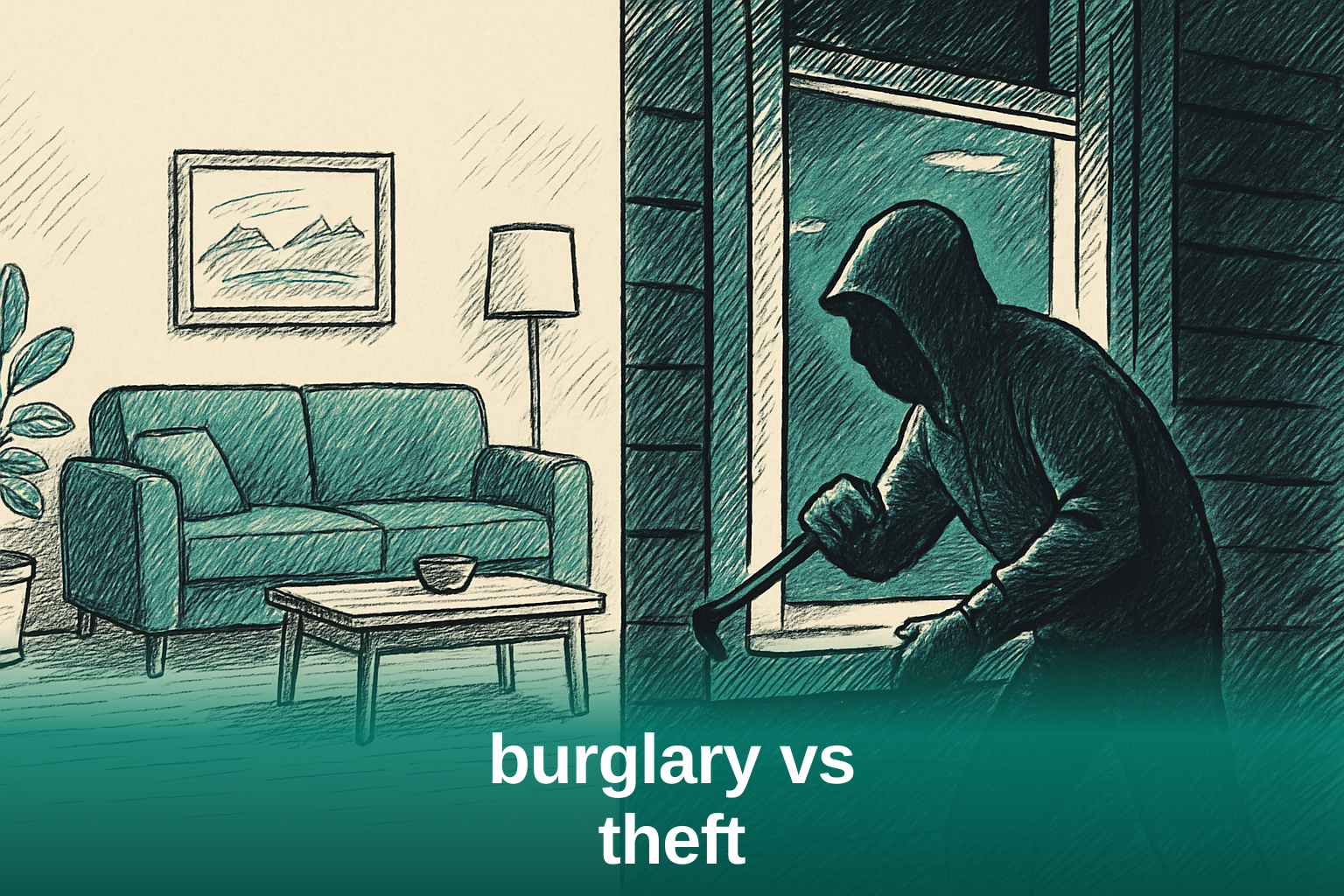
Theft centers on unlawfully taking property, while burglary centers on unlawfully entering a structure with criminal intent. Burglary does not require completing theft or taking any property. Penalties differ sharply: theft ranges from misdemeanors to felonies based on value, whereas burglary is typically a felony due to the invasion of private space.
People often use “burglary” and “theft” interchangeably in everyday conversation, but courts treat them as fundamentally different crimes. Imagine someone walking into an unlocked garage and taking a bike — is that theft or burglary? The answer depends on intent, permission, and how the person entered. This article breaks down the legal elements, real-world examples, penalties, and defenses for both charges so you can understand what each term actually means.
What Is Theft?
Theft, often called larceny in some jurisdictions, is the unlawful taking or control of another person’s property with the specific intent to permanently deprive the owner of it. Prosecutors must prove that the defendant exercised unauthorized control over the item, that the taking occurred without the owner’s consent, and that the defendant intended to keep the property indefinitely rather than borrow it. Unlike burglary, theft does not require unlawful entry into a structure, the use of force against a person, or even the physical presence of the victim. A theft charge can arise from something as simple as pocketing a wallet at a party or switching price tags in a retail store. The severity of the charge typically depends on the value of the stolen property, with low-value thefts charged as petty or petit theft and higher-value thefts charged as grand theft. The defining element of theft is the intent to permanently deprive the owner of their property, not the manner or location of the taking.
Legal Definition of Theft
In most U.S. jurisdictions, the crime of theft consists of three core elements that the prosecution must prove beyond a reasonable doubt. First, the defendant knowingly obtained unauthorized control over property belonging to another person. Second, the defendant acted without consent from the lawful owner. Third, the defendant possessed the specific intent to permanently deprive the owner of the property’s use or benefit. Some states, such as Illinois, broaden the definition to include obtaining property through deception or threat, even when no physical taking occurs. While statutory language varies slightly from state to state, these foundational elements remain consistent across the majority of legal codes.
Common Examples of Theft
Theft appears in many everyday scenarios that do not involve breaking into buildings. Shoplifting occurs when a person conceals merchandise and leaves a store without paying. Pickpocketing involves removing a wallet or phone from someone’s pocket or bag without their knowledge. Auto theft happens when a person drives away a parked car without the owner’s permission. Taking a coworker’s laptop from a shared office desk with the intent to keep it also qualifies as theft. Another example is theft of services, such as leaving a restaurant without paying or sneaking into a movie theater. In each case, the common thread is the unlawful taking of property or value without any unlawful entry into a structure.
Examples
- If a person takes a $300 pair of sunglasses from a store display without paying, that is theft. No unlawful entry occurred, so burglary charges would not apply.
What Is Burglary?
Burglary is the unlawful entry into a building, structure, or vehicle with the intent to commit a crime inside, regardless of whether that intended crime is ever completed. Most people mistakenly believe that burglary requires a forced break-in or the successful theft of property, but modern statutes have eliminated both requirements. Simply entering a closed store through an unlocked back door after hours can constitute burglary if the person intends to steal merchandise or commit vandalism. The crime is complete the moment the unlawful entry occurs with the requisite criminal intent, which means an alarm that scares off an intruder before anything is stolen does not prevent a burglary charge. Burglary laws exist to protect the sanctity of private and commercial spaces, and courts treat the invasion of those spaces as an aggravating factor independent of property loss. Burglary is complete upon unlawful entry with criminal intent, even if the offender takes nothing and leaves immediately.
Legal Definition of Burglary
The legal definition of burglary centers on three essential elements. The defendant must have knowingly entered a building, structure, dwelling, or conveyance without authorization or permission. Second, the entry must be unlawful, meaning the person lacked consent to be there, which can include entering through an unlocked door or using an unauthorized key. Third, at the moment of entry, the defendant must have possessed the intent to commit a crime inside, whether that crime is theft, assault, vandalism, or another felony. In states like Florida, burglary classifications depend heavily on the type of structure involved, distinguishing between dwellings, structures, and conveyances. In Illinois, simply entering a vehicle or building without permission, coupled with criminal intent, satisfies the statutory requirements.
Common Examples of Burglary
Burglary scenarios always include an element of unlawful entry coupled with criminal intent. A person who sneaks into a house while the owners are away to steal electronics commits burglary. Entering a locked convenience store after closing time through a rooftop vent to grab cash from the register is another clear example. Breaking into a parked car to steal a stereo system qualifies as burglary of a conveyance in many states. Even entering a neighbor’s unlocked shed with the intent to commit vandalism satisfies the legal definition. Hiding inside a department store until after closing, then emerging to steal goods, constitutes burglary because the initial entry was lawful but the remaining after hours with criminal intent transforms the act. In each scenario, the taking of property is not required for the charge to stand.
Examples
- A person who breaks into a closed store after hours to steal merchandise has committed burglary, even if an alarm scares them off before they take anything. The crime was complete at the moment of unlawful entry with criminal intent.
Burglary vs Theft: The 4 Key Differences
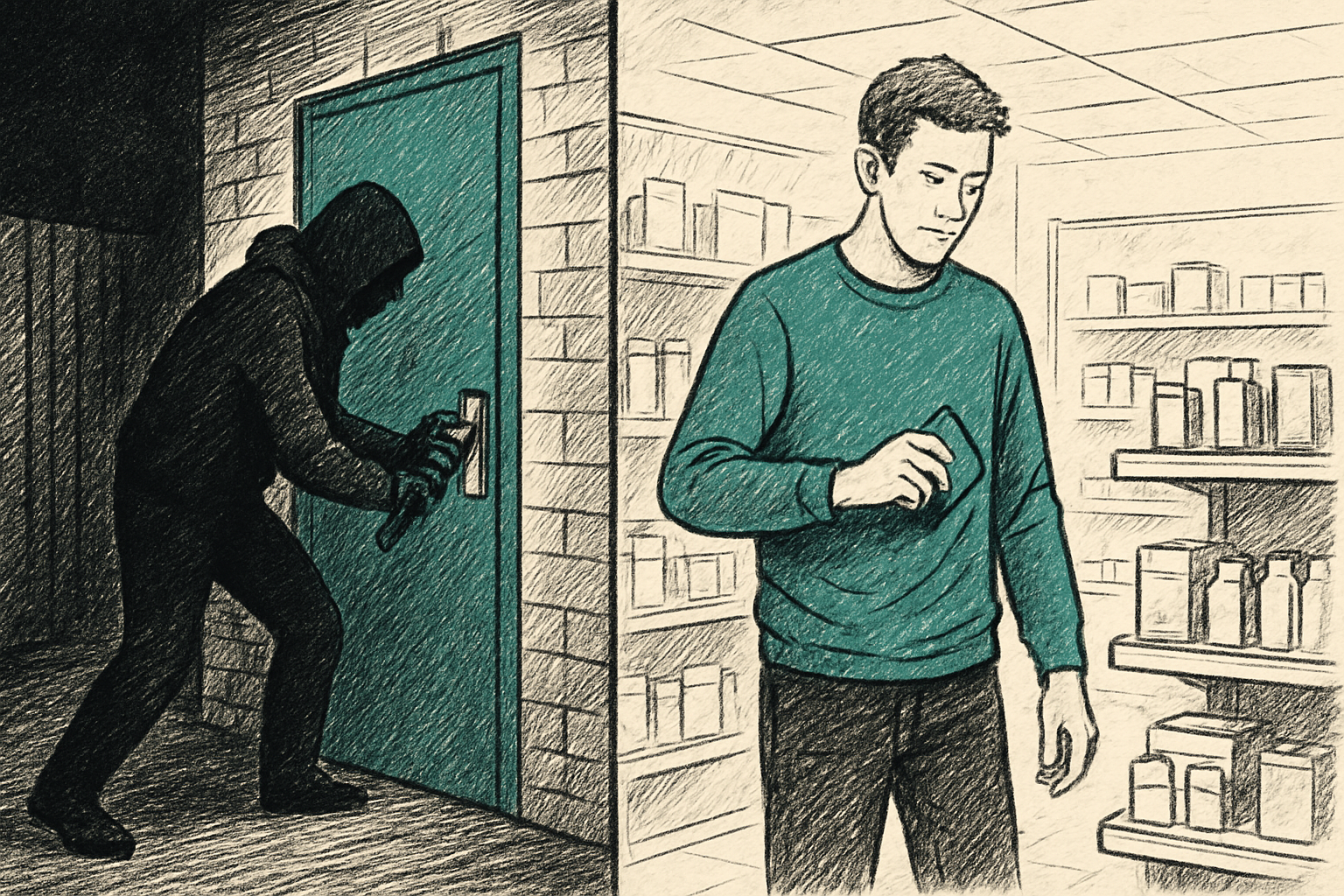
While both burglary and theft fall under the umbrella of property crimes, they differ in core elements, required conduct, and legal severity. Theft focuses on the unlawful acquisition of property, whereas burglary focuses on the unlawful invasion of a protected space with criminal intent. Courts analyze whether the defendant entered a structure without permission, what the defendant intended at the moment of entry, and whether any property was actually taken. These distinctions determine not only the charges filed but also the potential penalties and available defenses. Because burglary punishes the violation of spatial boundaries and the threat of further criminal conduct, it is almost universally classified as a felony. Theft, by contrast, can be charged as either a misdemeanor or a felony depending primarily on the monetary value of the stolen items. Understanding these four key differences helps defendants, victims, and business owners interpret police reports and insurance documents accurately.
| Aspect | Theft | Burglary |
|---|---|---|
| Primary Element | Unlawful taking of property | Unlawful entry with intent to commit a crime |
| Unlawful Entry Required? | No | Yes |
| Criminal Intent Required? | Intent to permanently deprive owner | Intent to commit any crime inside |
| Property Taken? | Yes, property must be taken | No, entry with intent is sufficient |
| Typical Charge | Misdemeanor or felony based on value | Typically a felony |
Intent: Taking vs. Entering to Commit a Crime
In a theft prosecution, the required intent is specifically directed at the property itself. The state must prove that the defendant intended to permanently deprive the lawful owner of their possessions. Burglary intent is broader and more forward-looking. The prosecutor must show that the defendant intended to commit some crime inside the structure at the moment of entry, and that crime does not need to be theft. For instance, a person who enters an office building after hours intending to destroy computer servers may face burglary charges despite having no plan to steal anything. Similarly, someone who enters a home intending to assault the resident commits burglary even if the assault never occurs. The critical distinction is that burglary intent targets a future crime inside a space, while theft intent targets the property itself.
Location: Anywhere vs. A Structure
Theft is location-agnostic. It can happen on a public sidewalk, inside a crowded store, at a workplace, or in an open field. As long as property is taken without consent, the venue does not change the fundamental nature of the offense. Burglary, however, is inextricably tied to a structure. The defendant must unlawfully enter a dwelling, building, commercial facility, or conveyance such as a car or boat. This requirement exists because burglary laws protect the privacy and security of enclosed spaces. A pickpocket who steals a wallet on the street commits only theft. If that same pickpocket first breaks into the victim’s locked car to take the wallet, the charge escalates to burglary because the taking occurred within an unlawfully accessed structure.
Completion: Theft Requires Taking, Burglary Does Not
A theft offense is not legally complete until the defendant actually takes possession or control of the property. If a shoplifter is stopped before exiting the store and never gains control of the merchandise, prosecutors may only have an attempt charge rather than a completed theft. Burglary operates under a completely different framework. The crime is consummated the instant the defendant crosses the threshold of a structure with criminal intent. Whether the defendant steals a single item, damages nothing, or flees empty-handed within seconds is irrelevant to the burglary charge itself. This principle surprises many defendants who believe that returning stolen goods or leaving a scene voluntarily negates criminal liability. It does not.
Severity: Misdemeanor vs. Felony
Theft charges span a wide spectrum of severity based almost entirely on the value of the stolen property. Low-value thefts, often called petit or petty theft, are misdemeanors punishable by county jail time and moderate fines. High-value thefts graduate to grand theft felonies with state prison exposure. Burglary generally begins at the felony level and escalates from there. Residential burglary, which involves unlawfully entering a home where people sleep, carries harsher penalties than commercial burglary because of the heightened risk to human life. The classification reflects a societal judgment that violating a private dwelling represents a more profound threat than stealing unattended property. Even burglary of an unoccupied garage with no theft completed often carries harsher consequences than a misdemeanor theft of goods worth a few hundred dollars.
Burglary vs Theft vs Robbery: Where Does Force Fit In?
Robbery adds a violent or intimidating element that neither theft nor burglary requires. Legally defined, robbery is the taking of property from a person or their immediate presence through the use of force or the threat of force. While theft can be entirely covert and burglary can occur in an empty building, robbery necessarily involves direct confrontation with a victim who reasonably fears harm. This distinction explains why robbery sentences typically exceed those for standalone theft or burglary charges. A single criminal episode can, however, include all three offenses. An intruder who unlawfully enters a home commits burglary, and if that intruder then threatens the homeowner with a weapon to obtain jewelry, the intruder also commits robbery. Understanding how force transforms the legal landscape helps defendants and victims accurately describe incidents to law enforcement and insurers.
| Criteria | Theft | Burglary | Robbery |
|---|---|---|---|
| Force Required? | No | No | Yes |
| Unlawful Entry Required? | No | Yes | No |
| Victim Present? | No | No | Yes |
| Primary Focus | Unlawful taking of property | Unlawful entry with criminal intent | Taking by force or threat |
It is entirely possible for one incident to generate charges for all three crimes simultaneously. Prosecutors frequently stack charges to reflect the full scope of criminal conduct. A defendant who plans to steal from a store after hours, breaks through a window, and then encounters a security guard and threatens them with a knife may face burglary for the break-in, robbery for the confrontation, and theft for the actual taking of merchandise. Juries may convict on all counts or on a subset depending on the evidence presented.
Examples
- A person who breaks into a home at 2 AM intending to steal electronics commits burglary. If the homeowner wakes up and the intruder threatens them with a weapon to hand over jewelry, the intruder has now also committed robbery.
Penalties for Theft and Burglary
Sentences for theft and burglary vary dramatically by jurisdiction, the value of any stolen property, the type of structure entered, and the defendant’s criminal history. In general, theft penalties track the economic harm caused by the offense, while burglary penalties reflect the dangerousness of invading a protected space. State legislatures publish specific sentencing grids that judges consult, but statutory ranges only tell part of the story. Prosecutors have broad discretion to file higher or lower charges, and plea negotiations often determine the actual sentence more than the initial statute. Prior convictions, the use of weapons, and the presence of occupants during a burglary can trigger sentence enhancements that add years to prison terms. Because both crimes can result in lengthy incarceration, heavy fines, and lasting criminal records, anyone facing these charges should understand the specific penalty framework in their state. Burglary is almost always punished more severely than theft because it endangers personal safety and privacy, not just property.
Theft Penalties by Value
Theft penalties follow a tiered structure tied to the fair market value of the stolen property. In Illinois, for example, theft of property valued at $500 or less is typically a Class A misdemeanor punishable by up to 364 days in jail and a fine of up to $2,500. When the value exceeds $500 but falls below $10,000, the charge becomes a Class 3 felony carrying two to five years in prison. Values between $10,000 and $100,000 trigger a Class 2 felony with three to seven years. A Class 1 felony applies to property valued between $100,000 and $500,000, resulting in four to fifteen years. The most serious thefts exceeding $1,000,000 can be charged as a Class X felony with six to thirty years. Florida uses a different threshold: petit theft covers property under $750, while grand theft applies to $750 or more.
| Property Value | Charge Classification | Potential Sentence |
|---|---|---|
| $500 or less | Class A Misdemeanor | Up to 364 days jail; fine up to $2,500 |
| $500 – $10,000 | Class 3 Felony | 2 – 5 years prison |
| $10,000 – $100,000 | Class 2 Felony | 3 – 7 years prison |
| $100,000 – $500,000 | Class 1 Felony | 4 – 15 years prison |
| $1,000,000 or more | Class X Felony | 6 – 30 years prison |
Burglary Penalties by Structure Type
Burglary sentences depend heavily on what was entered and under what circumstances. In Illinois, burglary of a vehicle or building without damage may be charged as a Class 3 felony with two to five years. If the entry causes damage to the structure or conveyance, the charge elevates to a Class 2 felony, carrying three to seven years. Burglary of a school, daycare, or place of worship becomes a Class 1 felony punishable by four to fifteen years. Residential burglary, which involves entering a dwelling, is also a Class 1 felony and often carries mandatory prison time. Florida classifies burglary by dwelling, structure, or conveyance, with stiffer penalties for occupied dwellings. If the burglary occurs while the premises are occupied or while the defendant is armed, the sentence can increase substantially.
| Structure Type | Charge Classification | Potential Sentence |
|---|---|---|
| Vehicle or building (no damage) | Class 3 Felony | 2 – 5 years prison |
| Building or vehicle (with damage) | Class 2 Felony | 3 – 7 years prison |
| School, daycare, or place of worship | Class 1 Felony | 4 – 15 years prison |
| Residential dwelling | Class 1 Felony | 4 – 15 years prison (mandatory prison likely) |
How Prior Records Affect Sentencing
Defendants with prior convictions face significantly harsher outcomes under habitual offender statutes. In Florida and several other states, repeat theft or burglary convictions can trigger mandatory minimum sentences or reclassification of charges to higher felony classes. A second petit theft offense that would normally be a misdemeanor may be filed as a felony if the defendant has a previous theft conviction. Similarly, repeat burglary offenders may lose access to probation or diversion programs entirely. Judges often view prior property crime convictions as evidence of an established pattern, which reduces willingness to impose lenient sentences. These enhancements make it critical for defendants with any criminal history to seek experienced legal counsel early in the process.
Hidden Consequences: What Happens After the Sentence Ends
A conviction for theft or burglary creates repercussions that extend far beyond jail time, fines, or probation. Many defendants are surprised to learn that a felony record can disqualify them from professional licenses, public housing, and federal student aid. Employers in sectors such as finance, healthcare, and education routinely conduct background checks, and a property crime conviction often results in automatic disqualification. Landlords may refuse rental applications, and some states restrict voting rights for felony offenders. Burglary convictions carry particularly heavy social stigma because they involve invading private spaces, which employers and housing boards view as a breach of trust. Even misdemeanor theft can trigger immigration consequences for non-citizens, including deportation proceedings. Understanding these collateral effects is essential when evaluating plea offers, as a reduced sentence today may still carry decades of invisible punishment. The long-term impact of a property crime conviction on housing, employment, and civil rights often exceeds the formal court sentence.
Legal Defenses to Theft and Burglary Charges
Being charged with theft or burglary does not guarantee a conviction. The prosecution bears the burden of proving every element of the offense beyond a reasonable doubt, and skilled defense attorneys attack weak evidence, constitutional violations, and flawed witness identifications. Defenses to theft typically challenge the defendant’s intent or right to possess the property, while defenses to burglary often focus on lawful access or lack of criminal intent at the moment of entry. Early intervention by a criminal defense lawyer can preserve surveillance footage, secure witness statements, and negotiate with prosecutors before charges are formally filed. The specific strategy depends entirely on the facts of the case, the jurisdiction, and the defendant’s prior record. An arrest is not a conviction, and defendants have constitutional rights that law enforcement must respect throughout the investigation and trial process.
Defenses to Theft Charges
Several defenses can defeat a theft charge or reduce it to a lesser offense. Lack of intent is one of the most powerful: if the defendant accidentally walked out of a store with an item or genuinely intended to return borrowed property, the prosecution cannot prove the required mental state. A claim of right defense applies when the defendant honestly believed the property belonged to them, such as taking a laptop from a shared workspace that looked identical to their own. Permission from the owner negates the unauthorized taking element. Mistaken identity arises when surveillance footage is grainy or eyewitness descriptions are vague. Finally, entrapment may apply if law enforcement induced the defendant to commit a theft they otherwise would not have contemplated.
Examples
- If a person takes a laptop from a shared office desk believing it is their own, they have a valid claim of right defense. The prosecution must prove the person knew the property did not belong to them.
Defenses to Burglary Charges
Burglary defenses often target the entry or intent elements. If the defendant had permission to enter the premises, the unlawful entry requirement fails. Lack of criminal intent is another common defense: a person who mistakenly enters the wrong apartment in a dark hallway did not possess the intent to commit a crime inside. An alibi defense places the defendant elsewhere at the time of the alleged entry, supported by receipts, GPS data, or witness testimony. Misidentification by neighbors or security guards can lead to wrongful charges, especially when the perpetrator wore a mask. Entrapment may also apply if an undercover officer persuaded the defendant to enter a building under false pretenses. Each of these defenses requires careful factual investigation and presentation.
Examples
- If a person enters an unlocked neighbor’s garage by mistake, thinking it is their own, they lack the criminal intent required for a burglary conviction.
What to Do If You Are Charged with Theft or Burglary
If police arrest you or issue a summons for theft or burglary, the steps you take in the first twenty-four hours can shape the entire trajectory of your case. Panic and poor decisions often create evidence that prosecutors later use against defendants. You need to protect your constitutional rights while simultaneously laying the groundwork for an effective legal defense. The most important principle is to avoid making statements to investigators without an attorney present, even if you believe you can explain your way out of the situation. Prosecutors are trained to twist admissions, partial confessions, and inconsistent statements into convictions. You should also preserve any evidence that supports your innocence, such as text messages, receipts, or contact information for witnesses. Taking methodical, informed action reduces the risk of accidental self-incrimination and demonstrates to the court that you are treating the matter seriously. Invoking your right to remain silent and demanding an attorney immediately are the two most protective actions you can take after any property crime arrest.
- Step 1: Exercise your right to remain silent. Do not speak to police without a lawyer present.
- Step 2: Request an attorney immediately. Early legal intervention can protect your rights.
- Step 3: Avoid contact with alleged victims. Any communication could worsen your situation.
- Step 4: Gather evidence that supports your side: receipts, text messages, witness contact information.
- Step 5: Do not attempt to handle the situation alone. Criminal charges can have lifelong consequences.
How Burglary and Theft Affect Insurance Claims
Property owners and business operators often discover the difference between burglary and theft only after filing an insurance claim. Most commercial and homeowner policies cover both types of losses, but the claims process, documentation requirements, and payout calculations can differ substantially. Burglary claims generally require evidence of forcible entry or visible signs of unlawful intrusion, such as broken locks, shattered windows, or damaged doors. Insurance adjusters use this physical evidence to confirm that the loss resulted from an external criminal act rather than negligence or employee theft. Theft claims, particularly those without signs of forced entry, may trigger more rigorous investigations to rule out fraud or misplacement. Business interruption coverage may also activate differently depending on whether the loss resulted from a burglary that forced a temporary closure or a simple theft that did not damage the premises. Understanding how your policy defines these terms can prevent delayed or denied claims. Documenting all physical damage before repairs is essential because insurers routinely deny burglary claims that lack proof of forced or unlawful entry.
To streamline your claim, contact law enforcement immediately to obtain an official incident report. Photograph damaged entry points, disarrayed inventory, and any missing items. Compile purchase receipts, appraisals, or inventory logs to establish value. Review your declarations page carefully, as some policies exclude certain theft scenarios or impose sub-limits on high-value categories like jewelry or electronics. If the insurer disputes whether the loss constitutes burglary or theft, the police report and photographic evidence often become the deciding factors.
Burglary vs Theft in the UK and New Zealand
Readers searching for burglary versus theft distinctions outside the United States will find that common law jurisdictions share conceptual DNA but use different statutory language. In England and Wales, theft is defined under the Theft Act 1968 as dishonestly appropriating property belonging to another with the intention of permanently depriving them of it. Burglary, under the same act, occurs when a person enters a building as a trespasser with intent to steal, inflict grievous bodily harm, or commit criminal damage. New Zealand’s Crimes Act 1961 similarly separates burglary, which requires entering a building or ship with intent to commit a crime, from theft, which requires dishonestly taking property. While the threshold values and sentencing frameworks differ from American state law, the fundamental distinction remains consistent: burglary requires trespassory entry plus criminal intent, whereas theft requires unlawful taking. Regardless of jurisdiction, burglary is universally treated as the more serious offense because it violates the sanctity of a protected space.
If you are researching these terms for immigration, extradition, or international insurance purposes, consult a solicitor or barrister licensed in the relevant jurisdiction. Terminology that sounds similar can mask significant procedural differences in how intent is proven and how sentences are structured.
Frequently Asked Questions
Defendants, victims, and concerned family members often have specific questions about how burglary and theft charges work in practice. The following answers address the most common points of confusion, from whether burglary requires actual theft to how prior convictions influence sentencing outcomes. Because state laws vary, you should always verify these general principles against the specific statutes in your jurisdiction. The answers below reflect the majority approach under modern American criminal codes, with references to Illinois and Florida law where specific examples help clarify the rule. If your situation involves pending charges, an evidentiary hearing, or an active investigation, these FAQs provide a starting point for informed conversations with your criminal defense attorney. Early legal advice tailored to your exact circumstances will always be more valuable than general information alone.
Frequently Asked Questions
Theft is the unlawful taking of property with intent to permanently deprive the owner. Burglary is the unlawful entry into a structure with intent to commit a crime inside. Burglary does not require any property to be stolen.
Yes. If a person unlawfully enters a building and then takes property, prosecutors can charge both burglary for the illegal entry and theft for the unlawful taking.
In most states burglary is a felony, though the class varies by structure type and circumstances. Residential burglary and armed burglary typically carry the harshest felony classifications.
No. In many jurisdictions, including Illinois, simply entering through an unlocked door without permission satisfies the entry element. Breaking is not required.
Robbery involves taking property directly from a person using force or the threat of force. Burglary focuses on unlawful entry into a structure and does not require a victim to be present.
Value determines whether theft is charged as a misdemeanor or felony. For example, Florida uses a $750 threshold between petit and grand theft, while Illinois uses $500 for the lowest felony tier.
Remain silent, request an attorney, avoid contacting the alleged victim, and gather any evidence that supports your innocence such as receipts or witness contacts.
Bottom Line: Burglary vs Theft
Theft punishes the unlawful taking of property, while burglary punishes the unlawful invasion of a protected space with criminal intent, making the two crimes legally distinct from the very moment the elements are examined by police, prosecutors, and courts. Burglary is complete the moment someone enters a structure intending to commit a crime inside, even if nothing is ever stolen and no damage occurs, which is why state statutes classify it as a felony in nearly every American jurisdiction. Because burglary directly threatens personal safety and the foundational privacy of homes and businesses, it carries steeper penalties, longer mandatory prison sentences, and significantly fewer diversion or probation options than simple theft. If you or someone you know is currently facing either charge, consulting a qualified criminal defense attorney immediately is the single most important step you can take to protect your constitutional rights, your freedom, and your future.