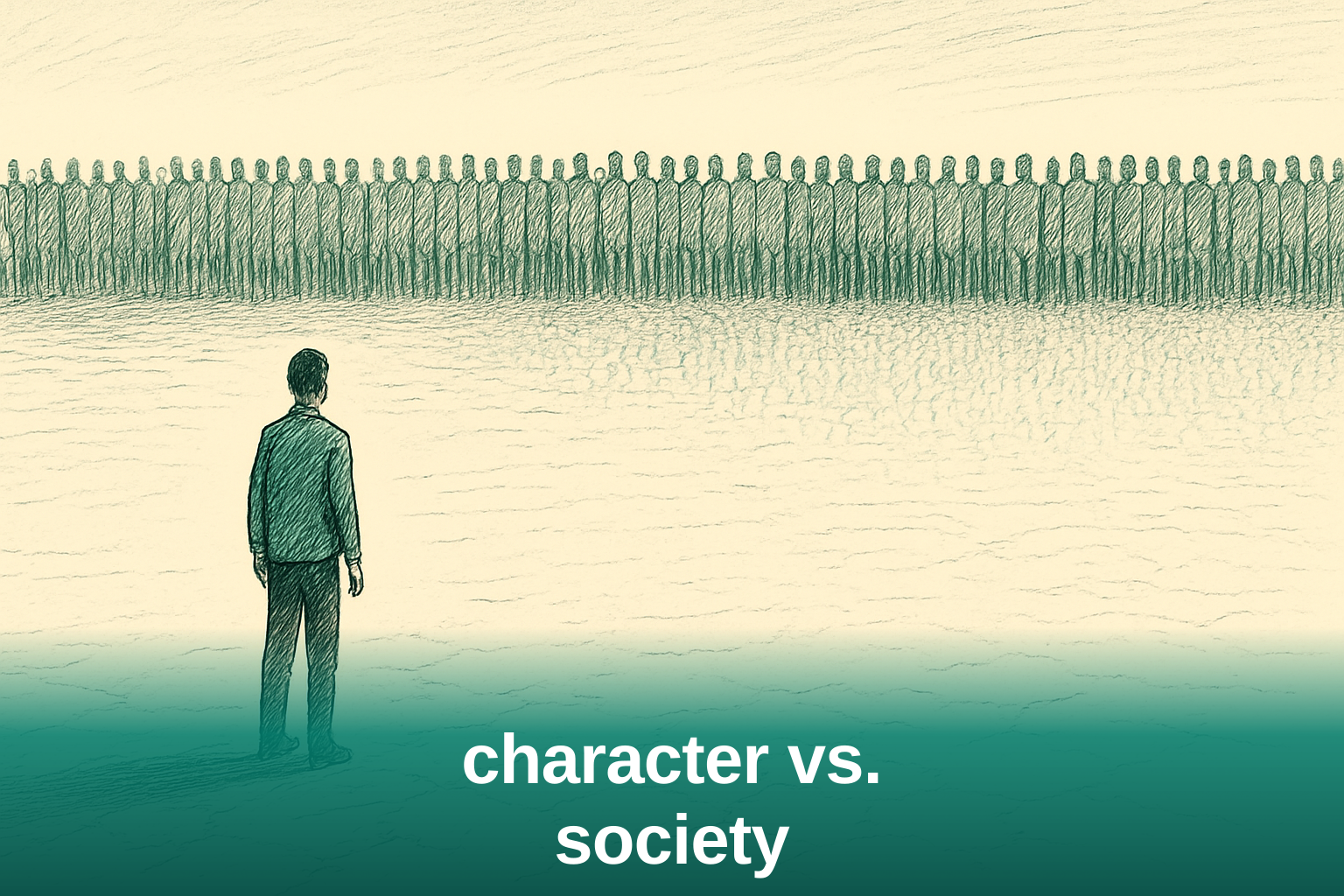

Have you ever stood alone against a room full of disagreeing voices? That isolating tension—one person versus the expectations of many—fuels some of the most compelling narratives ever written. Character vs. society is a type of external conflict in literature where a protagonist's beliefs, actions, or desires clash with the laws, norms, or expectations of their community, government, or culture. This conflict often arises when an individual challenges an unjust system, tradition, or social convention, making society itself the primary antagonist. In the sections ahead, we’ll unpack exactly how this conflict operates, examine iconic examples from classic novels and modern cinema, and share practical writing techniques so you can craft stories where the individual dares to defy the collective.
Table of Contents
- What Is Character vs. Society Conflict?
- Character vs. Society vs. Other Types of Literary Conflict
- Key Character vs. Society Examples in Literature
- Character vs. Society Examples in Movies and TV Shows
- How Character vs. Society Shapes Characters and Plot
- When Society Is Right: The Moral Complexity of Character vs. Society Conflict
- How to Write a Character vs. Society Conflict: 5 Practical Tips
- Common Themes in Character vs. Society Stories
- Is Your Story Really Character vs. Society? A Writer’s Diagnostic
- Frequently Asked Questions About Character vs. Society
- Final Thoughts: The Power of the Individual vs. the Collective
What Is Character vs. Society Conflict? (Definition & Meaning)
At its core, character vs. society conflict pits an individual against the collective forces that shape their world. Unlike a personal feud, this struggle positions an entire system—laws, cultural taboos, class hierarchies, or institutional dogma—as the opposing force. The protagonist does not merely dislike society; they want something that society forbids, whether that is freedom of thought, romantic choice, artistic expression, or basic human dignity. This dynamic creates a unique narrative pressure because the opponent is diffuse yet omnipresent. The hero cannot simply defeat a single villain to resolve the tension; they must either change the system, escape it, or accept its crushing weight. As a result, these stories often ask the hardest questions about identity: Who am I if the world around me demands that I become someone else? The conflict resonates because it mirrors real experiences of exclusion, rebellion, and the courage required to hear a different rhythm while everyone else dances to the same beat.
Imagine that society is a song playing over a crowded dance floor. Everyone moves to the same predictable beat, nodding in unison. The protagonist, however, hears a different melody entirely. Their dilemma is not merely about disliking the music; it is about choosing whether to fake the steps, endure the isolation of standing still, or risk ridicule by dancing alone. This analogy captures why character vs. society stories feel so intimate despite their vast scale. The "society" in these tales can take many forms: a totalitarian government that rewrites history, a small town that enforces cruel traditions through gossip, a rigid caste system that determines worth by birth, or a corporate culture that punishes empathy. Each version functions as an antagonist because it wields the power to define reality for everyone inside its borders.
The conflict also serves a profound social function. When an author embeds a specific injustice within a narrative—racism, censorship, gender oppression, or class warfare—they transform abstract policy into lived experience. Readers do not simply learn about these issues; they feel them through the protagonist's fear, hope, and defiance. This emotional bridge is why works like 1984 or The Handmaid's Tale remain culturally urgent long after their publication. They remind us that societies are not neutral backdrops; they are active participants in every human drama, capable of nurturing or destroying the souls within them.
Character vs. Society vs. Other Types of Literary Conflict (NEW)
Writers and students often confuse character vs. society with other external conflicts because the protagonist can face multiple pressures at once. However, the distinction matters: in character vs. character, the opposition is a specific person with a name and face; in character vs. nature, the threat is environmental and indifferent; in character vs. society, the antagonist is the abstract yet tangible weight of collective rules and expectations. Recognizing this difference helps readers identify the true source of tension in a story and allows authors to sharpen their thematic focus. While these conflict types can overlap—Winston Smith in Orwell’s dystopia battles Big Brother, his own fear, and the natural decay of his body—the primary engine driving the plot remains his resistance to the Party’s total control. Understanding where one conflict ends and another begins is essential for both literary analysis and effective storytelling.
When a writer misidentifies the core conflict, the narrative often loses coherence. A story that pretends to be about systemic injustice but actually resolves when one mean boss gets fired has accidentally become character vs. character. Conversely, a tale that promises a psychological descent but spends all its time fighting storms has drifted into character vs. nature. The following table clarifies these boundaries so you can categorize stories with confidence and build your own plots with precision.
| Conflict Type | Definition | Antagonist | Example | Key Difference from Character vs. Society |
|---|---|---|---|---|
| Character vs. Character | A protagonist faces opposition from another individual with conflicting goals or values. | A specific person | Harry Potter vs. Voldemort | The opponent is a single agent rather than a collective system or culture. |
| Character vs. Self | The protagonist battles internal doubts, desires, or moral dilemmas. | Their own mind or emotions | Hamlet’s indecision | The struggle is internal and psychological, not imposed by external social structures. |
| Character vs. Nature | A character struggles against natural forces or environmental catastrophes. | Wilderness, weather, animals | Pi vs. the ocean in Life of Pi | The threat is physical and amoral, lacking intentional social norms or laws. |
| Character vs. Technology | A protagonist conflicts with machines, artificial intelligence, or technological systems. | Devices or tech systems | Frankenstein vs. his creation | The opposition stems from human invention rather than cultural or communal expectations. |
| Character vs. Supernatural | A character faces ghosts, gods, monsters, or otherworldly phenomena. | Otherworldly beings | Odysseus vs. Poseidon | The force is metaphysical and beyond human society, not a product of group behavior. |
| Character vs. Fate | The protagonist fights against a predetermined destiny or prophecy. | Destiny or prophecy | Oedipus attempting to avoid his prophecy | The conflict is with cosmic or divine order rather than socially constructed rules. |
These categories rarely exist in isolation. The most enduring fiction often braids them together, using one conflict to amplify another. When a protagonist fights society while simultaneously wrestling with self-doubt, the external pressure forces internal growth. When nature becomes a metaphor for social indifference—think of the cold machinery in a dystopian factory—the boundaries blur productively. The key is to know which conflict carries the thematic weight. If removing the unjust law eliminates the story, you are writing character vs. society. If removing one nasty neighbor solves everything, you are writing character vs. character. Clarity here saves writers from mid-draft confusion and gives readers the coherent emotional journey they crave.
Key Character vs. Society Examples in Literature
Throughout literary history, authors have used the individual-versus-collective dynamic to expose injustice, challenge orthodoxy, and celebrate moral courage. These stories span continents and centuries, yet they share a common thread: a protagonist who refuses to accept the world as given. From totalitarian regimes that systematically erase truth to small towns that enforce cruel traditions through peer pressure, the societies in these works function as living antagonists with distinct personalities. Examining specific examples reveals how versatile this conflict can be in the hands of skilled writers. It can fuel a dystopian thriller, a courtroom drama, a romantic tragedy, or a quiet bildungsroman about a child awakening to adult hypocrisy. The following works represent some of the most powerful explorations of character vs. society conflict, each demonstrating a different facet of what happens when private conscience collides with public convention.
- 1984 by George Orwell: Winston Smith lives under the totalitarian gaze of Big Brother and the Party, where independent thought is a crime. His secret rebellion—keeping a diary, falling in love, seeking truth—places him in direct conflict with the surveillance state that defines reality itself. This is a quintessential person vs. society conflict because the antagonist is not one official but the entire machinery of Oceaniacontrol.
- To Kill a Mockingbird by Harper Lee: Atticus Finch defends Tom Robinson against fabricated charges in a segregated Alabama town. He fights not just a biased jury but the entrenched racism woven into the community’s social fabric. His stand reveals how moral integrity can become an act of profound societal defiance.
- The Hunger Games by Suzanne Collins: Katniss Everdeen volunteers to save her sister and becomes an unwilling symbol of rebellion against the Capitol. Her struggle escalates from personal survival to a public challenge against a government that weaponizes poverty and spectacle. The Capitol itself—with its fashion-obsessed elites and brutal arenas—is the antagonist.
- The Great Gatsby by F. Scott Fitzgerald: Jay Gatsby pursues Daisy Buchanan and the wealth he believes will win her, but the old-money class system of 1920s America rejects him regardless of his fortune. His tragedy illustrates how societal hierarchies can crush individual aspiration even when the protagonist obeys every visible rule.
- The Scarlet Letter by Nathaniel Hawthorne: Hester Prynne bears public shame for adultery in Puritan Boston, refusing to name her co-sinner. Her quiet endurance and embroidery become acts of resistance against a society that demands her total humiliation. The community’s religious rigidity is the force she must outlast.
- Fahrenheit 451 by Ray Bradbury: Guy Montag works as a fireman who burns books until he begins to question the anti-intellectual conformity of his world. His transformation from enforcer to fugitive pits him against a culture that has chosen comfortable ignorance over complex truth.
- The Catcher in the Rye by J.D. Salinger: Holden Caulfield roams New York City, despising the "phoniness" of adult society. His conflict is less political than existential; he rejects the social scripts of boarding schools, dating, and professional success. The entire post-war American social structure becomes his unseen opponent.
- One Flew Over the Cuckoo's Nest by Ken Kesey: Randle McMurphy enters a psychiatric ward and immediately challenges Nurse Ratched’s dehumanizing routines. While Ratched is a specific figure, she embodies institutional authority and the medicalized control of nonconformity. McMurphy’s laughter and gambling become revolutionary acts.
- Romeo and Juliet by William Shakespeare: The lovers pursue marriage despite the violent feud between Montague and Capulet. Their tragedy arises because the social order of Verona—embodied by family loyalty and civic violence—destroys private affection. The couple does not fight one villain but the collective hatred encoded in their world.
- Pride and Prejudice by Jane Austen: Elizabeth Bennet navigates a society where women’s security depends on strategic marriage. Her refusal to marry without respect, her rejection of Mr. Collins, and her eventual demand for equality with Darcy all challenge the gendered economy of her class. The rules of Regency England are her invisible adversary.
- The Handmaid's Tale by Margaret Atwood: Offred survives in Gilead, a theocratic regime that reduces women to reproductive vessels. Her small acts of memory, desire, and resistance position her against a entire cultural reconstruction of human worth. The state, the religion, and the household all function as one societal antagonist.
- Lord of the Flies by William Golding: Ralph attempts to maintain order and signal for rescue while Jack’s tribe descends into savagery. Ralph’s conflict is against the mob mentality that overwrites rational governance. The society the boys create becomes a brutal force he cannot reason with.
Key Takeaway: What unites all these examples is the protagonist's willingness to challenge the status quo, often at great personal cost. Whether fighting a totalitarian regime or simply refusing to marry for convenience, these characters demonstrate the tension between individual conscience and collective expectation.
Character vs. Society Examples in Movies and TV Shows (NEW)
Literature does not hold a monopoly on stories about individuals battling oppressive systems. Cinema and television amplify this conflict through visceral imagery that contrasts a lone face against crowds, uniform architecture, or ominous symbols of state power. When a director frames a single protagonist against a sea of identical soldiers or a sprawling bureaucratic maze, the visual grammar screams character vs. society without a word of dialogue. Filmmakers also use color, sound design, and pacing to make abstract systems feel terrifyingly concrete. Because the medium reaches global audiences instantly, movies and series often become the primary entry point for understanding how one person can resist many. The following examples demonstrate how screenwriters and directors adapt the timeless tension between individual freedom and collective control for the screen.
- The Matrix (1999): Neo discovers that reality is a simulated prison controlled by machines and chooses to unplug and fight. His journey from office drone to messiah pits one awakened individual against a system so vast it encompasses human perception itself.
- V for Vendetta (2005): V wages a theatrical war against the fascist Norsefire regime that has turned Britain into a surveillance state. His vendetta is personal, but his enemy is the entire apparatus of propaganda, curfew, and secret police that has replaced democracy with fear.
- The Dark Knight (2008): The Joker functions as an inverted protagonist, attempting to prove that Gotham’s moral order is a fragile lie. By forcing impossible choices on the city, he challenges the social contract itself. Though he is the villain, his conflict with collective morality mirrors the structural tension of man vs. society in reverse.
- Dead Poets Society (1989): John Keating inspires his students to think freely at a conservative prep school governed by tradition and parental ambition. His dismissal and the subsequent tragedy of Neil Perry show how educational institutions can crush individual artistry in the name of social advancement.
- Erin Brockovich (2000): Erin investigates Pacific Gas and Electric’s contamination of groundwater and takes on corporate lawyers and class prejudice. Her fight illustrates how legal and corporate systems can form an impenetrable wall against ordinary citizens seeking justice.
- The Handmaid's Tale (TV series): June Osborne evolves from captive handmaid to resistance leader. The televised Gilead expands the novel’s scope, showing how every household, market, and checkpoint reinforces oppression. June’s rebellion is visualized through her face in extreme close-up against the red habits of the collective.
Visual storytelling excels at this conflict because audiences can literally see the scale of what one person opposes. A novel can tell us a government is powerful; a film can show us endless corridors of identical offices. This sensory immediacy makes the abstract personal and the political intimate, ensuring that character vs. society remains as potent on screen as it is on the page.
How Character vs. Society Shapes Characters and Plot
When a writer chooses to pit a protagonist against society, the decision reverberates through every layer of the narrative. This conflict does not merely provide an obstacle course; it fundamentally reshapes who the character is and what the story means. Because the antagonist is everywhere and nowhere at once, the protagonist must develop new skills—moral clarity, strategic cunning, or public rhetoric—that a simpler duel with a rival would never require. The plot thickens organically because every act of defiance triggers systemic retaliation, creating a chain reaction that accelerates toward an inevitable climax. Whether the hero emerges as a martyr, a survivor, or a cautionary tale depends on how the conflict grinds against their initial beliefs. Understanding these mechanisms allows writers to craft arcs that feel inevitable yet surprising, and readers to appreciate the architecture beneath the emotion.
Character Development Through Societal Conflict
Opposing society forces a protagonist to evolve faster than comfortable circumstances ever would. Katniss Everdeen begins The Hunger Games as a survivor focused on poaching and protecting Prim. By the series end, she is a symbol of revolution. That transformation happens because the Capitol’s cruelty keeps raising the moral stakes. She cannot simply hide; she must choose what kind of public figure to become. Similarly, Winston Smith in 1984 starts with small rebellions—ink on paper, a stolen glance—that seem brave but manageable. The Party’s relentless pressure exposes his deepest fears and ultimately his capacity for betrayal. These arcs work because the external system functions like a forge: it heats the protagonist until their true alloy reveals itself. The conflict demands answers to existential questions. How much of myself can I sacrifice to fit in? What remains when the world strips away every comfort? The answers define the character’s final shape.
Plot Progression Driven by the Conflict
Character vs. society stories generate plot through escalation. Each time the protagonist breaks a rule, the system responds with greater force, forcing the hero into increasingly desperate choices. Winston’s secret diary leads to a love affair, which leads to contact with the Brotherhood, which leads to Room 101. The causal chain is direct and terrifying. This structure keeps readers hooked because the question is not whether conflict will occur but whether the individual can endure its consequences. The central dramatic question becomes: Will the hero change the system, or will the system break the hero? Every scene must tighten this screw. A protest that goes unpunished feels unrealistic; a protest that costs the protagonist their job, their home, or their family creates the mounting pressure that defines this conflict type.
The Ripple Effect: How the Conflict Impacts Society
Even when the protagonist fails, their rebellion can alter the social fabric around them. Atticus Finch loses Tom Robinson’s trial, yet his defense plants seeds of doubt in Maycomb. His children, his neighbors, and eventually the reader witness a man placing justice above popularity. Jay Gatsby dies believing his dream has failed, but his story exposes the hollowness of the American Dream for an entire generation. These ripple effects are crucial because they prevent character vs. society from becoming a simple power fantasy. The protagonist is not always a victorious savior; sometimes they are a stone dropped in a pond whose waves outlast the splash. This dynamic teaches us that individual conscience has public weight, even when the crowd seems deaf. The most sophisticated stories in this mode make sure that society is not identical at the end of the tale as it was at the beginning.
Key Takeaway: Societal conflict acts as a forge for protagonists, accelerates plot through systemic escalation, and creates ripple effects that often outlast the fate of the individual.
When Society Is Right: The Moral Complexity of Character vs. Society Conflict
Not every story that pits an individual against the collective ends with the hero vindicated. Some of the most unsettling narratives flip the script, presenting society as a fragile buffer against genuine danger and the protagonist as a destabilizing force. In these tales, the laws and norms the character resists exist for reasons the reader gradually accepts as valid, or at least understandable. This inversion creates a tragic irony: the more the protagonist fights for autonomy, the more harm they inflict on the community. Writers who explore this gray zone avoid preachy morality and instead force audiences to ask where freedom ends and responsibility begins. The result is fiction that feels closer to reality, because real societies are rarely monolithic villains and rebels are not always prophets. Recognizing this complexity deepens both the reading experience and the craft of building credible fictional worlds.
Anthony Burgess’s A Clockwork Orange presents Alex, a violent delinquent who revels in ultraviolence until the state subjects him to behavioral conditioning. The government’s methods are draconian, yet Alex’s freedom threatens innocent lives. The novel refuses easy answers, asking whether a society can ethically restrain those who destroy its fabric. Similarly, Robert Louis Stevenson’s The Strange Case of Dr. Jekyll and Mr. Hyde frames Victorian social restraint as a necessary cage for impulses that, when unleashed, cause catastrophe. Dr. Jekyll’s desire to transcend societal norms does not liberate him; it creates a monster. These works function as cautionary mirrors to the more common liberation narrative. They remind us that norms sometimes emerge from collective wisdom rather than mere cruelty. When a writer allows society to have a legitimate case, the conflict gains tragic weight. The reader no longer cheers mindlessly for rebellion but instead grapples with the cost of absolute individualism. This moral ambiguity is especially potent in modern storytelling, where audiences are tired of simplistic heroes and cartoonish oppression. By occasionally making society right, writers force readers to examine their own assumptions about which rules deserve breaking and which exist to protect the vulnerable.
How to Write a Character vs. Society Conflict: 5 Practical Tips
Translating the grand scale of society into an intimate, page-turning story requires more than outrage and a megaphone. Writers must ground abstract systems in concrete details that readers can smell, fear, and remember. The most effective character vs. society narratives feel personal even when the stakes are political, because the protagonist’s private loss drives every public confrontation. To achieve this balance, authors need to engineer motivation, personify opposition, raise the cost of disobedience, layer multiple conflicts, and choose an ending that honors the world they have built. The following five tips break these requirements into actionable strategies, each paired with a literary example and a hands-on exercise. Whether you are drafting a dystopian novel or a quiet contemporary story about a teenager defying a toxic school culture, these techniques will help you transform a philosophical idea into a living, breathing plot.
Tip 1: Give Your Character Clear Reasons to Oppose Society
A rebellion without roots feels performative. Your protagonist needs a catalyst: a personal wound, a witnessed injustice, or a forbidden desire that society explicitly condemns. In Fahrenheit 451, Montag’s dissatisfaction begins with a single conversation with Clarisse, who asks if he is happy. That question unlocks his buried unease. The best motivations are intimate. A mother fights censorship because her child asked why books are burned. A lawyer defends an outcast because he remembers his own father’s humiliation. The private reason justifies the public risk.
- Step 1: List your protagonist’s three core values before the story begins.
- Step 2: Design an event where society violates one of those values directly.
- Step 3: Write the scene where your protagonist realizes the violation was not accidental but systemic.
Tip 2: Personify Society Through Specific Characters or Institutions
Because "society" is abstract, readers need a human face to hate, fear, or pity. Nurse Ratched in One Flew Over the Cuckoo's Nest embodies institutional cruelty. O’Brien in 1984 represents the Party’s seductive logic. These characters are not merely villains; they are avatars of the system. When your protagonist argues with a teacher, debates a judge, or confronts a parent enforcing tradition, the societal conflict becomes immediate and emotional. Choose representatives who genuinely believe in the rules they enforce. A one-dimensional fanatic is boring; a true believer who thinks the oppressive system is saving lives is terrifying and compelling.
Tip 3: Make the Stakes for Disobedience High
Rebellion must cost something. If the protagonist breaks a rule and suffers only a mild scolding, the tension evaporates. In The Scarlet Letter, Hester’s adultery earns permanent public shame and exile from normal human sympathy. In Camus’s The Stranger, Meursault is condemned to death partly because he refuses to perform the social emotion of grief. The stakes can be physical—prison, death, torture—or social: ostracism, ruined reputation, loss of family. The key is that the punishment must fit the world. A dystopia executes dissenters; a suburban high school might exile them to the cafeteria’s isolated table. Both can feel devastating if rendered with specificity.
Tip 4: Layer Character vs. Society with Other Conflict Types
The most memorable stories rarely rely on a single axis of tension. Katniss fights the Capitol while wrestling with her own capacity for violence and her complicated feelings for Peeta and Gale. Holden Caulfield’s war against phoniness is inseparable from his unresolved grief over his brother’s death. When you combine external and internal pressures, the societal conflict gains psychological depth. The reader understands that the protagonist is not merely right while the world is wrong; they are wounded, flawed, and struggling. Ask yourself what private fear your hero carries that makes the public battle harder. Perhaps they crave approval from the very institution they must destroy. That inner contradiction is pure narrative gold.
Tip 5: Decide How the Conflict Will Resolve
Not every character vs. society story ends in revolution. The Hunger Games concludes with the Capitol’s fall, but 1984 ends with Winston’s surrender. Romeo and Juliet offers a tragic compromise: the lovers die, but their deaths finally unite the feuding families. Your ending must feel earned by the world you built. A lone hacker toppling a surveillance state overnight feels like fantasy; a lone hacker exposing one crime and escaping into exile feels plausible. Consider three endings before you choose.
- Step 1: Draft a version where the protagonist wins outright.
- Step 2: Draft a version where the protagonist loses completely.
- Step 3: Draft a version where neither side wins cleanly, but something shifts irrevocably.
Which ending best serves your theme? That is the one worth writing.
Common Themes in Character vs. Society Stories
While the settings and genres vary wildly, stories about individuals challenging their communities tend to cluster around a handful of universal human concerns. These recurring themes act as magnets, drawing readers back to the same conflict across different eras because they address questions that never lose relevance. Writers who recognize these patterns can craft narratives that speak to current audiences while tapping into deep archetypal resonance. The themes range from systemic racism and gender oppression to the suppression of knowledge and the struggle for authentic self-expression. By anchoring a specific plot in one or more of these thematic currents, an author ensures that the personal story carries social weight. Below are the most prevalent themes that define character vs. society fiction, each illustrated with a work that brings the abstraction to visceral life.
- Racism and discrimination: Protagonists confront laws, customs, or unspoken rules that dehumanize based on race. To Kill a Mockingbird remains the benchmark, showing how legal formalism cannot overcome communal prejudice.
- Oppression of women and gender inequality: From The Handmaid's Tale to Pride and Prejudice, characters resist systems that limit their autonomy, education, or romantic choice based on gender.
- Class differences and social mobility: The Great Gatsby explores how inherited wealth creates invisible walls that money alone cannot breach. The protagonist’s desire is reasonable; the society that blocks it is not.
- Abuse of power and totalitarianism: Dystopian novels like 1984 and V for Vendetta examine what happens when the state claims authority over truth itself.
- Censorship and the suppression of knowledge: Fahrenheit 451 asks what a society loses when it criminalizes curiosity. The conflict centers on who controls information and who has the right to think.
- Individual freedom vs. collective conformity: The Catcher in the Rye and Dead Poets Society celebrate the misfit who refuses to perform adulthood, success, or happiness according to script.
- Social justice and legal reform: Stories like Erin Brockovich or To Kill a Mockingbird frame the courtroom as a battlefield where one person challenges institutional negligence.
- Cultural traditions vs. personal desires: Romeo and Juliet and The Scarlet Letter show how family honor and religious orthodoxy can destroy private happiness.
- Sexual identity and LGBTQ+ rights: Modern YA fiction frequently pits queer protagonists against schools, families, or governments that refuse their right to love openly.
- Immigration and cultural assimilation: Contemporary fiction often explores protagonists caught between the demands of a new country and the traditions of their heritage, with both sides exerting social pressure.
These themes persist because they reflect genuine fractures in human experience. A reader in 1950 and a reader in 2030 both understand what it means to feel trapped by expectations. By channeling these concerns through specific characters, writers transform sociology into empathy. The protagonist becomes a proxy for the reader’s own fears and hopes, making the abstract theme feel urgently personal. When a theme is grounded in authentic emotion rather than sermonizing, the character vs. society conflict achieves its highest purpose: it does not merely entertain. It asks us to imagine a different world, and then it asks why we accept this one.
Is Your Story Really Character vs. Society? A Writer’s Diagnostic
Writers often begin with a protagonist who disagrees with everyone around them and assume they have built a character vs. society conflict. Yet a closer inspection sometimes reveals that the true tension is interpersonal, psychological, or environmental rather than systemic. Misidentifying the core conflict can weaken a manuscript because it leads to vague antagonists, inconsistent stakes, and thematic confusion. A genuine society-level struggle requires that the obstacle be embedded in collective rules, shared beliefs, or institutional power rather than in a single bully, a private phobia, or a storm. Before committing to this conflict type, run your premise through a diagnostic filter. Ask whether removing one person from the story would eliminate the problem. If the answer is no, and the protagonist would still face condemnation from the group, the law, or the culture, then you are likely writing character vs. society.
Use the following checklist to audit your draft:
- The Rule Test: Does your protagonist break a written or unwritten rule that applies to everyone in their community? If the transgression only angers one person, you have character vs. character.
- The Replacement Test: If the current antagonist died, would another figure immediately step in to enforce the same norm? Societal conflicts are hydra-headed; cut off one enforcer and another appears.
- The Internal Cost Test: Does your hero suffer mainly from private guilt, or do they face public punishment like exile, censorship, or mob shaming? External sanctions signal society-level stakes.
- The Scale Test: Could the conflict’s central problem exist in the real world as a documented social issue? If it requires magic or a natural disaster to function, you may be writing a different external conflict.
- The Resolution Test: Can the story end happily only if the system changes, not merely if one villain is defeated? If reforming the law, school policy, or cultural taboo is necessary for victory, your conflict is societal.
If your story passes four or more of these tests, you have a genuine character vs. society foundation. If not, consider reframing. A story that pretends to be about systemic injustice but resolves through a fistfight with one bad apple will leave readers unsatisfied. Clarity about your conflict type allows you to sharpen every scene around the correct source of tension. The result is a manuscript that feels focused, inevitable, and emotionally honest.
Frequently Asked Questions
Character vs. society is a type of external conflict where a protagonist opposes the laws, norms, values, or expectations of their community or culture. Society itself functions as the antagonist, creating tension through systemic opposition rather than individual malice.
Notable examples include Katniss Everdeen rebelling against the Capitol in The Hunger Games, Winston Smith resisting Big Brother in 1984, Atticus Finch challenging racism in To Kill a Mockingbird, and Hester Prynne enduring Puritan judgment in The Scarlet Letter.
In character vs. character, the protagonist faces a specific individual with opposing goals. In character vs. society, the antagonist is a collective system, institution, or cultural norm. The conflict is distributed across many people rather than concentrated in one rival.
This conflict allows authors to explore social injustice, critique oppressive systems, and examine the tension between personal conscience and collective pressure. It encourages readers to question the status quo and reflect on their own relationship with societal norms.
Yes. Films like The Matrix, V for Vendetta, and Dead Poets Society use visual contrasts between lone individuals and imposing systems to dramatize this conflict effectively for broad audiences.
Character vs. self is an internal conflict involving psychological struggle, doubt, or moral dilemma. Character vs. society is external, pitting the individual against social forces. The two often appear together, with external pressure forcing internal growth.
Start by giving your protagonist a deeply personal reason to rebel. Personify society through specific characters or institutions, make the stakes for disobedience high, layer in internal conflict, and choose an ending that aligns with your world’s logic and your thematic goals.
Final Thoughts: The Power of the Individual vs. the Collective
Character vs. society conflict endures because it strikes at a universal human anxiety: the fear that we must surrender our true selves to belong. Whether the protagonist topples a tyranny or merely refuses a single cruel tradition, their stand reminds us that societies are made of individuals, and individuals can change societies. By studying the examples, themes, and techniques in this guide, you now have the tools to recognize this conflict in the books you read and wield it skillfully in the stories you write. The next time you encounter a protagonist who hears a different rhythm while the world dances in unison, listen closely. That difference is where the story begins.