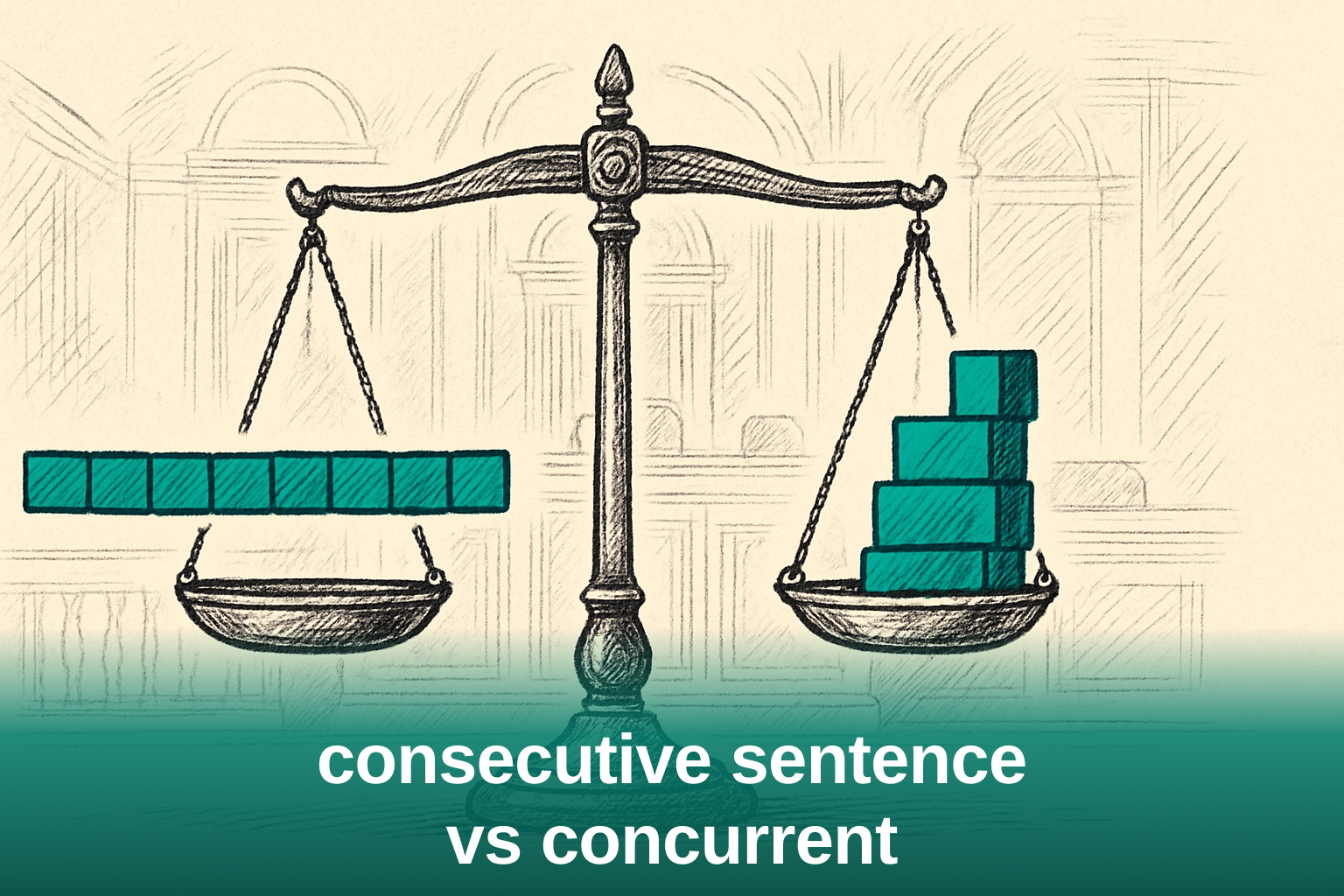

A concurrent sentence means a defendant serves multiple prison terms simultaneously, with release determined by the longest single sentence. A consecutive sentence means terms are served one after another, so the total time equals the sum of all sentences. Choosing between a consecutive sentence vs concurrent structure can alter a prison release date by years or even decades.
A concurrent sentence requires a defendant to serve multiple terms at the same time, resulting in release after the longest term. A consecutive sentence stacks terms sequentially, making the total equal to the sum of all sentences. Judges weigh aggravating and mitigating factors, state statutes, and federal guidelines when deciding between the two.
Imagine standing before a judge on two separate charges. One decision—barely a few words in the courtroom—could mean the difference between serving three years or serving ten. That is the real-world weight of the consecutive sentence vs concurrent distinction, a concept that confuses defendants and families alike.
This article breaks down exactly how each sentence type works, how judges choose between them, and what you can do to protect your future. You will see real calculations, state-specific rules, and practical tips no one else is talking about.
What Is a Concurrent Sentence?
A concurrent sentence allows a person convicted of multiple offenses to serve all imposed prison terms simultaneously rather than one after another. Under this structure, the defendant is released once the longest single sentence has been fully served, while shorter sentences run in parallel. For example, if a judge imposes five years for burglary and three years for theft concurrently, the total time served remains five years. Courts often view concurrent sentencing as the default approach when crimes are related or part of a single criminal episode, such as a burglary where both breaking-and-entering and property theft occurred. The key benefit is clear: the defendant avoids having smaller terms stacked on top of one another, preserving at least a possibility of earlier release. However, concurrent sentencing does not reduce the length of the longest term itself. It merely prevents additional years from being added behind it. For defendants facing multiple charges, securing concurrent terms is usually the single most favorable outcome at sentencing.
What Is a Consecutive Sentence?
A consecutive sentence—commonly called a “stacked sentence”—requires a defendant to finish serving one prison term before the next one begins. Under this arrangement, the total incarceration time equals the sum of every individual sentence imposed. If a person receives five years for robbery and three years for assault as consecutive sentences, the result is eight full years behind bars. Judges typically reserve this harsher structure for crimes that are separate, distinct, or involve aggravating circumstances, such as offenses committed against different victims at different times. The cumulative effect can be staggering. Two sentences of five years and two of eight years, if run consecutively, total twenty-six years—effectively transforming moderate individual penalties into a de facto life sentence. Because the impact is so severe, many defendants and their families underestimate the danger of stacked terms until the judge speaks. Understanding this risk early in a case is essential for anyone facing multiple charges.
Consecutive vs Concurrent: Side-by-Side Comparison

When you place a concurrent sentence beside a consecutive sentence, the structural difference sounds simple, yet the practical consequences are enormous and often life-altering. Concurrent sentences run together like parallel tracks, with release determined by whichever single term is longest, while consecutive sentences line up end-to-end like boxcars, each segment adding length to the overall journey. This distinction matters because the same set of convictions can produce radically different release dates depending on the judge’s choice alone. A defendant who expects to serve only the longest term may suddenly face the sum of every term if the court finds aggravating circumstances. In this section, you will find a clear comparison table that breaks down how each sentence type affects total time served, parole eligibility, good-time credits, and appellate strategy. After the table, detailed real-world calculations demonstrate exactly how years are gained or lost when sentences shift from parallel to stacked.
Key Differences at a Glance
| Parameter | Concurrent Sentence | Consecutive Sentence |
|---|---|---|
| How terms are served | All sentences run simultaneously | Sentences run one after another |
| Total time served | Equal to the longest single sentence | Sum of all individual sentences |
| Default presumption | Common default for related offenses | Used for separate or aggravated crimes |
| Parole eligibility | Set by the longest term; earlier possible date | Delayed until cumulative term is partially served |
| Effect of appeal | Overturning one term may not reduce total time | Overturning one term directly reduces total time |
| Typical judicial view | Standard for connected conduct | Reserved for repeated or predatory behavior |
| Defendant impact | Preserves earliest possible release | Can add years or decades to incarceration |
- Concurrent = longest term controls release.
- Consecutive = every term is added to the total.
- Judges start with concurrent unless facts justify stacking.
- State laws can override judicial discretion and mandate consecutive terms.
Real-World Calculation Examples
Examples
- DUI + Drug Possession: A defendant receives 1 year for DUI and 3.5 years for drug possession. Concurrent result: 3.5 years total. Consecutive result: 4.5 years total.
- Multiple Felonies: Two 5-year sentences plus two 8-year sentences. Concurrent result: 8 years total. Consecutive result: 26 years total.
- Larceny + Attempted Larceny: 20 years for larceny and 5 years for attempted larceny. Concurrent result: 20 years total. Consecutive result: 25 years total.
- Three Nonviolent Offenses: Three 2-year sentences for nonviolent crimes. Concurrent result: 2 years total. Consecutive result: 6 years total.
How Do Judges Decide Between Consecutive and Concurrent Sentences?
The decision to stack or parallel prison terms rests primarily with the sentencing judge, but that power is bounded by statutes, guidelines, and case-specific facts. Most jurisdictions begin with a presumption that related sentences should run concurrently, reflecting the principle that a single criminal episode should not generate punishment beyond what is necessary for retribution and deterrence. However, judges may impose consecutive sentences when they find the crimes were independent, involved separate victims, or were accompanied by aggravating conduct that demands greater accountability. The judge will review the statutory framework, presentence investigation reports, arguments from both the prosecution and defense, and any applicable sentencing guidelines. In some states, the legislature removes discretion entirely and mandates consecutive terms for specific offenses like violent felonies or crimes committed while on parole. For defendants, this means preparation matters: presenting mitigating evidence and persuasive legal arguments can tip the balance toward the more lenient concurrent outcome.
Judicial Discretion and the Default Rule
Federal law and many states presume concurrent sentences unless a statute demands otherwise or the judge exercises discretion to stack. Judges examine whether the crimes are related, such as an attempt and the completed offense, which usually results in concurrent terms. When offenses are independent, like a DUI and a separate drug possession, consecutive sentencing becomes far more likely.
Aggravating Factors That Lead to Consecutive Sentences
Aggravating factors are circumstances that increase the severity of a crime in the eyes of the court. The presence of several factors can strongly push a judge toward stacked sentences. Common aggravating factors include:
- Prior convictions that demonstrate a pattern of criminal behavior.
- Planning or premeditation showing the offense was deliberate.
- Committing a crime in front of a child, which increases societal harm.
- High risk of recidivism based on criminal history or psychological evaluations.
- Use of weapons during the offense.
- Multiple victims or targeting vulnerable populations.
- Organized group activity or gang involvement.
- Pecuniary motives such as financial fraud or profit-driven drug trafficking.
- Exceptional cruelty or violence beyond what the charge requires.
Mitigating Factors That Support Concurrent Sentences
Mitigating factors are circumstances that reduce moral culpability and can persuade a judge to impose concurrent rather than consecutive terms. Effective mitigating arguments often highlight:
- Absence of a criminal record or minimal prior contacts with the law.
- Good character demonstrated through employment, education, or community service.
- Genuine remorse and acceptance of responsibility.
- Duress or coercion that limited the defendant’s free will.
- Youth or advanced age at the time of the offense.
- Minor role in the criminal conduct compared to co-defendants.
- Cooperation with law enforcement during the investigation.
State and Federal Rules on Consecutive vs Concurrent Sentences
While the basic definitions of concurrent and consecutive sentences are consistent across the United States, the rules governing their use vary sharply between federal courts and individual state jurisdictions. Federal law provides a baseline presumption in favor of concurrent sentencing, but it also includes specific guidelines for cases where a defendant already has an undischarged prison term when a new sentence is imposed. Meanwhile, state legislatures have created a patchwork of mandatory consecutive rules, statutory caps, and judicial discretion standards that can dramatically change the outcome of a case. A defendant in Illinois may face mandatory stacking for certain violent felonies, while a defendant in Wisconsin benefits from broader judicial discretion. Understanding whether you are in federal court or state court—and which state—is therefore one of the first and most consequential questions a defense attorney must answer.
Federal Sentencing Guidelines (§5G1.3)
The Federal Sentencing Guidelines, specifically §5G1.3, govern how federal judges impose sentences when a defendant already has an undischarged term of imprisonment. Under this provision, the court must decide whether the new sentence will run at the same time as the existing one or begin only after the prior sentence ends. The guideline generally favors concurrent sentencing when the new offense is factually related to the earlier conduct. However, the judge retains limited discretion to depart from the presumption if compelling reasons exist. The U.S. Sentencing Commission provides authoritative resources interpreting these calculations.
State-Specific Mandatory Consecutive Rules
States are free to craft their own mandatory rules, and the differences are significant. Illinois requires consecutive sentences for first-degree murder, certain Class X felonies involving severe bodily injury, and specific sexual assaults against children. Utah imposes a 30-year aggregate cap on consecutive sentences unless the offense authorizes death or life imprisonment; moreover, any offense committed while in prison or on parole generally must run consecutively. Wisconsin grants judges broad discretion without strict mandatory stacking requirements in most cases.
Impact of Consecutive vs Concurrent Sentences on Prison Time
The distinction between concurrent and consecutive sentencing is not merely a technical legal nuance; it reshapes every stage of a defendant’s incarceration and post-release life in profound ways. A concurrent term keeps the release date anchored to the longest single sentence, which in turn affects parole hearings, good-time credit calculations, and family reunification timelines. A consecutive term pushes that date further into the future, often compounding the emotional and financial strain on loved ones who must wait years longer for reunification. Beyond the immediate prison walls, the stacking of sentences can alter probation conditions, increase vulnerability to violations, and even change the strategic value of an appeal. Defendants who understand these ripple effects before sentencing are better equipped to assist their counsel, set realistic expectations, and make fully informed decisions about plea offers.
Parole Eligibility and Early Release
Parole boards calculate eligibility based on the total sentence structure. Under concurrent terms, eligibility is tied to the longest sentence, allowing an earlier hearing date. Under consecutive terms, the board must account for the cumulative total, which can delay eligibility by many years.
Probation Violations and Cumulative Effects
A defendant serving consecutive sentences faces a hidden danger: violating probation on one sentence can trigger consequences across all stacked terms. If a person serving four consecutive sentences violates probation on the first day, the violation may extend every sentence in the stack. For concurrent sentences, a violation typically affects only the specific term involved.
Appeal Options
Consecutive sentences generally provide more opportunities for appellate relief because of their cumulative nature. If an appeals court overturns or reduces even one sentence, the total time drops accordingly. With concurrent sentences, overturning a shorter term may not change the release date if the longest sentence remains intact.
Common Mistakes to Avoid When Understanding Sentencing
Misconceptions about sentencing law can cost defendants years of freedom and lead to devastating strategic errors at the worst possible moment. Many people assume that concurrent sentences automatically cut total incarceration in half, or they believe a judge can freely ignore mandatory state statutes and impose whatever structure seems fair in the moment. These dangerous myths lead to poor plea decisions, inadequate trial preparation, and missed opportunities to argue for a significantly more favorable outcome. In reality, sentencing is governed by a complex web of default rules, mandatory stacking laws, and discretionary judicial factors that differ sharply from one jurisdiction to another. Recognizing the most common errors before your hearing can help you ask smarter questions, avoid costly assumptions, and work far more productively with your own defense attorney before it is too late.
Mistake: Assuming Concurrent Means Half the Time
Some defendants think a concurrent sentence reduces each term by fifty percent. In reality, you serve the full longest term while the shorter terms run alongside it.
Mistake: Confusing Concurrent with Suspended Sentences
A suspended sentence places the defendant on probation instead of active prison. Concurrent terms still require incarceration during the period of the sentence.
Mistake: Believing Judges Have Unlimited Freedom
Many states enforce mandatory consecutive sentencing for specific offenses. No amount of judicial sympathy can override a clear legislative mandate.
Mistake: Ignoring the Danger of New Charges While Incarcerated
Committing an offense while in custody or on parole often triggers automatic stacking under laws like those in Utah.
Mistake: Overlooking Good-Time Credit Differences
Some jurisdictions apply good-time credits differently when sentences are stacked rather than parallel. The total reduction can be smaller under consecutive terms.
Practical Tips for Defendants Facing Multiple Charges
Facing multiple criminal charges is one of the most stressful experiences a person can endure, but strategic decisions made early in the process can significantly affect the final sentence and long-term consequences. Defendants who truly understand the mechanics of concurrent and consecutive terms can work more effectively with their attorneys to shape plea negotiations, gather persuasive mitigating evidence, and prepare thoroughly for the sentencing hearing. The goal is never to manipulate the system, but rather to ensure the court sees the full context of your conduct, your personal background, and your genuine potential for rehabilitation. Every character reference you collect, every program you complete, and every argument your lawyer makes can nudge the outcome toward a concurrent structure that preserves your future and minimizes unnecessary harm to your family and your community.
- Step 1: Never accept a plea bargain without asking your attorney whether the sentences will run concurrently or consecutively. This single term changes your release date.
- Step 2: Request that your lawyer negotiate a written plea agreement specifying concurrent sentences if the facts support it.
- Step 3: Gather mitigating evidence such as volunteer records, employment references, and rehabilitation program certificates to present to the court.
- Step 4: If you are already serving a sentence and face new charges, contact counsel immediately—federal §5G1.3 issues are complex and time-sensitive.
- Step 5: Demonstrate remorse and stability at sentencing; your demeanor can influence the judge’s assessment of your character.
- Step 6: Research your state’s aggregate sentence limits. For example, Utah caps consecutive terms at 30 years in most cases.
How to Read Your Sentencing Order
After the judge speaks, the court enters a formal document called the judgment and commitment order, and this paper—not the oral remarks—controls when you are actually released. Many defendants scan this order quickly and miss the single sentence that dictates whether their sentences run concurrently or consecutively. Look for phrases such as “to run concurrently with” or “to run consecutively to” preceding each count number. If the order states that Count Two runs concurrently with Count One, those terms overlap; if it says consecutively, Count Two begins only after Count One ends. You should also verify the date from which each sentence is calculated, as clerical errors can shift your release date by months. If the language is ambiguous, your attorney can file a motion for clarification before you leave the courtroom. Understanding this document is the final step in knowing exactly how much time you will serve.
Frequently Asked Questions
A consecutive sentence requires a defendant to serve time for each offense one after another, with terms added together. A concurrent sentence allows all sentences to run at the same time, with release occurring after the longest single term.
For a defendant, a concurrent sentence is almost always better because it results in release after the longest single term. A consecutive sentence significantly extends incarceration by stacking each term.
Yes. A judge can impose a mixed structure where some counts run concurrently with each other but consecutively to other counts. This creates a partial stacking effect.
In many states, including Utah, an offense committed while on parole or in prison generally must run consecutively to the original sentence unless the judge specifically orders otherwise.
Yes. Consecutive sentences delay parole eligibility because the total term is longer. Concurrent sentences allow parole consideration based on the longest single term.
“Stacked sentences” is a colloquial term for consecutive sentences. It describes the way individual terms are piled on top of one another, increasing the total time served.
Yes. Defense counsel can negotiate a plea agreement that includes a recommendation or binding term for concurrent sentencing. This is a key strategy in multi-charge cases.
Final Verdict: Consecutive vs Concurrent — Which Is Better?
For defendants facing multiple charges, a concurrent sentence is almost always the more favorable outcome. It allows all sentences to be served simultaneously, resulting in release after the longest single term. A consecutive sentence stacks terms, potentially adding years or decades to incarceration. While judges retain significant discretion, understanding aggravating factors, state mandatory rules, and federal guidelines empowers defendants to participate actively in their own defense. If you or a loved one is facing multiple charges, consult an experienced criminal defense attorney who can argue for the structure that best protects your freedom.