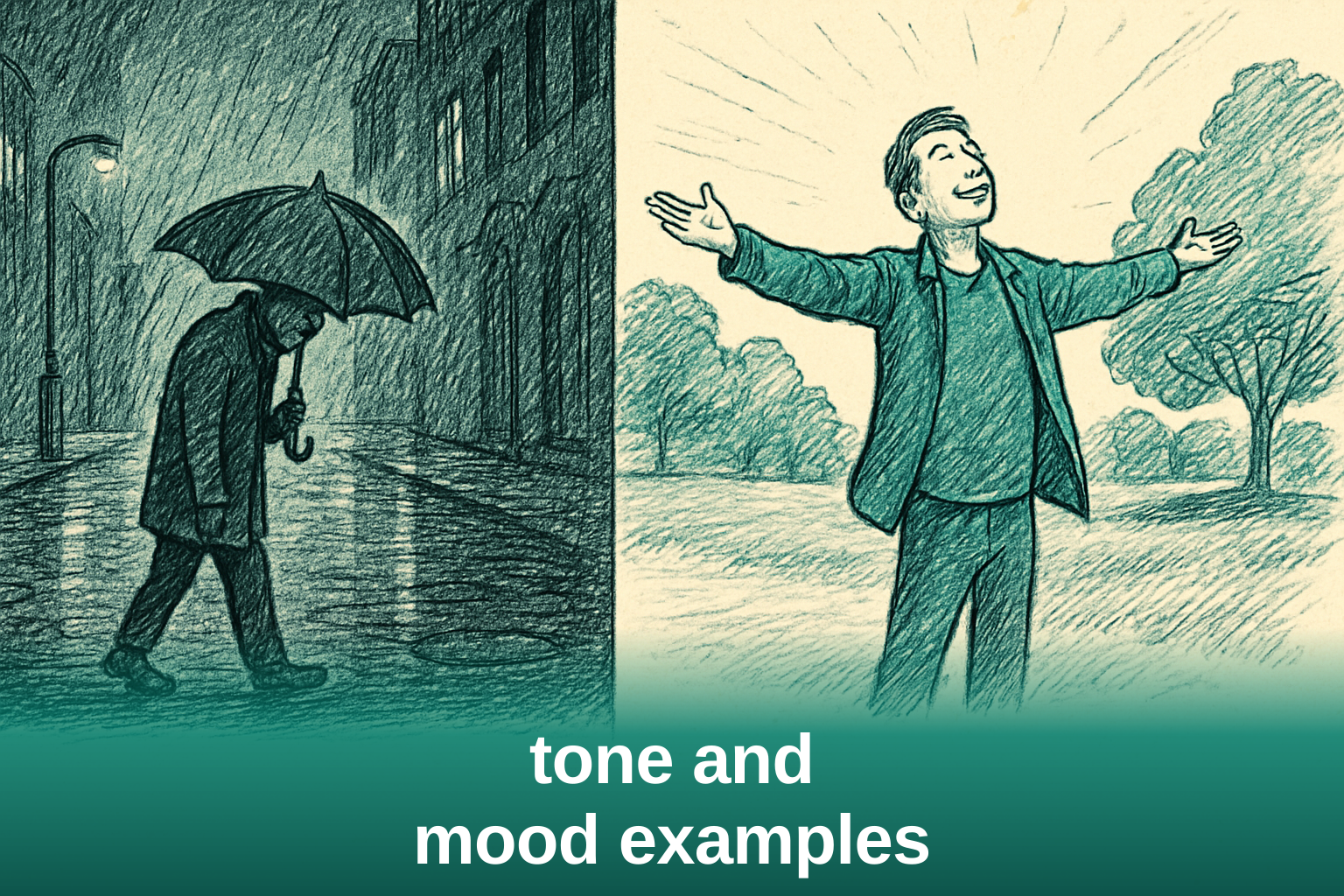

Tone is the author's attitude toward the subject, conveyed through word choice and style. Mood is the emotional atmosphere that surrounds the reader, built from setting, imagery, and sound. While tone belongs to the writer, mood lives in the audience's response.
Most readers finish a chapter feeling shaken without knowing why. They blame the plot, but the real engine is the author's attitude and the surrounding atmosphere. Tone and mood examples separate these two essentials: tone is the author's attitude, while mood is the reader's feeling. This guide delivers more than twenty-five clear samples from literature, poetry, film, and music so you can spot each device with confidence.
Tone reflects the author's or narrator's attitude toward a subject, revealed through diction, syntax, and point of view. Mood reflects the emotional response felt by the reader, shaped by setting, imagery, and atmosphere. Together they control how a story is perceived and experienced.
What Is the Difference Between Tone and Mood?
Every student of literature eventually hits the same wall: two words that sound interchangeable but point to entirely different mechanics. Tone is the writer's emotional stance—an attitude projected through vocabulary, sentence rhythm, and perspective. Mood is the sensory envelope that wraps around the reader, generated by shadows, sounds, and symbolic details. Think of tone as the narrator's facial expression and mood as the weather inside the room where you read. One originates with the creator; the other settles inside the audience. Understanding this boundary matters because misreading tone leads to misinterpreting theme, while ignoring mood flattens the emotional depth of a scene. The fundamental rule is that tone belongs to the author and mood belongs to the reader. Whether you are analyzing a gothic novel or a pop song, recognizing who owns the attitude and who feels the atmosphere separates casual reading from sharp criticism. The following definitions break each concept into concrete traits you can identify immediately.
Tone Definition: The Author's Attitude
Tone lives in the language decisions a writer makes. It answers the question, "How does the author feel about this topic?" A passage describing a funeral might adopt a solemn, respectful tone, while another might treat the same event with bitter irony. Key indicators include formal versus casual diction, positive versus negative connotations, and the use of figurative language. When Jonathan Harker writes in his journal with trembling hesitation, we sense Bram Stoker's fearful tone. When a blogger writes "do you have a sec?" the tone is casual and friendly; shift to "we need to talk" and the tone turns ominous. Tone is always owned by the voice telling the story, never by the reader reacting to it.
Mood Definition: The Reader's Feeling
Mood is the emotional residue left on the reader after absorbing a scene. It answers the question, "How does this text make me feel?" Unlike tone, mood depends heavily on setting, sensory imagery, pacing, and cultural associations. A dark corridor, a sudden silence, and the scent of rain can merge into a mood of dread even when the narrator's tone remains clinical. Mood is subjective: one reader feels nostalgic during an autumn description while another feels melancholy. Because mood lives in the audience, it can shift with context and personal memory. The most powerful moods are built from concrete details that bypass the intellect and strike the senses directly.
Tone vs. Mood: A Quick Comparison Table
| Feature | Tone | Mood |
|---|---|---|
| Definition | The author's attitude toward the subject | The reader's emotional response to the text |
| Belongs to | Writer / Narrator | Audience / Reader |
| Created by | Diction, syntax, point of view | Setting, imagery, atmosphere |
| Answers the question | How does the author feel about this? | How does this make me feel? |
| Example words | Sarcastic, formal, nostalgic, bitter | Suspenseful, gloomy, joyful, eerie |
Tone and Mood Examples in Literature
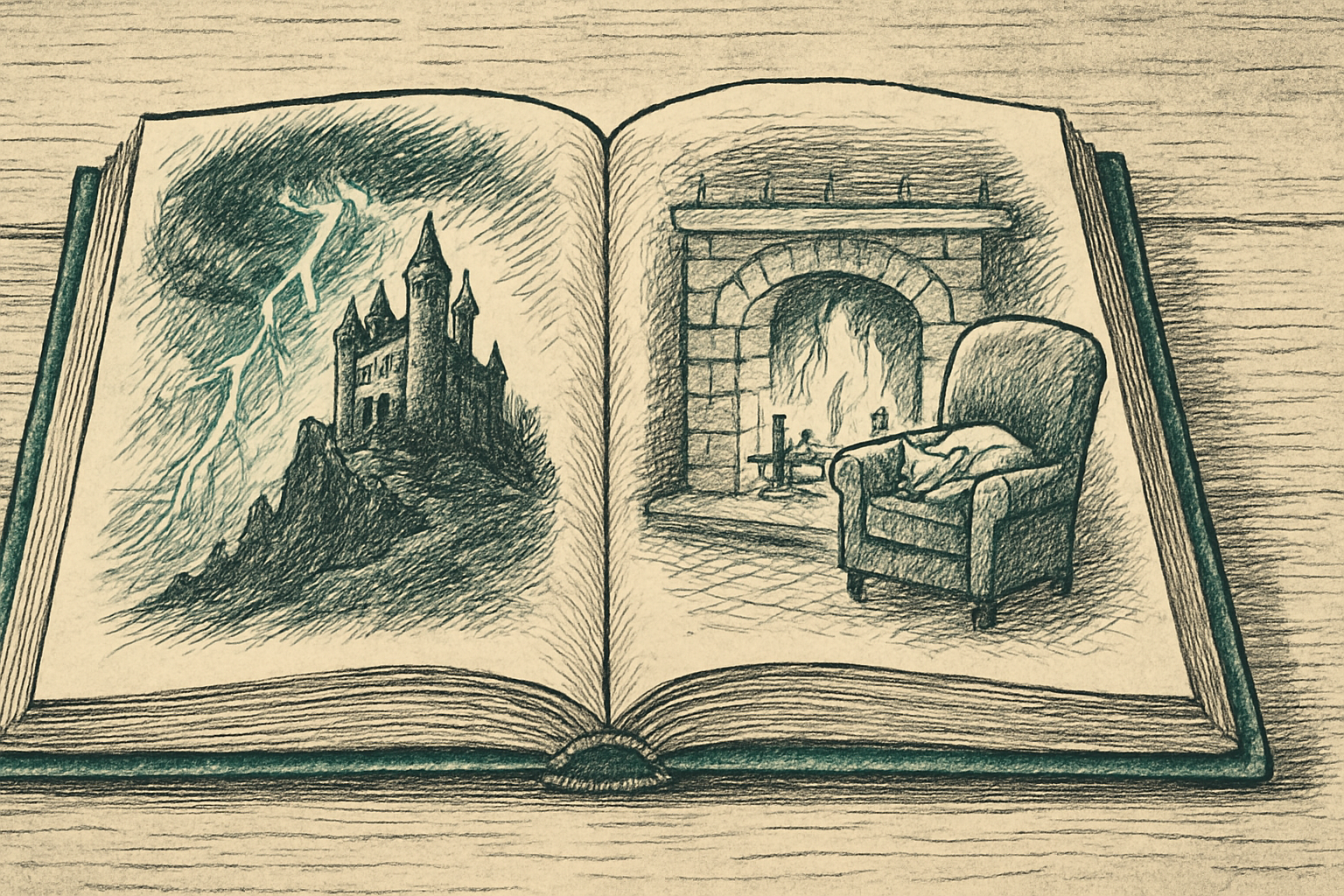
Classic novels provide the richest laboratory for studying tone and mood because long-form fiction gives both devices room to evolve across hundreds of pages. In literature, tone often emerges through a narrator's lexical habits—do they linger on grotesque details or skim past them with detached brevity? Mood, meanwhile, accumulates through setting descriptions, weather patterns, and the physical reactions of characters who inhabit the scene. When tone and mood align, the effect is immersive and hypnotic; when they clash, the result can be irony, horror, or black comedy. The following three examples from Bram Stoker, Anne Rice, and William Goldman illustrate both harmony and tension between the author's attitude and the reader's emotional response. Each passage shows how a single scene can be decoded through two separate lenses, giving you a practical blueprint for your own analysis and classroom discussion.
Tips
- Look for word choice of the narrator to pinpoint tone.
- Notice setting and weather details to identify mood.
- Ask whether the narrator attitude matches your emotional response.
- Track both elements across chapters to spot shifts.
Example 1: When Tone and Mood Match (Dracula by Bram Stoker)
In Bram Stoker's Dracula, Jonathan Harker's journal entries demonstrate perfect alignment between tone and mood. When Harker writes, "I did not sleep well… There was a dog howling all night under my window," his tone is apprehensive and fearful. The mood matches this attitude because the reader feels disoriented by the foreign setting and threatened by the nocturnal sounds. Harker's physical thirst—"I had to drink up all the water" but "was still very thirsty"—adds a primal unease that deepens the gloomy atmosphere. Because the narrator's attitude and the reader's feeling move in the same direction, the scene feels claustrophobic and inevitable.
Example 2: When Tone and Mood Clash (Interview with the Vampire by Anne Rice)
Anne Rice's Interview with the Vampire offers a textbook case of deliberate discord. The vampire Louis speaks with a tone of "quiet ease," calmly recounting centuries of violence as if discussing weather. However, the mood of the scene is terrified, conveyed through the journalist's physical reactions: he "shuddered," "recoiled," and felt "cold sweat running down the side of his face." The gap between the vampire's calm tone and the journalist's horror creates dramatic irony that keeps the reader unsettled. This example proves that multiple tones can coexist in one scene, and mood often depends on which perspective the audience adopts.
Example 3: Tone and Mood in The Princess Bride by William Goldman
William Goldman's The Princess Bride shifts tone and mood rapidly. In the frame narrative, the tone is sardonic and introspective: "I wandered through December snows, longer than the month itself." The narrator's attitude is detached and slightly cynical. In contrast, during the Buttercup rescue scene, the mood is chaotic heartbreak: "Buttercup ran. She whirled and burst away and the tears came bitterly; she could not see, she stumbled, she slammed into a tree trunk, fell, rose, ran on." Goldman uses fragmented syntax and visceral language to create a mood that outpaces the narrator's ironic tone.
Tone and Mood Examples in Poetry
Poetry compresses language into its most concentrated form, which makes tone and mood especially visible on the page. Because poets have fewer words than novelists, every syllable carries emotional weight, and a single line break can shift the atmosphere entirely. The speaker's attitude—whether reverent, playful, or resigned—becomes the tone, while the images, sounds, and rhythms stir the reader's mood. These compact forms demand that readers slow down, making the emotional architecture impossible to ignore. The following examples from Robert Frost and Shel Silverstein demonstrate how meter, rhyme, and diction create distinct emotional experiences. Frost's reflective seriousness contrasts sharply with Silverstein's exaggerated humor, proving that tone and mood are not locked to genre but shift according to the poet's intent and the reader's imagination.
Mnemonic
Tone is how the author TALKS; Mood is how you MOVE while reading. If the writer sounds bitter, that is tone. If you feel shivers, that is mood.
Example 4: "The Road Not Taken" by Robert Frost
Frost's speaker adopts a reflective, serious tone: "Two roads diverged in a yellow wood, / And sorry I could not travel both." The diction is measured and contemplative, suggesting a mind weighing consequences. The mood, however, is sparsely melancholic with a lingering note of hope. The "yellow wood" and "leaves no step had trodden black" evoke autumnal transition, leaving the reader suspended between regret and quiet affirmation. The poem's enduring power comes from this balance of solemn tone and wistful mood.
Example 5: "Sick" by Shel Silverstein
In "Sick," the tone is playfully dramatic: "I cannot go to school today, / Said little Peggy Ann McKay." Silverstein piles hyperbole upon hyperbole, from "my tonsils are as big as rocks" to "my tongue is covered up with hair." The mood is light, humorous, and affectionate. The reader smiles not because the situation is realistic, but because the speaker's theatrical tone generates a joyful, comic atmosphere.
Tone or Mood: Which One Should You Analyze First?
When you open a new text, the simultaneous presence of voice and atmosphere can feel overwhelming. Many readers wonder whether they should hunt for the author's attitude first or sink into the emotional atmosphere. The answer depends on your analytical goal. If you are writing an academic essay, starting with tone gives you an anchor because it is embedded in word choices and syntactic patterns that can be quoted directly. If you are reading for pleasure or teaching younger students, beginning with mood is often more intuitive because it relies on immediate gut feeling rather than technical vocabulary. However, the two are inseparable: identifying a sarcastic tone early will prime you to feel tension, and noticing a peaceful mood will clue you into the narrator's contentment. Use tone as the map and mood as the territory. Train yourself to mark diction for tone and imagery for mood on your first pass, then compare your notes.
Consider a political speech: the speaker's tone might be urgent and rallying, but your mood could be skeptical depending on the setting and your own beliefs. Alternatively, a nature documentary narrator might keep a neutral, matter-of-fact tone while underwater cinematography leaves you feeling serene and small. Neither starting point is wrong. What matters is that you eventually examine both layers so your analysis does not confuse the speaker's intent with your own reaction.
Tone and Mood Examples in Film and Music
Literary concepts do not stay on the page; they migrate into every storytelling medium that uses language, image, or sound. In film and music, tone is carried by directorial choices, performance style, and lyrical perspective, while mood is orchestrated through lighting, sound design, and melody. A horror director might maintain a detached, almost clinical tone while bombarding the viewer with shadows and dissonant chords to produce anxiety. A songwriter might write earnest lyrics in a major key, creating a tone of sincerity and a mood of uplift that carries the listener forward. These multisensory examples make tone and mood tangible because you can literally hear and see them at work. The next two examples explore how setting constructs mood in cinema and how music separates the artist's attitude from the listener's emotional journey.
Example 6: Creating Mood with Setting in Film
In Stanley Kubrick's The Shining, the Overlook Hotel is presented through a detached, observational tone: the camera simply records long corridors and geometric carpets. Yet the mood is deeply frightening because the setting is isolated, the lighting is unnaturally bright, and the silence feels loaded. The director's calm tone makes the horrifying mood feel inescapable, as if the terror were objective fact rather than fiction. This shows that mood can dominate even when the tone refuses to participate emotionally.
Example 7: How Music Separates Tone from Mood
Music offers perfect illustrations of tone and mood operating independently. Connie Talbot's rendition of "Let It Be" carries a calm, reflective tone—an attitude of gentle acceptance toward adversity. Yet one listener might feel peaceful while another feels nostalgic. Similarly, Demi Lovato's "Let It Go" projects an empowered, bold tone, but the mood it generates could be liberating for one person and melancholic for another who associates the song with loss. These songs prove that tone is fixed by the artist's delivery, while mood remains the listener's private territory.
Tone and Mood Examples in Sentences
Sometimes the clearest way to grasp an abstract distinction is to watch it operate at the sentence level before scaling up to paragraphs and chapters. A single clause can shift from neutral to hostile just by swapping one verb, and a short sentence can feel ominous while a long, flowing one feels soothing. By isolating tone and mood in miniature, you strip away plot complexity and see the raw machinery of language without distraction. The following ten sentence pairs demonstrate how authors engineer attitude and atmosphere word by word. Each pair presents a neutral baseline, then a revised version that injects a specific tone or mood. Study these micro-examples before you tackle full novels, and you will develop an instinct for spotting emotional cues in any paragraph you encounter on the page.
10 Sentence Pairs Showing Tone vs. Mood
Examples
- Neutral vs. Sarcastic Tone: "The meeting started on time." vs. "Miraculously, the meeting started on time, and nobody fainted from shock." The second sentence mocks the rarity of the event.
- Neutral vs. Tense Mood: "She walked down the hall." vs. "She crept down the narrow hall, her breath shallow in the silence." The second version builds anxiety through sensory detail.
- Formal vs. Casual Tone: "I request your immediate assistance." vs. "Hey, can you give me a hand?" Diction alone redefines the relationship between speaker and listener.
- Joyful vs. Gloomy Mood: "Sunlight filled the kitchen." vs. "Weak sunlight filtered through the dirty kitchen window." Adjectives and filtering verbs drain the energy from the scene.
- Optimistic vs. Cynical Tone: "The project will succeed." vs. "Sure, this project will 'succeed,' just like the last three did." Scare quotes and comparison flip the attitude completely.
- Mysterious Mood: "A note sat on the table." vs. "A crumpled note lay on the dusty table, its ink smeared and unreadable." Physical decay invites curiosity and unease.
- Neutral vs. Angry Tone: "I disagree." vs. "I have never heard such a ridiculous claim in my life." Hyperbole transforms polite dissent into outrage.
- Peaceful Mood: "The lake was still." vs. "The lake lay motionless beneath a silver dawn, not even a ripple daring to disturb it." Personification amplifies the hush.
- Nostalgic Tone: "I visited my old school." vs. "I wandered through those familiar hallways, and every locker seemed to whisper my name." The verb choice and metaphor reveal longing.
- Frightening Mood: "The door opened." vs. "The door groaned open, and a cold breath spilled into the room." Auditory and thermal details trigger fear.
Tone and Mood Word Lists
Even when you understand the theory, finding the right label for an author's attitude or a scene's atmosphere can stall your analysis and frustrate your writing process. Vocabulary lists bridge that gap by giving you precise adjectives for the job, turning vague impressions into arguable claims. The following tables organize more than fifty tone words and fifty mood words into emotional categories. Rather than memorizing every term, treat these lists as reference tools you can scan while reading or revising your own drafts. When a passage feels negative but you cannot name the flavor, glance at the tone list and decide whether the author sounds bitter, cynical, or merely solemn. When a chapter leaves you restless, check the mood list to see if the atmosphere is tense, suspenseful, or ominous. Expanding your descriptive vocabulary sharpens both academic essays and creative drafts because specificity creates clarity.
50+ Tone Words to Describe an Author's Attitude
- Positive: optimistic, hopeful, joyful, playful, sincere, affectionate, amused, approving, benevolent, calm, complimentary, encouraging, excited, friendly, gentle, grateful, happy, kind, loving, passionate, proud, relaxed, respectful, reverent, sympathetic, tender, warm
- Negative: angry, annoyed, bitter, critical, cynical, disdainful, fearful, hostile, ironic, mocking, pessimistic, sarcastic, scornful, severe, threatening, apathetic, belligerent, condescending, disgusted, embarrassed
- Neutral / Formal: formal, objective, matter-of-fact, simple, scholarly, clinical, detached, impartial, informative, serious, bureaucratic, journalistic, legalistic, reserved, technical
- Other: nostalgic, reflective, humorous, dramatic, intimate, morbid, flippant, ambiguous, urgent, apologetic, confessional, contemplative, eccentric, ironic, speculative
50+ Mood Words to Describe a Reader's Feeling
- Positive: joyful, peaceful, hopeful, romantic, uplifting, content, cheerful, ecstatic, elated, excited, happy, jubilant, lighthearted, loving, pleasant, satisfied, serene, thankful, triumphant, vibrant
- Negative: gloomy, frightening, suspenseful, melancholic, tense, anxious, depressed, desperate, devastated, distressed, dreadful, eerie, foreboding, grim, hopeless, hostile, lonely, miserable, morbid, mournful, nervous, ominous, somber, sorrowful, threatening, uneasy
- Neutral / Atmospheric: mysterious, dreamy, nostalgic, calm, contemplative, hypnotic, meditative, pensive, quiet, reflective, restless, serene, tranquil, whimsical, airy, bucolic, ethereal, hushed, nocturnal, surreal
How to Identify Tone and Mood in Any Text
Recognition is a skill, not a gift, and like any skill it improves with deliberate practice and the right set of questions. The process begins by separating the narrator's voice from your own reaction. If you feel sad, that is mood; if the narrator sounds sad through word choice, that is tone. To move beyond gut instinct, you need systematic checkpoints that force you to examine textual evidence rather than rely on first impressions. The five questions below for tone focus on diction, figurative language, and point of view, while the five questions for mood target setting, sensory detail, and pacing. Master these questions, and you will stop guessing and start arguing from proof. The final subsection addresses the most frequent misconceptions that trick even experienced readers, so you can avoid the classic trap of saying the tone is sad simply because you felt sad while reading.
5 Questions to Ask About Tone
- Step 1: What is the author's attitude toward the subject? Look for loaded adjectives and figurative language that reveal bias or emotion.
- Step 2: Are the words positive, negative, or neutral? Highlight connotations to see whether the diction praises, criticizes, or merely observes.
- Step 3: What feeling do the author's descriptions suggest? A narrator who lingers on decay may hold a pessimistic or morbid tone.
- Step 4: Is the narrator's voice formal or casual? Slang creates intimacy; Latinate diction creates distance and authority.
- Step 5: Does the tone shift at any point? A sudden change from humor to gravity often signals thematic importance.
5 Questions to Ask About Mood
- Step 1: How does this scene make me feel? Trust your initial physical reaction—tight chest, calm breath, or restless energy.
- Step 2: What words or images create that feeling? Note sensory details and symbolic objects that trigger emotion.
- Step 3: How does the setting contribute to the mood? Weather, lighting, and geography are often the primary engines of atmosphere.
- Step 4: Does the mood change as the story continues? Track emotional arcs across chapters or stanzas to see the full design.
- Step 5: Would different readers feel the same way? Acknowledge subjectivity; mood is personal and culturally influenced.
Common Misconceptions to Avoid
- Confusing tone with mood. Saying "the tone is sad because I felt sad" collapses the author's attitude into your reaction. Check the text for evidence of the narrator's stance first.
- Choosing emotions instead of attitudes. "Sad" is a mood; "mournful" or "cynical" is a tone. Tone must describe the speaker's posture, not the reader's tearfulness.
- Ignoring word choice. If you are not examining diction, you are guessing. A single verb can invert tone from respectful to mocking.
- Assuming tone never changes. A novel may open with sarcasm and close with sincerity. Track shifts carefully across the narrative.
- Thinking mood is universal. Not every reader feels dread during a storm scene; cultural background and personal memory color emotional response.
Difference Between Tone and Mood Examples in News and Social Media
Literary analysis is not confined to novels and poems; it thrives anywhere language tries to persuade, inform, or entertain a mass audience. News headlines, tweets, and brand slogans all manipulate tone to signal attitude, while they rely on imagery and context to generate mood. A journalist covering a protest might adopt an objective, detached tone, yet the selected photographs, punctuation, and word order can leave readers feeling anxious or indignant. A wellness influencer might write with an encouraging, empathetic tone, but the filtered sunset backdrop creates a dreamy, aspirational mood. Recognizing these layers protects you from manipulation and improves your own digital communication. The following examples show how tone and mood diverge in short-form nonfiction, giving you a practical lens for everything from workplace email etiquette to viral content marketing.
Consider the headline: "Market Sees Moderate Adjustment." The tone is neutral and scholarly. Yet if the article runs beneath a photo of panicked traders, the mood becomes alarming. In a corporate email, the phrase "Per my last email" carries a sharp, irritated tone, while the reader's mood might shift from productive to defensive. These everyday examples prove that tone and mood are not classroom abstractions; they are tools of daily persuasion.
How to Use Tone and Mood in Your Own Writing
Understanding tone and mood elevates you from passive reader to active architect of experience, which is the single most important leap a developing writer can make. Every story you tell—whether flash fiction, a college essay, or a screenplay—benefits from conscious emotional design that guides the audience without lecturing them. Controlling tone means choosing words that broadcast your attitude without sermonizing. Shaping mood means staging environments that make your audience feel before they think. The devices that govern tone operate at the micro level: a single adjective can tilt a sentence from neutral to scathing. The elements that govern mood work more broadly: a storm rolling in, a recurring melody, or a whispered secret can color an entire chapter. The following subsections break down three tone devices and three mood elements, each paired with exercises you can apply to your current draft immediately.
3 Devices That Enhance Tone: Diction, Syntax, Context
Diction is your word choice. Compare "Do you have a sec?" with "We need to talk." Both request attention, but the former is casual and friendly while the latter is ominous and commanding. Syntax controls rhythm through sentence length. Short fragments create panic: "Darkness. Silence. Then, a scrape." Long, flowing compound-complex sentences create contemplation: "As the sun dipped below the horizon and the last birdsong faded into the cooling air, he finally understood." Context means considering the cultural baggage of your words; a term that sounds witty in one decade may sound offensive in the next.
3 Elements That Heighten Mood: Setting, Theme, Dialogue
Setting is the stage where mood lives. A dark room with drawn curtains creates tension; a sunlit café creates comfort. Theme influences mood by giving the atmosphere moral weight: a war story feels heavier than a vacation story even in quiet scenes. Dialogue can confirm or rupture mood. Whispered secrets amplify tension; unexpected laughter in a funeral scene creates jarring emotional complexity.
Tone and Mood Examples: Key Takeaways
After traveling through literature, poetry, film, music, and sentence-level analysis, the core principles remain simple but easy to forget in the heat of interpretation. Tone belongs to the creator; mood belongs to the audience. One is intentional and embedded in language; the other is emergent and shaped by perception. They can sing in harmony or clash for dramatic effect, and neither is fixed from the first page to the last. The word lists give you vocabulary, the identification questions give you method, and the literary examples give you models. What ties everything together is the habit of reading twice: once for the author's attitude and once for your own emotional response. Keep these summaries nearby when you write or teach. If you remember nothing else, remember that distinction and apply it to every text you meet.
- Tone is the author's attitude; mood is the reader's feeling.
- They can match or clash depending on narrative strategy.
- Tone is built through diction, syntax, and context.
- Mood is built through setting, theme, imagery, and dialogue.
- Both can shift across a single work.
- Use word lists to name what you notice.
- Practice by analyzing one scene from two separate angles.
Frequently Asked Questions
Tone is the author's attitude toward the subject, while mood is the feeling the reader experiences. Tone comes from the writer; mood happens inside the reader.
In a horror story, the tone might be fearful (author's attitude), while the mood is suspenseful (reader's feeling). They often match but can also differ.
Common tone words include optimistic, sarcastic, formal, playful, serious, cynical, hopeful, and nostalgic. These describe the author's attitude.
Common mood words include joyful, gloomy, suspenseful, peaceful, frightening, mysterious, and dreamy. These describe the reader's emotional response.
Look at the author's word choice, imagery, and sentence structure. Ask yourself: "What is the author's attitude toward this subject?"
Pay attention to the setting, atmosphere, and sensory details. Ask yourself: "How does this text make me feel as a reader?"
Yes, they can. For example, a character might speak in a calm tone (author's attitude) while the scene creates a tense mood (reader's feeling).
Wrapping Up: Why Tone and Mood Matter
Mastering tone and mood transforms both how you read and how you write. When you can name the author's attitude and your own emotional response as separate forces, you unlock a deeper layer of meaning in every text. The tools in this guide—from literary examples to sentence-level drills—give you a framework you can apply to classrooms, drafts, and daily media consumption. Start by asking two questions before you turn the page: whose attitude am I hearing, and what atmosphere am I entering?