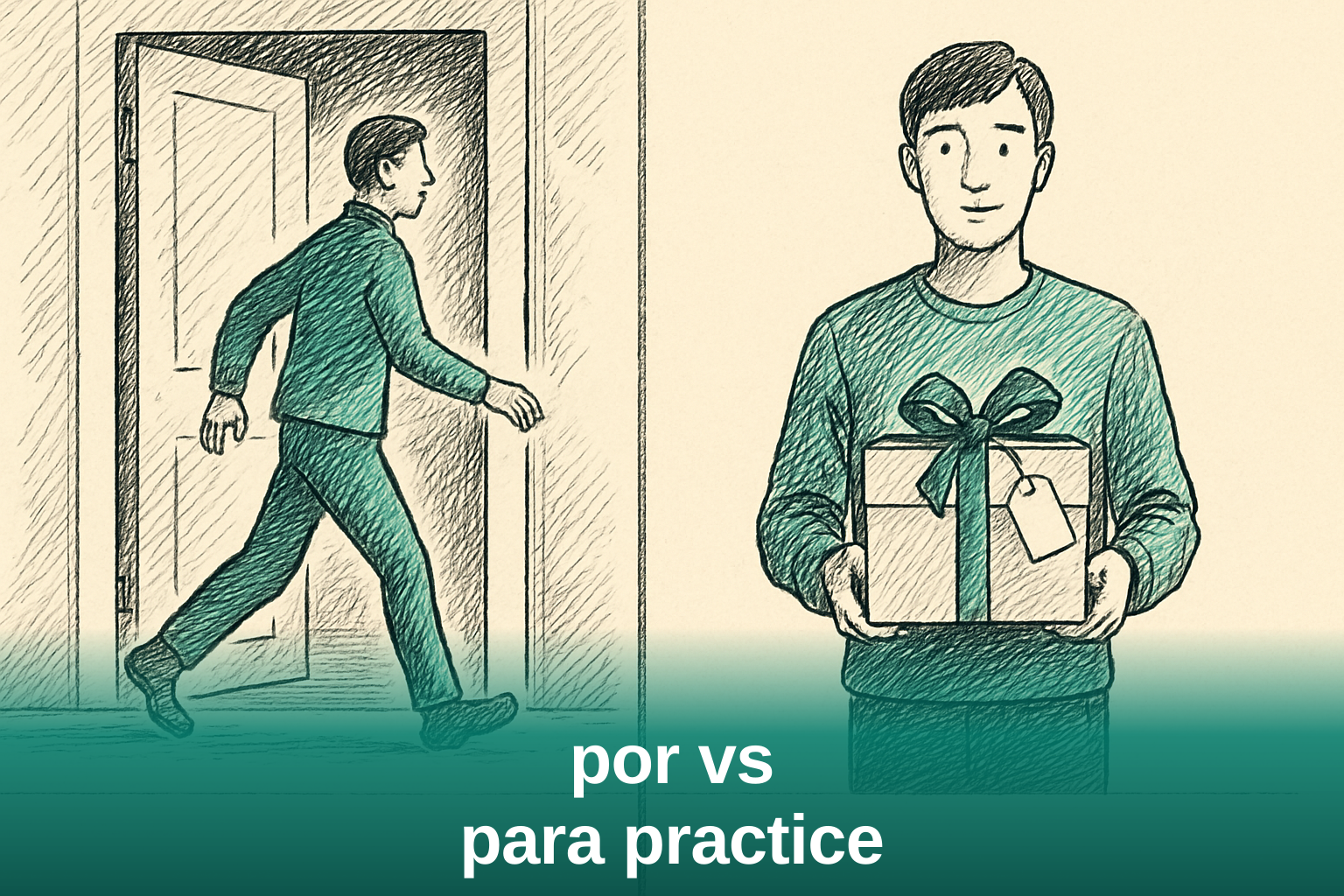

Por and para both translate as “for,” but they split the workload. Use para when you mean purpose, destination, recipient, or deadline. Use por when you mean cause, reason, means, exchange, or duration. This page gives you 60 graded exercises, a 20-question quiz, and a printable PDF so you stop guessing and start speaking with confidence.
Every Spanish learner hits the same wall. You want to say “I did it for you,” and you freeze—is it por ti or para ti? You need to finish a report “for Monday,” and your brain offers para and por at the same time. The confusion is normal: both words often map to a single English preposition. In the next sections, you will get a one-minute memory trick, a quick-reference table, 12 real-life examples, and 60 exercises grouped by rule so you can train each use in isolation before mixing them together.
Por vs para practice starts with a simple split: para points forward to goals, destinations, recipients, and deadlines, while por points backward or around to causes, means, exchange, and duration. Para ti means the person is the recipient; por ti means the person is the reason. Para el lunes sets a deadline; por dos horas measures duration. This page contains 60 structured exercises and a 20-question test with instant explanations.
Must-know memory hook: para points forward (goal, destination, deadline); por points backward or around (cause, means, duration).
Por vs Para in One Minute: The Core Difference
The fastest way to choose between por and para is to imagine a timeline. Para lives in the future. It answers the question “what for?” or “for whom?” and points toward an endpoint. When you say Estudio para el examen, the exam is the target ahead of you. When you say Salgo para Madrid, Madrid is the destination you are heading toward. Para also marks deadlines—Entrega para el viernes—because Friday is the finish line. On the other side, por lives in the past, present, or surrounding space. It answers “why?” or “how?” or “for how long?” Llegué tarde por el tráfico looks back at the cause. Viajamos por España moves through the territory rather than toward a final point. Por tres horas measures duration, and pago por el café covers exchange. This directional split gives you a mental model that survives real conversations. Once you feel this forward-versus-around motion in your gut, the textbook rules become easier to apply under pressure.
Por vs Para Rules in Spanish (Quick-Reference Table)
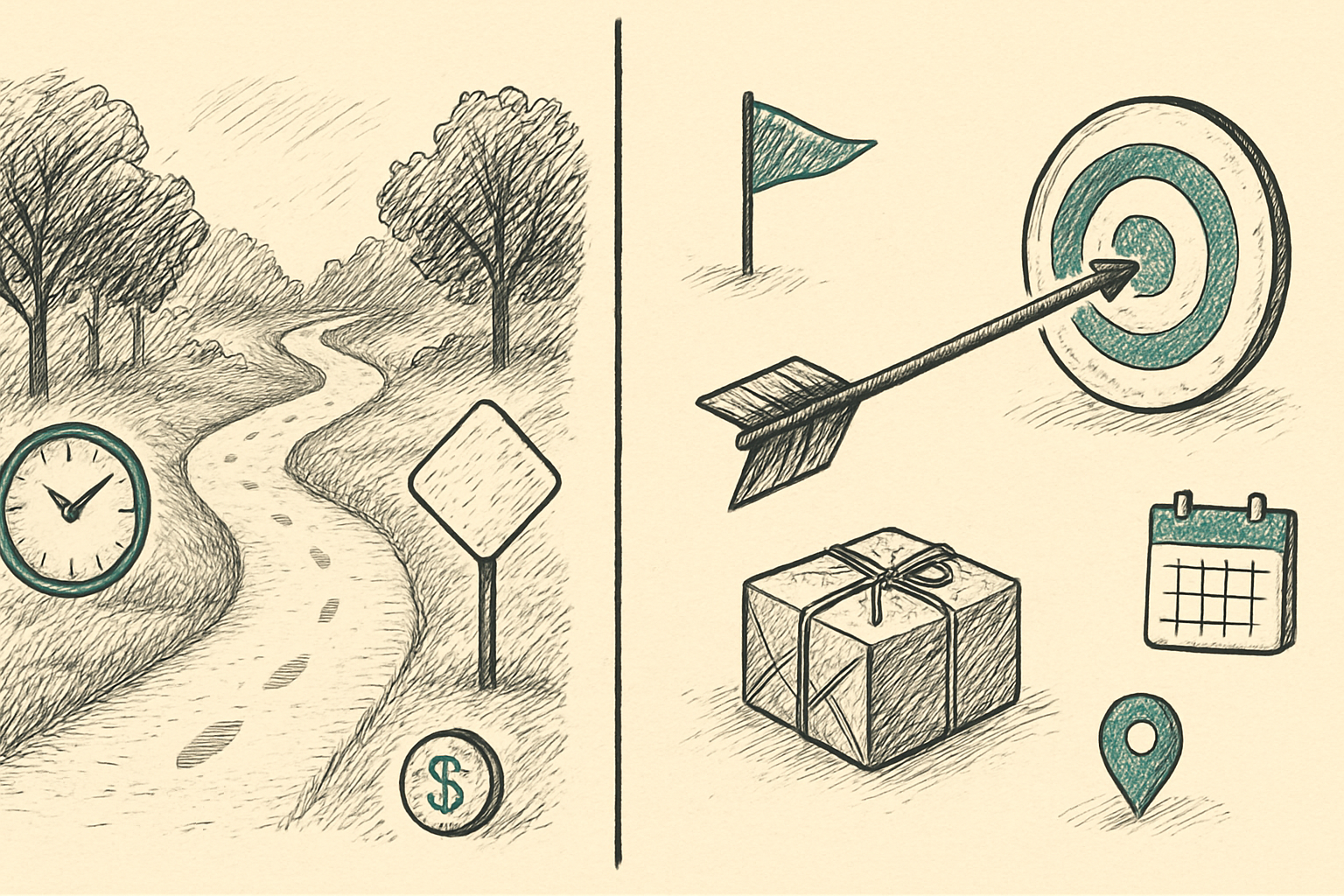
Por and para look like a single preposition in English, but Spanish keeps them separate for a reason. The quickest way to stop mixing them up is to stop translating word-for-word and start matching the situation to the correct category. Por shows up when you are explaining why something happened, how it was done, or how long it lasted. It also covers movement through a space and exchanges of money or goods. Para shows up when you are aiming at a future result, sending something to a destination, giving an object to a recipient, or setting a deadline. If you can label the context as cause, means, or duration, por is your friend. If you can label it as goal, destination, recipient, or endpoint, para is the right choice. The table below turns these categories into a side-by-side reference you can scan in seconds.
| Por — use it for | Para — use it for |
|---|---|
| Cause or reason (because of) | Purpose or goal (in order to) |
| Means of communication or transport (by, via) | Destination (headed to) |
| Exchange or price (in exchange for) | Recipient (for someone) |
| Duration (for a period of time) | Deadline (by a specific time) |
| Movement through or along (through, across) | Opinion (for me, in my view) |
| Frequency (per, times per) | Employment (work for a company) |
| Gratitude or apology (thanks for, sorry for) | Contrast from expectation (for a beginner, you speak well) |
| Agent in passive voice (done by someone) | Use or function (for cutting) |
Keep this table open in a second tab while you work through the exercises. When you hit a blank, ask yourself whether the sentence looks forward to a target or backward to a cause. If it describes an endpoint, deadline, or intended recipient, reach for para. If it explains why something happened, how it traveled, or how long it lasted, reach for por. The table turns guesswork into a two-second decision.
Por vs Para Examples: 12 Sentences You Will Actually Use
Memorizing rules is useful, but your brain anchors grammar through real sentences. The twelve examples below come from daily life—coffee shops, offices, airports, and living rooms—so you can imagine yourself saying them tomorrow. Six sentences use por to show cause, means, exchange, or movement through a space. Six sentences use para to show purpose, destination, recipient, deadline, or opinion. Each example includes a one-line explanation that links the sentence back to the rule it demonstrates, so you are never left guessing. Read them aloud. Notice how para feels like pointing at a future target, while por feels like looking back at a reason or looking around a place. Once these twelve patterns sound natural in your mouth, the sixty exercises that follow will feel less like a test and more like a casual chat.
Examples
- Por: Gracias por tu ayuda. (Thanks for your help.) — Reason for gratitude.
- Por: Te envié el archivo por correo. (I sent you the file by email.) — Means of communication.
- Por: Viajamos por México durante dos semanas. (We traveled through Mexico for two weeks.) — Movement through and duration.
- Por: Lo hice por mi familia. (I did it for my family.) — Motivation/cause.
- Por: Pagué cincuenta euros por la cena. (I paid fifty euros for dinner.) — Exchange/price.
- Por: Camino por el parque todos los días. (I walk through the park every day.) — Movement through.
- Para: Este café es para ti. (This coffee is for you.) — Recipient.
- Para: Estudio español para trabajar en Barcelona. (I study Spanish to work in Barcelona.) — Purpose/goal.
- Para: Salgo para Chile mañana. (I leave for Chile tomorrow.) — Destination.
- Para: Necesito el informe para el lunes. (I need the report by Monday.) — Deadline.
- Para: Para mí, esta película es perfecta. (For me, this movie is perfect.) — Opinion.
- Para: ¿Para qué quieres mi teléfono? (What do you want my phone for?) — Purpose/intention.
Por vs Para Practice: 60 Exercises by Rule
This is the main training ground where rules become reflexes. Sixty sentences are split into seven themed sets so you can isolate each use of por and para and build accuracy before you mix them. Every sentence shows the Spanish with a blank, an English translation in parentheses, the correct answer, and a short explanation. You can work through them in order if you want a full workout, or you can jump straight to the sets that give you the most trouble. Do not rush. The goal is not speed; it is accuracy that survives a real conversation. After you finish a set, read every correct sentence aloud twice. Hearing yourself say the preposition correctly helps lock it into memory far better than silent reading. When you are ready for chaos, Set 7 throws both prepositions into single sentences so you can prove you truly know the difference.
- Step 1: Skim the quick-reference table above to wake up the rules.
- Step 2: Pick one practice set and cover the answer line with your hand.
- Step 3: Read the Spanish sentence aloud, insert por or para, then check the explanation.
- Step 4: Repeat the sentence correctly three times before moving to the next one.
Practice Set 1 — Cause, Reason, and Motivation (por)
Exercises
- Llegué tarde ___ el tráfico. (I arrived late because of the traffic.) por/para → por (Traffic is the cause.)
- Gracias ___ la invitación. (Thanks for the invitation.) por/para → por (Expression of gratitude.)
- Lo hice ___ ti. (I did it for you / because of you.) por/para → por (You are the motivation.)
- Perdón ___ el ruido. (Sorry for the noise.) por/para → por (Apology for a reason.)
- No pude dormir ___ el calor. (I couldn’t sleep because of the heat.) por/para → por (Heat caused the problem.)
- Te admiro ___ tu honestidad. (I admire you for your honesty.) por/para → por (Reason for admiration.)
- Estoy aquí ___ mi hermana. (I am here for my sister / because of my sister.) por/para → por (She is the reason.)
- Lloró ___ la tristeza. (She cried because of sadness.) por/para → por (Sadness is the cause.)
- Lo siento ___ llegar tarde. (I’m sorry for arriving late.) por/para → por (Apology for the action.)
- Me enojé ___ su actitud. (I got angry because of his attitude.) por/para → por (Attitude caused the anger.)
Practice Set 2 — Purpose and Goal (para)
Exercises
- Estudio español ___ trabajar en Madrid. (I study Spanish to work in Madrid.) por/para → para (Work is the goal.)
- Corro ___ mantenerme en forma. (I run to stay in shape.) por/para → para (Staying in shape is the purpose.)
- Te llamé ___ pedirte perdón. (I called you to ask for forgiveness.) por/para → para (The call’s purpose is to apologize.)
- ¿___ qué estudias medicina? (What do you study medicine for?) por/para → Para (Asks about purpose.)
- Compro harina ___ hacer galletas. (I buy flour to make cookies.) por/para → para (Cookies are the intended outcome.)
- Usa este cuchillo ___ cortar el pan. (Use this knife to cut the bread.) por/para → para (Function/purpose of the knife.)
- Viajo ___ conocer nuevas culturas. (I travel to meet new cultures.) por/para → para (Travel’s purpose.)
- Ahorro dinero ___ comprar un coche. (I save money to buy a car.) por/para → para (The car is the goal.)
- Practico cada día ___ mejorar. (I practice every day to improve.) por/para → para (Improvement is the aim.)
- Ella se viste rápido ___ no llegar tarde. (She dresses quickly so as not to arrive late.) por/para → para (Negative purpose: in order not to.)
Practice Set 3 — Destination vs Movement Through (para vs por)
Exercises
- Salgo ___ Chile mañana. (I leave for Chile tomorrow.) por/para → para (Chile is the destination.)
- Viajé ___ Francia y España. (I traveled through France and Spain.) por/para → por (Movement through countries.)
- ¿Vas ___ Madrid este fin de semana? (Are you going to Madrid this weekend?) por/para → para (Madrid is the endpoint.)
- Pasamos ___ el parque camino a casa. (We passed through the park on the way home.) por/para → por (Moving through the park.)
- El tren sale ___ Barcelona a las nueve. (The train leaves for Barcelona at nine.) por/para → para (Barcelona is the destination.)
- Caminamos ___ la playa al atardecer. (We walked along the beach at sunset.) por/para → por (Movement along/through.)
- Envíen la carta ___ la oficina central. (Send the letter to the main office.) por/para → para (The office is the recipient/destination.)
- Los niños corrieron ___ todo el jardín. (The children ran all around the garden.) por/para → por (Running around/through the space.)
Practice Set 4 — Recipient vs Reason for an Action (para ti vs por ti)
Exercises
- Este regalo es ___ ella. (This gift is for her.) por/para → para (She is the recipient.)
- Todo lo que he hecho, lo he hecho ___ ti. (Everything I have done, I have done for you / because of you.) por/para → por (You are the reason, not the recipient.)
- Trabajo ___ ti, porque te quiero cuidar. (I work for you because I want to take care of you.) por/para → por (You are the motivation.)
- Guardé un asiento ___ mi madre. (I saved a seat for my mother.) por/para → para (Mother is the recipient.)
- Lo compré ___ mis padres. (I bought it for my parents.) por/para → para (Parents are the recipients.)
- Me preocupo ___ ti cada día. (I worry about you every day.) por/para → por (You are the cause of the worry.)
- Esta carta es ___ el director. (This letter is for the principal.) por/para → para (The principal is the intended recipient.)
- Daría mi vida ___ mis hijos. (I would give my life for my children.) por/para → por (Children are the reason/motivation.)
Practice Set 5 — Deadline vs Duration (para el lunes vs por dos horas)
Exercises
- Necesito la presentación ___ el viernes. (I need the presentation by Friday.) por/para → para (Friday is the deadline.)
- Tengo que trabajar ___ ocho horas hoy. (I have to work for eight hours today.) por/para → por (Duration of work.)
- ¿Sales ___ la mañana? (Do you go out in the morning?) por/para → por (Part of the day: duration/period.)
- Entrega el proyecto ___ el lunes. (Submit the project by Monday.) por/para → para (Monday is the deadline.)
- Estudié ___ tres horas sin parar. (I studied for three hours without stopping.) por/para → por (Length of time.)
- La reunión es ___ las diez. (The meeting is for ten o’clock.) por/para → para (Specific time/deadline.)
- Pago la mensualidad ___ mes. (I pay the monthly fee per month.) por/para → por (Frequency/rate.)
- Quiero el informe ___ mañana por la tarde. (I want the report by tomorrow afternoon.) por/para → para (Tomorrow afternoon is the deadline.)
Practice Set 6 — Means of Communication and Exchange (por)
Exercises
- Mándame tus documentos ___ correo. (Send me your documents by mail.) por/para → por (Means of sending.)
- Te doy sesenta pesos ___ la mochila. (I’ll give you sixty pesos for the backpack.) por/para → por (Exchange/price.)
- La contacté ___ teléfono. (I contacted her by phone.) por/para → por (Means of communication.)
- Pagué demasiado ___ este café. (I paid too much for this coffee.) por/para → por (Exchange.)
- Envíame la foto ___ WhatsApp. (Send me the photo via WhatsApp.) por/para → por (Means/platform.)
- Te cambio mi manzana ___ tu naranja. (I’ll trade my apple for your orange.) por/para → por (Exchange.)
- Hablé con ella ___ videollamada. (I spoke with her by video call.) por/para → por (Means of communication.)
- Vendí mi bicicleta vieja ___ cien dólares. (I sold my old bicycle for a hundred dollars.) por/para → por (Price/exchange.)
Practice Set 7 — Mixed Sentences: Both Prepositions in One Sentence
Exercises
- Mañana ___ la mañana te voy a llevar algo que hice ___ ti. (Tomorrow in the morning I’ll bring you something I made for you.) por/para / por/para → por (period of day) / para (recipient)
- Les hablé ___ teléfono ___ invitarlas a mi boda. (I spoke to them by phone to invite them to my wedding.) por/para / por/para → por (means) / para (purpose)
- ¿___ qué quiero tu teléfono? ___ llamar a mi novia. (What do I want your phone for? To call my girlfriend.) por/para / por/para → Para (purpose question) / para (purpose answer)
- Salgo ___ Madrid ___ una reunión importante. (I’m leaving for Madrid for an important meeting.) por/para / por/para → para (destination) / para (purpose)
- Te doy veinte euros ___ tu libro ___ ayudarte con los gastos. (I’ll give you twenty euros for your book to help you with expenses.) por/para / por/para → por (exchange) / para (purpose)
- Viajamos ___ tren ___ llegar antes del concierto. (We travel by train to arrive before the concert.) por/para / por/para → por (means) / para (purpose/goal)
- Gracias ___ venir; esta fiesta es ___ todos ustedes. (Thanks for coming; this party is for all of you.) por/para / por/para → por (gratitude) / para (recipient)
- Pagué cincuenta dólares ___ la entrada ___ ver la exposición. (I paid fifty dollars for the ticket to see the exhibition.) por/para / por/para → por (exchange) / para (purpose)
Por vs Para Practice Quiz (20 Questions, Instant Explanations)
It is time to test yourself under exam conditions. This twenty-question quiz covers every rule you practiced in the seven sets above: cause and motivation, purpose and goal, destination versus movement, recipient versus reason, deadline versus duration, means and exchange, and mixed sentences. Each question gives you a Spanish sentence with a blank and its English meaning, followed by two choices. After you choose, an explanation tells you why the answer is correct. The questions are ordered to spiral back to earlier rules, so you cannot rely on short-term memory from a single set. Keep the quick-reference table closed while you work. If you score sixteen or higher, you are ready for real-world use. If you score lower, revisit the specific sets mentioned in the results table and drill them again before retaking the quiz tomorrow.
20-Question Quiz
1. Estudio inglés ___ conseguir un mejor trabajo. (I study English to get a better job.)
Answer: para
Studying has a future goal: getting a better job. Para expresses purpose before an infinitive.
2. Llegué tarde ___ la lluvia. (I arrived late because of the rain.)
Answer: por
The rain caused the lateness. Por introduces the reason or cause.
3. Este mensaje es ___ tu jefe. (This message is for your boss.)
Answer: para
The boss is the intended recipient of the message.
4. Salimos ___ Barcelona a las ocho. (We leave for Barcelona at eight.)
Answer: para
Barcelona is the destination or endpoint of the journey.
5. Necesito el documento ___ mañana. (I need the document by tomorrow.)
Answer: para
Tomorrow is the deadline, a future point in time.
6. Te enviaré la foto ___ correo. (I’ll send you the photo by mail.)
Answer: por
Mail is the means or channel of communication.
7. Pagué doscientos euros ___ el billete. (I paid two hundred euros for the ticket.)
Answer: por
The ticket is the item received in exchange for the money.
8. Caminamos ___ el bosque durante horas. (We walked through the forest for hours.)
Answer: por
The forest is the space being moved through.
9. ¿___ qué llamaste a tu madre? (What did you call your mother for?)
Answer: Para
The question asks about purpose or intention, so para qué is correct.
10. Trabajo ___ ocho horas cada día. (I work for eight hours every day.)
Answer: por
Eight hours is a span of time, not a deadline.
11. Lo hice ___ ti, porque te quiero. (I did it for you because I love you.)
Answer: por
You are the motivation behind the action, not the recipient of an object.
12. Guardé este asiento ___ mi hermana. (I saved this seat for my sister.)
Answer: para
My sister is the intended recipient of the seat.
13. Viajamos ___ tren. (We travel by train.)
Answer: por
Train is the means or mode of transport.
14. La reunión es ___ las tres. (The meeting is for three o’clock.)
Answer: para
Three o’clock is the scheduled deadline or appointed time.
15. Te doy mi manzana ___ tu pera. (I’ll give you my apple for your pear.)
Answer: por
The pear is the item received in exchange.
16. ___ mí, esta sopa está muy salada. (For me, this soup is very salty.)
Answer: Para
This is an opinion, and para mí is the standard phrase.
17. Pasé ___ tu casa ayer, pero no estabas. (I passed by your house yesterday, but you weren’t there.)
Answer: por
The movement is through or by the location, not toward it as a destination.
18. Corro ___ mantenerme saludable. (I run to stay healthy.)
Answer: para
Staying healthy is the goal or purpose of running.
19. Gracias ___ tu paciencia. (Thanks for your patience.)
Answer: por
Gratitude is always followed by por in standard Spanish.
20. ___ fin terminé el proyecto. (I finally finished the project.)
Answer: Por
Por fin is a fixed expression meaning “finally.”
| Question | Focus | Correct Answer |
|---|---|---|
| 1 | Purpose/Goal | para |
| 2 | Cause/Reason | por |
| 3 | Recipient | para |
| 4 | Destination | para |
| 5 | Deadline | para |
| 6 | Means | por |
| 7 | Exchange | por |
| 8 | Movement Through | por |
| 9 | Purpose Question | para |
| 10 | Duration | por |
| 11 | Reason/Motivation | por |
| 12 | Recipient | para |
| 13 | Means of Transport | por |
| 14 | Deadline/Time | para |
| 15 | Exchange | por |
| 16 | Opinion | para |
| 17 | Movement Along/Through | por |
| 18 | Purpose/Goal | para |
| 19 | Gratitude | por |
| 20 | Set Expression | por |
Common Mistakes in Por vs Para Practice (and How to Fix Them)
Even advanced learners slip on the same five or six rocks. The mistakes below are collected from real student essays and speaking drills, and each one comes with a wrong example, a corrected version, and a quick diagnostic. The goal is not to shame the error; it is to wire your brain to spot the trap before your mouth falls into it. Pay special attention to Mistake 3, the para ti versus por ti confusion, because it changes the emotional meaning of a sentence. Also watch Mistake 1, the deadline-for-duration swap, which examiners love to test. Read the wrong sentences out loud so your ear learns to cringe at the sound. Then read the right versions twice so your tongue knows where to go next time.
Mistake 1: Using por for a deadline. Wrong: Necesito el informe por viernes. Right: Necesito el informe para viernes. Why: Deadlines are endpoints, so they take para. Por measures how long something lasts, not when it is due.
Mistake 2: Using para for duration. Wrong: Estudié para tres horas. Right: Estudié por tres horas. Why: Para looks forward to a target; por looks around at duration. Hours spent are a span of time, not a finish line.
Mistake 3: Confusing para ti and por ti. Wrong: Lo hice para ti (when you mean “because of you” as the motivation). Right: Lo hice por ti (motivation) vs Esto es para ti (recipient). Why: If the person receives an object, use para. If the person inspires the action, use por.
Mistake 4: Using por before an infinitive of purpose. Wrong: Viajo por aprender. Right: Viajo para aprender. Why: When an infinitive expresses the goal of the action, para is the bridge.
Mistake 5: Mixing up por qué and para qué. Wrong: Using ¿Por qué? when you mean “What for?” Right: ¿Por qué? asks for the cause; ¿Para qué? asks for the purpose. Why: They are not interchangeable. Por qué digs into motivation; para qué looks at intended outcome.
Mistake 6: Using para for movement through. Wrong: Caminamos para el parque. Right: Caminamos por el parque. Why: Para heads toward an endpoint; por moves through or around a space.
Build Your Own Por vs Para Error Log
Books and apps give you generic drills, but your own mistakes are the best teachers. An error log turns random slips into a personalized study plan. Every time you choose por when you needed para, or vice versa, write the full sentence in a note on your phone. Beneath it, add one line explaining why the correct preposition fits the context. After one week, a pattern will emerge. Maybe you overuse para before every infinitive, or you reach for por whenever a person appears in the sentence. That pattern is your personal grammar villain. Attack it with targeted sets instead of repeating every exercise blindly. Review the log for five minutes before bed; spaced repetition beats cramming because it retraces the exact mental path where you stumbled.
Set Expressions With Por and Para You Should Memorize
Not every por or para follows a neat logical rule. Spanish stores a handful of common expressions that you simply have to memorize as fixed phrases. These chunks behave like vocabulary more than grammar, and native speakers use them constantly without analyzing why. If you try to apply the purpose-versus-cause logic to por favor or para siempre, you will waste mental energy. The table below lists six high-frequency expressions with por and six with para, each paired with its English equivalent. Learn them as complete blocks. Drop them into your own sentences as soon as possible so they move from memorized list to active language. Once these twelve feel automatic, your speech will sound far more natural and less like a grammar exercise.
| Por Expression | Meaning | Para Expression | Meaning |
|---|---|---|---|
| por ejemplo | for example | para siempre | forever |
| por favor | please | para variar | for a change |
| por supuesto | of course | para que | so that |
| por ciento | percent | para qué | what for |
| por qué | why | para dónde | where to |
| por fin | finally | para ti | for you |
These twelve expressions do not bend under the general rules. Treat them as vocabulary, not grammar. Flash-card them for two minutes a day until they sound strange with any other preposition.
How to Practice Por vs Para Every Day: A 7-Day Plan (NEW)
Random practice creates random results. If you want to lock por and para into long-term memory, you need a spaced schedule that revisits each rule before you forget it. This seven-day plan spreads the sixty exercises, the quiz, and original writing across a realistic week. Each day demands between fifteen and thirty minutes of focused work. Days one through four build the foundation by isolating rules and then mixing them. Day five tests your recognition with the full quiz. Day six forces production by making you write original sentences. Day seven measures your improvement with a retake. If you follow this plan, you will move from confused guessing to confident choice in one week. Adjust the pace if life gets busy, but do not skip Day six—production is where real fluency lives.
- Day 1: Read the quick-reference table and complete Practice Sets 1 and 2. Focus on cause versus purpose.
- Day 2: Work through Sets 3 and 4. Master destination versus movement and the tricky para ti versus por ti split.
- Day 3: Tackle Sets 5 and 6. Lock in deadline versus duration and means of communication.
- Day 4: Complete Set 7 (mixed sentences) and review yesterday’s wrong answers aloud.
- Day 5: Take the 20-question quiz. Record your score and note every slip.
- Day 6: Write ten original sentences: six with por and four with para. Check them against the table.
- Day 7: Retake the quiz. If you score 18/20 or higher, move on to free writing. If not, repeat Days 3 and 5.
Por vs Para Practice PDF: What Is Inside (NEW)
Screen practice is convenient, but sometimes you need a physical page you can highlight, annotate, or complete on a train without Wi-Fi. The por vs para practice PDF is a single downloadable workbook that contains every exercise on this page in a clean, printable format. It opens with the quick-reference rules table, followed by all sixty practice sentences with answer blanks, the twelve set expressions, and the twenty-question quiz with a separate answer key. Teachers can photocopy it for classroom pair work, and solo learners can tape completed pages into a notebook for review. The PDF mirrors the exact order of the sections above, so you never lose your place. Download it now and turn your next coffee break into a grammar workout.
Frequently Asked Questions
You are not the first student to wonder why Spanish needs two words for “for,” and you will not be the last. The questions below come from real search queries, classroom discussions, and exam-prep forums where learners consistently ask the same core questions. Each answer is short, direct, and links back to the relevant section so you can dig deeper if you need more context or extra examples. If you do not see your exact question here, work through the seven practice sets above; most doubts disappear once you see the rules in action rather than in abstract theory. Memorizing a definition is not the same as recognizing a pattern inside a living sentence, and these FAQs are designed to bridge that gap quickly without repeating the full lesson.
Frequently Asked Questions
Para points forward to a purpose, destination, recipient, or deadline. Por points backward or around to a cause, reason, means, exchange, or duration. For example, Trabajo para ti means I work to benefit you as a recipient, while Trabajo por ti means I work because of you or in your place.
Start with the rules table, then work through the sixty exercises grouped by rule. Finish with the twenty-question quiz and download the PDF for offline review.
Yes. The page includes a twenty-question quiz with instant explanations after each answer, plus a results table so you can track which rules still feel shaky.
Yes. The PDF contains all sixty exercises, the rules table, the twelve set expressions, and the twenty-question test with an answer key.
The most frequent slips are using por for deadlines, using para for duration, and confusing para ti (recipient) with por ti (reason). Review the Common Mistakes section for a full breakdown.
Sixty structured exercises plus the twenty-question test are enough for solid A2–B1 mastery. After that, write your own sentences to move the skill from recognition to production.
Final Verdict on Por vs Para: Have You Really Mastered Them?
You have moved from guessing to knowing when you can score twenty out of twenty on the quiz without hesitating, write ten original sentences that mix both prepositions, and hear a native speaker use por or para without mentally translating it back to English. The split is simple in theory—para chases the goal ahead, por circles the reason behind—but it only becomes automatic through deliberate repetition. Finish the sixty exercises, mark your errors, follow the seven-day plan, and keep the PDF nearby for a quick brush-up before your next conversation.