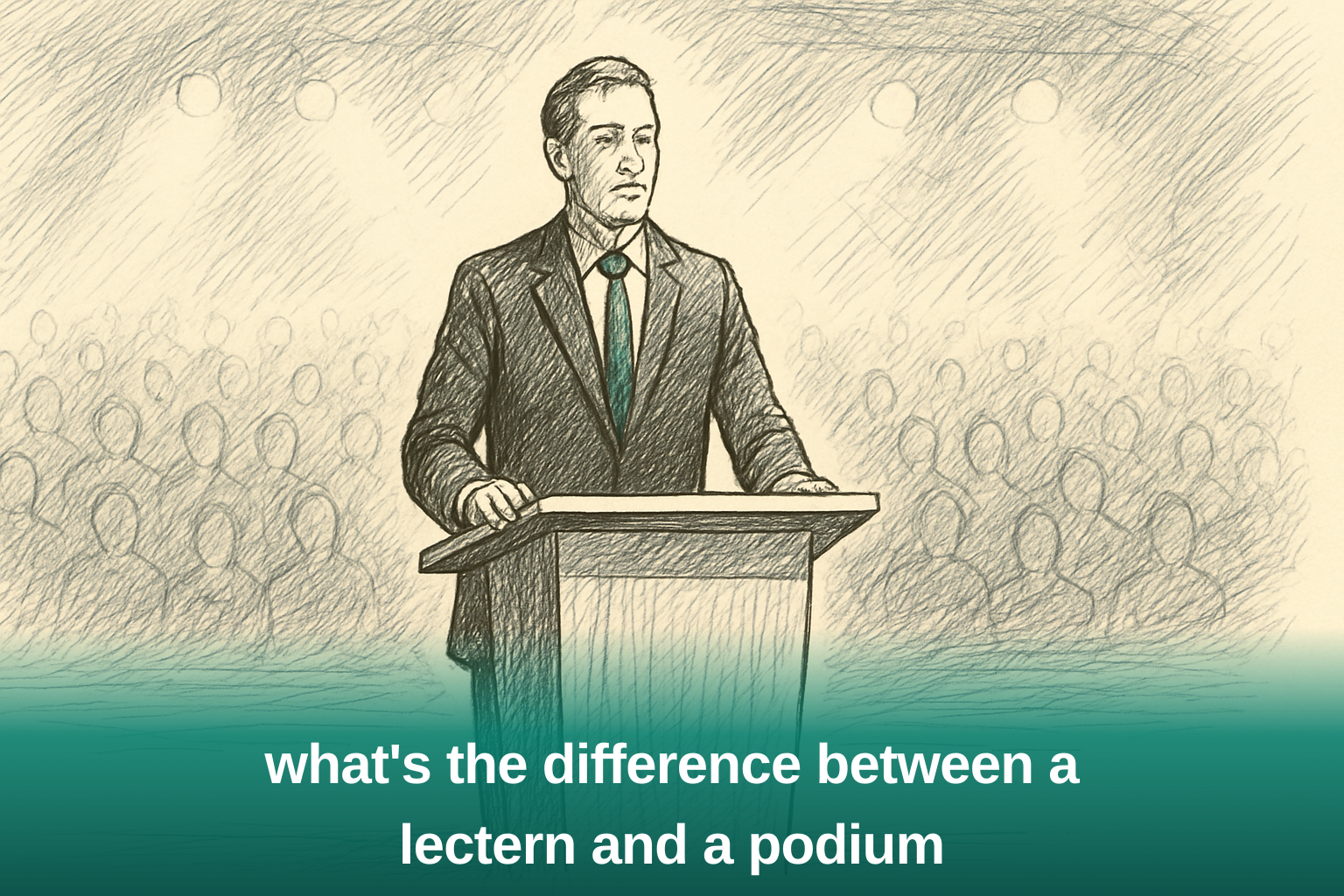

Imagine an awards ceremony. The gold medalist climbs three steps and stands on a small platform to receive her medal. Minutes later, the announcer says she “gave her victory speech from the podium,” even though she was clearly standing behind a slanted reading stand. If that sounds familiar, you are not alone. Industry observers note that in everyday use, most people call a lectern a “podium,” and this pattern appears repeatedly in rental catalogs and church furniture listings. Millions of people use these two words as synonyms every day, yet they refer to completely different objects. So what’s the difference between a lectern and a podium? This article clears up the confusion with authoritative dictionary definitions, side-by-side comparisons, verified pricing data, and practical tips for choosing the right setup for your next presentation.
A lectern is a tall stand with a slanted top that holds notes or books, while a podium is a raised platform or stage that elevates the speaker above the floor. The core distinction is spatial: speakers stand behind a lectern and on a podium. Merriam-Webster defines a lectern specifically as “a stand used to support a book or script in a convenient position for a standing reader or speaker,” whereas Oxford and Cambridge classify a podium as a raised platform for a conductor, speaker, or athlete.
Quick Answer: Lectern vs. Podium
If you need a memory trick borrowed from anatomy, think of a podiatrist who cares for feet: you stand ON a podium. Merriam-Webster defines a lectern specifically as “a stand used to support a book or script in a convenient position for a standing reader or speaker.” Oxford and Cambridge agree that a podium is a raised platform for a conductor, speaker, or athlete. In practice, the lectern sits at waist height—typically 40 to 48 inches—and angles toward the speaker so she can glance down at notes without losing eye contact with the audience. The podium, by contrast, lifts the speaker herself—sometimes only six inches, sometimes several feet—creating visibility across a crowded auditorium. Because modern stages often combine both items, a speaker may physically stand on a podium while also standing behind a lectern placed on top of it. That layered setup is why photographs and casual conversation collapse the two words into one. Understanding the dictionary definitions is the first step toward using each term with confidence in professional settings. It is worth noting, however, that while these definitions are technically precise, common usage in the AV and events industry frequently ignores the distinction, which is why verifying specifications before renting is essential.
Key Takeaways:
- A podium is a platform you stand ON.
- A lectern is a stand you stand BEHIND.
- Most things called “podiums” in everyday speech are actually lecterns.
What Is a Lectern?
A lectern is a freestanding fixture—usually waist-high to chest-high, or roughly 40 to 48 inches tall—designed to hold reading material at a comfortable angle. Its signature feature is a slanted top surface that keeps papers, tablets, or hardcover books from sliding onto the floor. Many models include a lip or ledge at the bottom to catch documents, and some add a small shelf underneath for water bottles or remote controls. Etymologically, the word drifts down from the Latin legere, meaning “to read,” which is exactly what happens behind one. You will find lecterns in university lecture halls, hotel conference suites, and legislative chambers where speakers need a physical anchor for their script but do not require any elevation above the floor. Contemporary designs range from minimalist acrylic pedestals that disappear on camera to ornately carved hardwood pulpits that dominate a room’s focal point. Regardless of style, the functional brief remains unchanged: support the text so the speaker can focus on delivery. Merriam-Webster, Oxford, and Cambridge all stress this reading convenience rather than any role in lifting the speaker.
Examples
- “The professor placed her notes on the lectern before starting the lecture.”
- “The CEO adjusted the microphone on the lectern and began her keynote speech.”
Types of Lecterns
Not every lectern looks the same. Event planners and speakers can choose from several formats based on venue, mobility needs, technology requirements, and budget. The following categories are standard across major supplier catalogs, with verified 2024 pricing illustrating the cost spectrum.
- Tabletop lectern. Compact and lightweight, this model sits on an existing table or desk. It is ideal for panel discussions or training rooms where space is tight. Basic models can start well under three hundred dollars.
- Floor lectern. A full-height unit that rests directly on the floor. It delivers visual authority and is the default choice for keynote addresses. Entry-level metal truss versions are cataloged near $800.
- Portable lectern. Built with foldable legs or collapsible frames, these travel easily between hotel ballrooms and breakout sessions. In-stock models frequently ship within days and weigh less than twenty pounds.
- Acrylic lectern. Made from clear or frosted plastic, it offers a contemporary look that does not obstruct sight lines or camera angles. Entry-level acrylic models start around $653.
- Wooden lectern. Traditional oak, mahogany, or walnut constructions suit formal ceremonies, courtrooms, and places of worship. Handcrafted hardwood versions often start near $1,833, with custom pulpits and hardwood lecterns averaging roughly fourteen weeks from order to delivery.
- Multimedia / AV lectern. Integrated with cable ports, monitor arms, and built-in speakers, these units keep laptops and presentation gear organized. Motorized height-adjustable models can exceed $7,553.
- Church lectern. Often adorned with symbolic carvings such as an eagle representing John the Evangelist and the resurrection, this variant blends devotional art with function and may be fixed near an altar.
What Is a Podium?
A podium is a raised platform or small stage upon which a person stands to become visible or acoustically prominent. Unlike a lectern, it does not hold books; instead, it holds people. The word descends from the Greek pódion, literally a “small foot” or base, which is why the object functions as a footing above the floor plane. Podiums range from modest six-inch risers at corporate press conferences to elaborate tiered structures at Olympic medal ceremonies. Conductors use them in symphony halls to project authority over the orchestra, and politicians mount them at rallies so thousands can see a single figure above the crowd. Because the podium elevates the body rather than the script, it frequently appears without any reading material at all. When speech notes are necessary, organizers often place a lectern on top of the podium, creating a combined setup that satisfies both elevation and readability. The Oxford English Dictionary emphasizes this platform aspect, while Merriam-Webster notes its specific use for conductors and award recipients. Modular podiums can be expanded with stairs, skirting, and extensions to fit any footprint.
Examples
- “The athlete stood on the podium to receive her gold medal.”
- “The conductor stepped onto the podium and raised his baton.”
Difference Between a Lectern and a Podium: The Key Distinctions

Separating these two objects becomes effortless once you focus on the speaker’s physical relationship to each surface. A lectern is an accessory for documents; a podium is an architectural element for the human body. You stand behind a lectern because it shields your notes and provides a natural resting place for your forearms. You stand on a podium because it separates you horizontally and vertically from the audience. Materials reinforce these roles: lecterns are built from acrylic, wood, or aluminum at reading height, while podiums are constructed from carpeted plywood, steel frames, or modular staging blocks. In the AV industry, catalogs sometimes label a tall reading stand as a “podium,” which deepens the confusion, but technical standards remain consistent across dictionaries and theatrical rigging manuals. When both appear in the same room, the podium is the floor feature and the lectern is the furniture feature. Understanding this hierarchy prevents costly rental mistakes—no one wants to order a twelve-inch platform when they actually needed a slanted book stand.
| Feature | Lectern | Podium |
|---|---|---|
| Primary Function | Holds notes, books, or a script at reading height | Elevates the speaker above floor level |
| Speaker Position | Stand behind it | Stand on it |
| Physical Form | Slanted top with a ledge; often a single pillar or four-legged stand | Raised platform, block, or tiered stage |
| Typical Height | Waist to chest high (approx. 40–48 inches) | 4 inches to several feet above floor level |
| Common Materials | Wood, acrylic, metal, laminate | Plywood, steel, carpeted staging, concrete |
| Etymology | Latin legere (“to read”) | Greek pódion (“small foot” or base) |
| Typical Usage Scenarios | Conferences, lectures, sermons, press briefings | Awards ceremonies, political rallies, orchestra conducting, sports medal presentations |
One way to remember the split is to look at your feet. If your shoes are touching a raised surface that lifts your entire body higher than the front row, you are on a podium. If your feet remain on the same floor as the audience and you are leaning slightly forward toward a slanted board, you are behind a lectern. This simple test works in nearly every venue, from school auditoriums to international summit halls.
Each option carries distinct advantages and drawbacks. A lectern provides a built-in surface for notes, a fixed anchor for a microphone, and a psychological barrier that can steady nervous speakers; however, it can also hide the speaker’s body and restrict natural movement. A podium offers open visibility, greater freedom of gesture, and enhanced sight lines for large crowds, yet it supplies no place for papers and usually forces the speaker to manage a handheld microphone or memorize the script.
Event rental companies sometimes add to the confusion by listing lecterns under “podiums” in their inventory. When ordering, always request a photo or dimensional drawing. Confirm whether the item elevates the speaker or merely holds paper. That single question will eliminate most mismatched deliveries.
Price and lead time also diverge sharply. A basic in-stock folding lectern can ship within days for under three hundred dollars—for example, the Oklahoma Sound 600 Aristocrat is cataloged near $279—while custom hardwood pulpits require roughly fourteen weeks of craftsmanship and command prices well above $5,000. Podiums, being essentially platforms, scale with size: a simple riser costs little, but a large stage with integrated podiums demands structural engineering and venue consultation.
Why Do People Confuse Lecterns and Podiums?
The mix-up is not random laziness; it is the result of converging linguistic, commercial, and cultural pressures. First, the phrase “podium stand” appeared in mid-twentieth-century AV catalogs as an adjective-noun pairing describing a tall stand placed on a podium. Over time, the noun dropped away and the adjective “podium” colonized the entire object, so event staff began asking for “the podium” when they meant the lectern. Second, American English in particular treats “podium” as a catch-all for any speaking furniture, while British English sometimes prefers “lectern” for the same item, creating transatlantic static. Third, churches and courtrooms often build lecterns onto raised platforms, so a single speaker occupies both objects simultaneously. The audience sees one person in one place and assigns one label. Fourth, modern dictionaries now list secondary definitions acknowledging the popular misuse, which paradoxically validates the error and makes it harder to correct in casual conversation. In the AV industry, technicians frequently compound the issue by referring to equipment carts as “podium carts,” further muddying the waters. Social media and televised speeches reinforce the pattern because commentators rarely pause to inspect the furniture beneath the president’s notes.
It is important to present a balanced view: while technical guides, dictionaries, and architectural specifications maintain a rigid distinction, lexicographers accept that living language evolves through common usage. Therefore, insisting on precision in a casual conversation may seem pedantic, yet in procurement, legal contracts, and event planning, using the correct term prevents expensive misunderstandings.
Related Terms: Pulpit, Dais, Rostrum, Ambo, and Bimah
Once you clear the lectern-podium hurdle, a cluster of related architectural terms waits to complicate your vocabulary. Each word describes a specific kind of elevated speaking structure, usually tied to a historical period, religious tradition, or formal ceremony. A pulpit encloses the preacher; a dais honors a panel of dignitaries; a rostrum recalls ancient Rome; an ambo serves Catholic liturgy; and a bimah anchors Jewish worship. Knowing these distinctions does more than win trivia games. It helps event planners communicate precisely with venues, helps speakers navigate unfamiliar spaces with confidence, and helps readers interpret historical texts or architectural plans without tripping over jargon. In the sections below, we unpack each term so you can recognize it on sight and use it with authority. These objects share a common DNA—every one of them manipulates height and visibility—but their cultural contexts make them non-interchangeable. Mastering this vocabulary ensures you will never again specify a “stage” when you mean a “dais” or request a “pulpit” for a secular corporate launch.
Tips
- Use “pulpit” only for enclosed, sacred preaching structures.
- Use “dais” when honoring multiple guests at a head table.
- Use “rostrum” for formal ceremonial platforms with historical connotations.
- Use “ambo” and “bimah” only in their specific religious contexts.
Pulpit
A pulpit is a raised, often enclosed structure entered by steps, used primarily in Christian churches for preaching. Unlike a freestanding lectern, a pulpit may have walls, a canopy, or a railing that sets it apart as a sacred space within the sanctuary. The enclosure elevates the minister both literally and symbolically above the congregation, and many pulpits are fixed architectural features rather than movable furniture. In some traditions, the pulpit is reserved for the proclamation of scripture, while a separate lectern handles general announcements. According to 2024 supplier data, custom hardwood pulpits can take around fourteen weeks from order to delivery, with prices ranging from roughly $5,016 for traditional church wood models to nearly $5,795 for winged glass designs. When you see a speaker step into a structure rather than stand behind it, you are almost certainly looking at a pulpit. The advantage of a pulpit is its commanding presence and sacred gravitas; the disadvantage is its permanence and lack of portability.
Dais
A dais is a raised platform at the head of a banquet hall, boardroom, or ceremonial space, designed to seat multiple honored guests or an entire panel of speakers. While a podium typically elevates one person, a dais can accommodate a long head table, thrones, or rows of chairs for dignitaries. The word travels from Old French and ultimately from Latin discus, related to the idea of a raised disk or table. If you are organizing a gala dinner or a formal wedding, you might place the bridal party or keynote panel on a dais so every attendee has a clear sight line. In corporate boardrooms, the CEO and directors often sit at a long table on a dais so they face the rest of the shareholders. It is not a reading stand and not a single-person riser; it is collective architecture for shared visibility. In the AV industry, the word “dais” is sometimes used loosely to mean a stage, which can create confusion when ordering equipment.
Rostrum
Rostrum carries the flavor of ancient Rome. Originally, it named the speaking platform in the Roman Forum decorated with the rostra—the bronze beaks or prows of captured enemy ships. The Latin rostrum literally means “beak.” Today the word survives as a formal synonym for any platform for public speaking, though it appears more often in British parliamentary or academic contexts than in everyday American rental catalogs. You are more likely to encounter the word in British parliamentary transcripts than in an American rental agreement. A rostrum is functionally close to a podium, but the historical baggage gives it a ceremonial weight suited to debates, state funerals, or graduation ceremonies where tradition matters as much as acoustics.
Ambo and Bimah
An ambo appears in Catholic, Orthodox, and some Protestant churches as a raised reading platform with a slanted surface, often made of stone or wood and permanently fixed near the altar. It functions like a liturgical lectern, yet its placement and sacred purpose distinguish it from secular conference furniture; some church furniture experts describe the ambo as a cross between a pulpit and a lectern. A bimah serves a parallel role in Jewish synagogues: it is an elevated platform, typically in the center or at the front, where the Torah is read and where the service leader may stand. Unlike a simple lectern, the bimah is a communal focal point large enough for several participants and a scroll. In contemporary synagogue design, the bimah may be centrally located to reflect the democratic nature of Jewish worship, while in some Orthodox traditions it remains near the ark. Both terms remind us that reading sacred text demands more than a portable stand; it requires an architectural statement that signals reverence and community identity.
How to Choose the Right One for Your Event
Start with the speaker’s needs. If she only requires a place to rest her notes and a microphone, a floor lectern or tabletop lectern is sufficient and far easier to transport than a stage platform. If the venue is a vast auditorium where visibility matters more than paperwork, a podium or a full stage will project the speaker’s presence to the back row. Religious ceremonies often call for a pulpit or an ambo to respect liturgical tradition, while panel discussions need a dais so multiple participants share equal prominence. For modern corporate settings, an acrylic lectern keeps cameras happy by minimizing visual clutter, and a multimedia lectern with cable management prevents the spaghetti of exposed laptop cords. Budget also matters: a simple acrylic lectern can cost around $653, whereas motorized height-adjustable units can exceed $7,500. Material choice sends a message too—acrylic and glass project modern transparency, while walnut and oak signal permanence and tradition.
When evaluating options, weigh the practical trade-offs carefully. A tabletop lectern is affordable and ships quickly, yet it may look insubstantial in a grand ballroom. A floor lectern anchors the stage visually but can block sight lines for audience members seated low and close to the front. A podium or dais solves visibility problems for large crowds, though it introduces trip hazards, requires guardrails or steps, and demands additional furniture if the speaker needs note support. For high-stakes events, request a site survey or a dimensional drawing before signing a rental contract.
What Is the Difference Between a Lectern and a Podium in Modern Hybrid Designs?
Contemporary event design has blurred the old boundaries by creating hybrid units that function as both podium and lectern. A motorized height-adjustable lectern, for example, can rise from sitting to standing position, effectively becoming a small podium for the speaker while still holding a laptop at a readable angle. Similarly, some rental companies now offer combined units—freestanding reading stands mounted on carpeted platforms—so the speaker gains elevation and note storage in one rental package. These combinations are practical, but they also explain why language lags behind engineering. When a single SKU contains both a platform and a slanted top, calling it simply a “podium” feels natural even if it is technically a bundle. If you are shopping for speaking furniture, look past the product name and study the specifications: check the footprint, the reading surface dimensions, and whether the unit elevates the speaker, the notes, or both. Prices for these integrated solutions vary widely, from basic metal truss lecterns near $800 to motorized hardwood models exceeding $7,500. Hybrid designs are especially popular in hotel ballrooms where setup time is limited and labor costs are high. Always request a floor plan review before signing a rental contract.
What Is the Difference Between a Podium and a Lectern for Microphones and Posture?
The physical difference between a lectern and a podium shapes everything from microphone choice to body language. A lectern gives the speaker a natural anchor: hands rest on wood, the torso hides subtle note-checking, and a gooseneck microphone can be clamped directly to the stand. That fixed position creates intimacy but can also become a barrier, literally placing furniture between the speaker and the crowd. A podium, because it is open, forces the speaker to hold a handheld microphone or wear a lapel mic, freeing the body to move but removing the safety net of hidden notes. Presenters who rely heavily on detailed scripts often prefer a lectern, while those who work from bullet points or storytelling thrive on an open podium where gestures read clearly from a distance. Understanding this dynamic helps event planners spec the right audio package and helps speakers rehearse with the correct physical constraints. It also explains why televised debates use transparent lecterns—so viewers can see the candidate while still preserving note space. Wireless technology has made podium speaking easier, but it has not removed the psychological comfort of resting one’s hands on a solid surface.
Audio engineers note that lecterns typically accommodate a fixed gooseneck condenser microphone, which delivers consistent sound quality but restricts lateral movement. Open podiums, by contrast, usually require a wireless handheld or lavalier microphone system; these allow the speaker to pace and pivot, yet they introduce potential feedback issues and demand more complex sound checks. From a posture perspective, a lectern encourages a forward-leaning stance that can appear engaged but may strain the lower back over long speeches, whereas a podium permits a balanced, grounded posture with both feet firmly planted on an elevated surface.
Final Verdict on Lectern vs. Podium
Years of interchangeable misuse have turned two precise words into a single vague guess, yet the engineering remains distinct. A podium lifts the person; a lectern lifts the notes. Whether you are ordering rental furniture for a corporate gala or writing a sermon for Sunday morning, choosing the correct term signals professionalism and prevents logistical surprises. Look at where the speaker’s feet land: if they are on a platform, you need a podium; if they are on the floor behind a reading stand, you need a lectern.
Frequently Asked Questions
The main difference is position. You stand on a podium because it is a raised platform, and you stand behind a lectern because it is a reading stand that holds your notes. Merriam-Webster defines a lectern as “a stand used to support a book or script in a convenient position for a standing reader or speaker,” while Oxford and Cambridge define a podium as a raised platform.
In everyday conversation many people do use them as synonyms, and major dictionary publishers have started noting this informal usage. Technically, however, they describe different objects, and professionals in event planning, theater, and architecture still maintain the distinction. AV catalogs and church furniture listings frequently label lecterns as “podiums,” which perpetuates the confusion.
A pulpit is a raised, often enclosed structure in a church that a preacher steps into to deliver a sermon. It is usually fixed in place and carries religious significance that a standard lectern does not. Custom hardwood pulpits can require roughly fourteen weeks of craftsmanship and are priced from approximately $5,000 to $5,800 depending on materials.
A podium is much smaller than a stage. A stage can hold scenery, multiple performers, and lighting rigs, while a podium is designed for one person or a small group to stand on. A dais, by contrast, is a raised platform intended for several honored guests or a head table.
A dais is a raised platform at the end of a room intended for several honored guests or a head table. Unlike a podium, which typically serves one speaker, a dais accommodates a group. The term derives from Latin discus, related to a raised disk or table.
The word comes from the Latin legere, meaning “to read.” It entered English through Medieval Latin and Old French, always retaining its connection to reading aloud.
It derives from the Greek pódion, meaning “small foot” or “base.” The word traveled through Latin and into English as a term for a raised platform that serves as a footing above the floor.