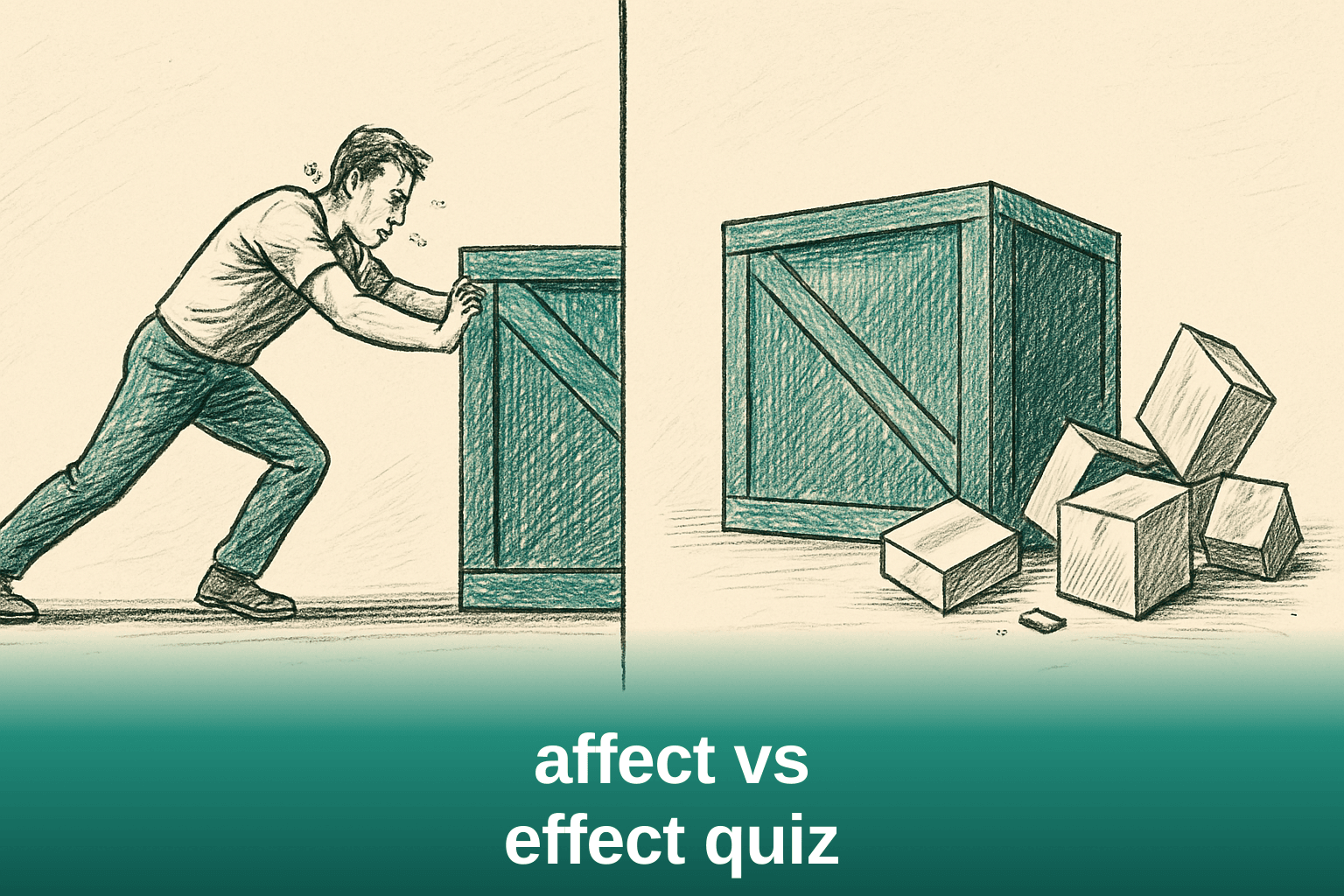

TL;DR: Affect = action (verb). Effect = result (noun). This affect vs effect quiz has 20 questions total. The answer key with explanations starts right after Question 20.
You stare at the blank, pencil frozen, because affect and effect look identical in your head. This affect vs effect quiz fixes that in twenty questions. Here is the one-line rule: affect is almost always a verb meaning to influence, and effect is almost always a noun meaning a result. You will get 10 fill-in-the-blank items, 10 multiple-choice challenges, and a full answer key with explanations. If you have ever mixed these two up in an essay or an email, this page is built for you.
This affect vs effect quiz contains 20 questions — 10 fill-in-the-blank and 10 multiple choice — with a complete answer key and explanations below. Remember the core rule: affect is usually a verb meaning to influence, and effect is usually a noun meaning a result.
The 60-Second Rule: Affect Is a Verb, Effect Is a Noun
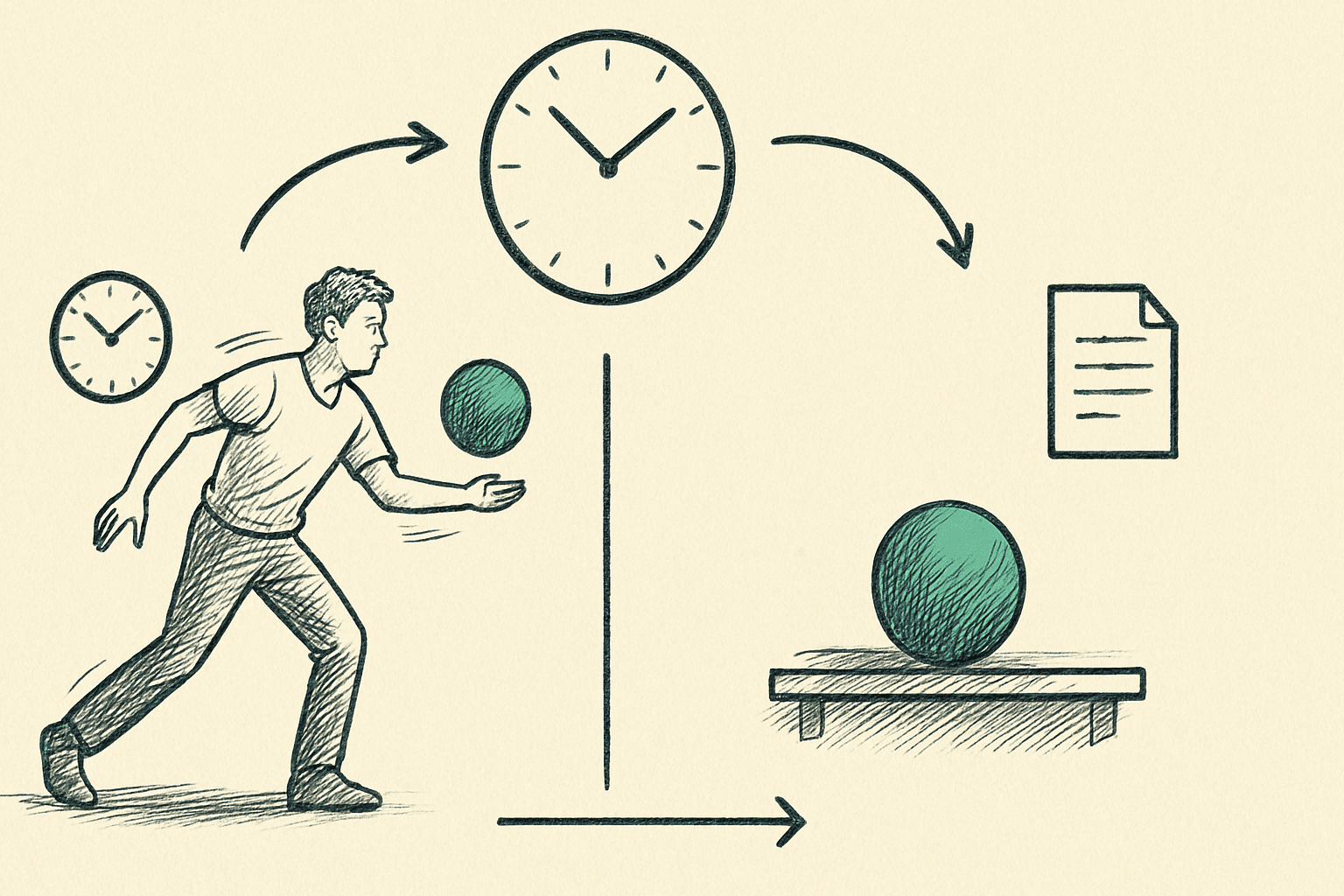
If you have sixty seconds before a test, lock in this single distinction. Affect functions as a verb in the vast majority of sentences you will ever read or write; it means to influence, change, or act upon something. Effect functions as a noun; it names the result, outcome, or consequence that follows a cause. Think of the sentence “The weather affects my mood.” Here, affects shows action — the weather is doing something. In “The weather had an effect on my mood,” effect names the result of that action. Both words share the same root concept of change, but their grammatical jobs differ. Yes, each word can flip roles in rare cases, and we will cover those exceptions later so they do not ambush you on advanced exams. For now, treat this rule as your default setting. When you see a word describing an action or process, reach for affect. When you need a label for the outcome, reach for effect. In standard English, affect is the verb and effect is the noun nine times out of ten.
Examples
- Loud noises affect my concentration. (verb — the noises are influencing something)
- The new law will affect thousands of workers. (verb — to influence)
- The effect of the new law was immediate. (noun — the result)
- Side effects include drowsiness. (noun — outcomes)
Affect vs Effect Quiz: 20 Questions
This is the core of your training. Below you will find 20 questions split into two halves. The first ten are fill-in-the-blank sentences drawn from everyday contexts like health, weather, school, and technology. The second ten are multiple-choice items written at the level of standardized tests such as the SAT, ACT, and TOEFL. Each sentence has only one correct answer, and every answer is explained in the key that follows. Grab a piece of paper or open a notes app, record your choices, and resist the urge to peek ahead. The questions are designed to catch the exact mistakes that cost students points on grammar tests. Because this is an affect vs effect online quiz you can take at your own pace, there is no timer breathing down your neck. Just focus on identifying whether the missing word is performing an action or naming a result. Working through all 20 sentences before checking the key is the single best way to build lasting confidence.
- Step 1: Read the sentence aloud to hear the rhythm.
- Step 2: Decide if the blank needs a verb (an action) or a noun (a thing/result).
- Step 3: Choose affect or effect and write it down.
- Step 4: Move to the next question without checking answers.
Part 1 — Fill in the Blank (Questions 1–10)
| # | Sentence | Options |
|---|---|---|
| 1 | Heavy rain tends to ______ my motivation to go running. | affect / effect |
| 2 | The special effects in the movie had a stunning visual ______. | affect / effect |
| 3 | Lack of sleep can ______ your ability to concentrate. | affect / effect |
| 4 | The new policy will ______ how we submit assignments. | affect / effect |
| 5 | One surprising ______ of the diet was clearer skin. | affect / effect |
| 6 | Loud music does not usually ______ her study habits. | affect / effect |
| 7 | The ______ of the medicine was stronger than expected. | affect / effect |
| 8 | A sudden frost can ______ the entire citrus harvest. | affect / effect |
| 9 | The principal's speech had a profound ______ on the students. | affect / effect |
| 10 | Stress can ______ both your mood and your sleep. | affect / effect |
Part 2 — Multiple Choice (Questions 11–20)
| # | Sentence | A | B | C | D |
|---|---|---|---|---|---|
| 11 | The ______ of the new highway on local wildlife has worried scientists for months. | affect | effect | effects | affecting |
| 12 | The CEO hopes to ______ major changes before the end of the fiscal year. | reflect | affect | effect | perfect |
| 13 | How will the tuition increase ______ incoming students? | effect | reject | affect | infect |
| 14 | A flat ______ is sometimes observed in patients taking certain antidepressants. | effect | affect | defect | infect |
| 15 | The medication did not produce the desired ______ until the third day. | affect | effect | reject | infect |
| 16 | Critics argued that the ban would negatively ______ creative freedom. | affect | effect | infect | reject |
| 17 | One lasting ______ of the pandemic was the shift to remote work. | affect | effect | infect | reject |
| 18 | The coach's pep talk did not seem to ______ the team's performance. | effect | reject | affect | infect |
| 19 | Researchers are studying the ______ of screen time on adolescent sleep. | affect | effect | reject | infect |
| 20 | The new manager will ______ a complete overhaul of the scheduling system. | reflect | affect | effect | reject |
Answer Key With Explanations
Now it is time to check your work. Below you will find the complete answer key for this affect vs effect quiz with answers that explain why each choice is correct. Every explanation identifies the word’s grammatical role in the sentence so you can see the verb-noun rule in action. If you got a question wrong, do not skip the explanation; that is exactly where the learning happens. We have varied the wording so you are not reading the same note ten times. Questions 12 and 20 use effect as a verb, while Question 14 uses affect as a noun — if those surprised you, jump to the exceptions section after you finish here. Use this key as your personal tutor. Read each note aloud once, then close your eyes and repeat the logic in your own words. The explanations below are the real value of this practice tool, because they turn a wrong guess into a locked-in rule.
Answers to Part 1 (1–10)
| # | Answer | Explanation |
|---|---|---|
| 1 | affect | Heavy rain acts upon motivation, so you need the verb affect (to influence). |
| 2 | effect | The sentence names a visual result produced by the movie, so effect is the noun. |
| 3 | affect | Sleep loss influences concentration; this is an action, requiring the verb affect. |
| 4 | affect | The policy will change how assignments are submitted, so the verb affect fits. |
| 5 | effect | The diet produced a result — clearer skin — so the noun effect is correct. |
| 6 | affect | Music influences study habits; the sentence needs the verb affect. |
| 7 | effect | The sentence describes the result of medicine, so effect functions as a noun. |
| 8 | affect | A frost influences the harvest; use the verb affect to show action. |
| 9 | effect | The speech produced a result on the students, so the noun effect is needed. |
| 10 | affect | Stress influences both mood and sleep, which makes affect the right verb. |
Answers to Part 2 (11–20)
| # | Answer | Explanation |
|---|---|---|
| 11 | effect (B) | The sentence names a result on wildlife, so the noun effect is correct. |
| 12 | effect (C) | Here effect is a verb meaning “to bring about.” See the exceptions section for more. |
| 13 | affect (C) | The tuition increase will influence students, requiring the verb affect. |
| 14 | affect (B) | In psychology, affect is a noun describing emotional expression. This is a rare exception. |
| 15 | effect (B) | The desired outcome of the medication is a result, so the noun effect fits. |
| 16 | affect (A) | A ban influences creative freedom; the verb affect carries that meaning. |
| 17 | effect (B) | The pandemic produced a lasting result, so you need the noun effect. |
| 18 | affect (C) | The talk did not influence performance, which makes affect the correct verb. |
| 19 | effect (B) | Researchers study a result, so the noun effect is the right choice. |
| 20 | effect (C) | The manager will bring about an overhaul, so effect is used here as a formal verb. |
How to Score Your Affect vs Effect Quiz
Add up your correct answers out of twenty. If you scored between eighteen and twenty, you have mastered the standard rule and can handle most academic and professional writing with confidence. A score of fourteen to seventeen means you understand the basics, but the exceptions and trickier sentence patterns are still slipping past you. If you landed between ten and thirteen, revisit the sixty-second rule and retake the quiz after a short break. Anything below ten simply means you need a fresh run through the basics — no shame, just more practice. The goal is not a perfect score on the first try; the goal is to finish this page knowing why you missed what you missed. Because this is an affect vs effect practice quiz designed for repeated use, you can reset and try again as many times as you need. Use your score as a diagnostic tool, not a final judgment.
Memory Tricks That Make Affect vs Effect Stick
When the clock is ticking, you need a shortcut that fires instantly. Start with RAVEN: Remember Affect Verb Effect Noun. The acronym fits the dark, dramatic vibe of grammar anxiety, and it works. Next, link the first letter of affect to action — both start with A — and the first letter of effect to end result or outcome — both start with E. You can also lean on the fixed phrase “cause and effect,” which you have heard a thousand times; in that pairing, effect is always the noun result. Another visual trick is to picture the word affect running because verbs are motion words, while effect sits still like a finished product. Pick just one of these tricks, repeat it once, and it will be there when you need it. The best memory device is the one you can summon in under three seconds.
The Exceptions Most Quizzes Ignore (NEW)
Most basic quizzes pretend these two words never swap roles, but advanced tests love to exploit that blind spot. Effect can indeed serve as a verb meaning “to bring about” or “to cause,” as in “The new manager will effect a change.” This usage is formal and rare, yet it appears in legal, political, and business writing. Affect can also appear as a noun, almost exclusively in psychology and medicine, where a flat affect describes a reduced display of emotion. You might also encounter affect as an older literary noun meaning feeling or emotion, though that usage has largely faded. Because these flip roles are uncommon, standard quizzes often skip them entirely. However, if you are preparing for the GRE, SAT, or advanced ESL proficiency exams, you need to recognize them on sight. These exceptions are not trivia; they are the exact traps that separate a good score from a great one.
Examples
- The treaty effected a ceasefire after months of violence. (verb — brought about)
- She hoped to effect real reform within the department. (verb — to cause)
- The patient presented a flat affect during the evaluation. (noun — emotional expression)
- His affect was subdued, but his words were sharp. (noun — outward display of feeling)
- The novel captures the affect of grief without naming it. (noun — emotion, literary)
- The policy effected immediate changes in hiring practices. (verb — caused)
Affect vs Effect in Real Writing: 6 Sentence Patterns (NEW)
Knowing the rule is one thing; deploying it in your own essays and emails is another. Native speakers and strong writers rely on a handful of proven sentence templates that make the choice automatic. The first pattern pairs a subject directly with the verb: “The weather affects my mood.” The second uses the noun inside a prepositional phrase: “The effect of caffeine on sleep is well documented.” A third common structure inserts have or has before the noun: “The speech had a profound effect on the crowd.” You will also see affect followed by a clause beginning with how: “Stress affects how we process information.” Idiomatic phrases like take effect and in effect appear frequently in news and legal writing. Finally, writers often use effect in statements of purpose: “The goal is to effect change.” Master these six patterns and you will spend far less time second-guessing yourself. Templates turn grammar rules into muscle memory.
| Pattern | Example 1 | Example 2 |
|---|---|---|
| [Subject] affects [object] | The weather affects my mood. | Poor lighting affects productivity. |
| The effect of [X] on [Y] | The effect of caffeine on sleep. | The effect of diet on health. |
| [X] has an effect on [Y] | Sugar has an effect on energy. | Music has an effect on focus. |
| [X] affects how [Y] | Stress affects how we eat. | Price affects how buyers choose. |
| take effect / in effect | The medicine took effect quickly. | The law is now in effect. |
| to effect [change] | They hope to effect change. | The coup effected a new policy. |
Common Mistakes the Quiz Is Designed to Catch
Even students who know the rule cold sometimes stumble over specific sentence structures. One of the most frequent errors is dropping effect into a verb slot because it sounds more formal: “The weather effects my plans” is wrong; the weather influences them, so affect is the verb you need. Another trap appears after the article the — “the affect of the storm” is almost always incorrect because the signals a noun is coming, and that noun should be effect. Writers also confuse the fixed phrase cause and effect, accidentally writing cause and affect. In emotional contexts, people reach for affect when they mean effect after an adjective: “a profound affect” should be “a profound effect.” Finally, do not confuse affect with the adjective effective or the noun affect used in psychology unless you are writing for a medical audience. Each of these errors appears in at least one question above, so review the answer key if you missed it.
Affect vs Effect on Standardized Tests: What the Quiz Is Really Preparing You For
If you think this quiz is just about grammar, think again. Standardized tests like the SAT, ACT, and TOEFL do not ask you to define affect or effect in isolation; they bury the words inside long reading passages under time pressure. A sentence might read, “The reform did little to ______ the underlying inequality,” and your job is to recognize that the blank needs a verb of influence, not a noun. The tests also reward students who know the exceptions: effect as a verb appears in formal passage-based questions, while affect as a noun shows up in psychology excerpts. By working through all 20 questions here — especially the multiple-choice section — you are building the exact pattern-recognition speed those exams demand. This affect vs effect quiz for students mirrors the pacing and distraction techniques real tests use. The grammar you master today is the same grammar that buys you points on test day.
Affect vs Effect vs Effect (Verb) vs Affect (Noun): The Full Picture (NEW)
It is time to step back and see every role these two words can play. In everyday English, the roles are simple: affect acts, effect results. But the full picture includes four distinct cells. Affect as a verb means to influence, and it is by far the most common usage you will encounter in newspapers, novels, and conversation. Effect as a noun names a result, and it follows close behind in frequency across academic and professional writing. Then come the two switch hits: effect as a formal verb meaning to bring about, and affect as a specialized noun in psychology and medicine. The table below shows all four roles side by side with their frequency and a clear example. Study it once, and you will never be surprised by a trick question again. Seeing all four roles in one view is the fastest way to end the confusion permanently.
| Word | Role | Meaning | Example | Frequency |
|---|---|---|---|---|
| affect | verb | to influence | The news affects her mood. | common |
| effect | noun | result / outcome | The effect was immediate. | common |
| effect | verb | to bring about | They hope to effect change. | formal / rare |
| affect | noun | emotional expression | He showed a flat affect. | technical / rare |
Printable Affect vs Effect Worksheet (PDF) (NEW)
Sometimes you need to study away from the screen, or you want to hand a quiz to your students without worrying about Wi-Fi. That is why we built a printable affect vs effect worksheet that includes the same 20 questions you just answered plus 10 additional review sentences for extra practice. The PDF opens with quick instructions, presents all 30 items in a clean layout, and ends with a full answer key on the final page. Teachers can use it as a classroom handout, and independent learners can tuck it into a binder for a flight or a coffee shop session. Because the extra 10 questions focus on the exceptions and sentence patterns covered above, the worksheet functions as a second pass that cements what you learned here. Having a physical copy turns one-time practice into repeatable training.
FAQ
Students, teachers, and ESL learners tend to ask the same handful of questions after finishing a grammar quiz. Some wonder whether the rule changes in British English or scientific writing. Others want to know if online tools like Quizlet or Quizizz cover the same depth. The six questions below address the most common points of confusion, including where to find the answer key, whether this quiz works for classrooms, and how the exceptions fit into real exams. Each answer is short, direct, and designed to remove any lingering doubt. If you still feel shaky after reading them, run through the 20 questions one more time before bedtime. Many visitors search specifically for an affect vs effect quizlet or affect vs effect quizizz alternative; this page gives deeper explanations than flashcards alone. Repetition is what moves a rule from your short-term memory into your long-term command.
Frequently Asked Questions
Affect is usually a verb meaning to influence or change something. Effect is usually a noun meaning a result or outcome. For example, “Loud noises affect my focus” and “The effect was immediate.”
There are 20 questions total, split into two parts: 10 fill-in-the-blank sentences and 10 multiple-choice items.
The complete answer key and explanations appear in the “Answer Key With Explanations” section immediately after the 20 questions.
Yes. The vocabulary stays within an A2–B2 range, and every answer is explained in plain English with everyday examples.
Yes. You can print the PDF worksheet version, which includes 30 questions and a full answer key for classroom use.
Effect can be a verb meaning “to bring about” (to effect change), and affect can be a noun in psychology describing emotional expression (a flat affect). See the exceptions section above for details.
This quiz includes detailed explanations for every answer, covers rare exceptions, and offers a printable PDF — features not found in standard Quizlet or Quizizz decks.
Final Verdict: What Your Quiz Score Means
You came here because affect and effect never stay in the right boxes when you are writing under pressure. Now you have a solid rule, twenty practice sentences, and a clear map of the rare exceptions that trip people up on advanced tests. If you scored eighteen or higher, you can trust the pattern recognition you built here and move on to other grammar challenges. If you struggled, print the worksheet and retake this affect vs effect test after a day away from the screen. Spaced repetition beats cramming every time. Either way, the confusion ends when you stop memorizing isolated definitions and start seeing how these two words behave inside real sentences. The fastest way to stop second-guessing yourself is to revisit this quiz until the pattern feels automatic. Make this page your reference, and return whenever the blank starts staring back.