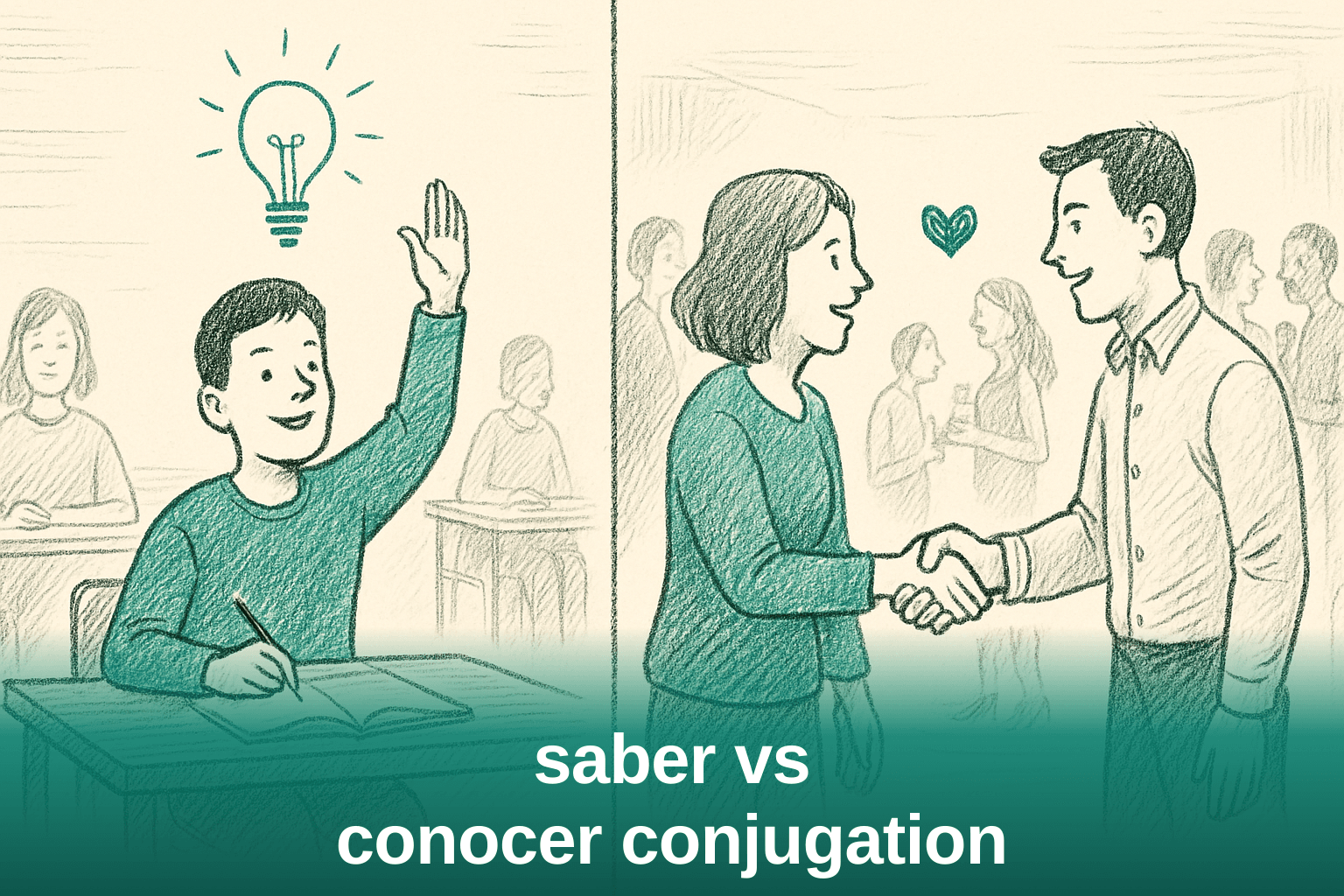

Saber vs conocer conjugation boils down to two irregular yo forms and one semantic choice: use saber for facts and skills, and conocer for familiarity with people, places, and things. In the present tense, saber becomes sé and conocer becomes conozco, while every other form follows regular -er patterns. In the preterite, the meanings shift—supe means “I found out” and conocí means “I met.”
Saber and conocer both translate to “to know” in Spanish, but they follow different conjugation patterns and semantic rules. Saber is used for facts, skills, and information, while conocer expresses familiarity with people, places, or things. Both verbs are irregular only in the first-person singular present tense: yo sé and yo conozco. In the preterite, their meanings shift sharply—supe conveys “I found out,” and conocí means “I met someone for the first time.”
You are texting a friend from your Spanish class, and you want to say, “I know Lucia.” Your thumb hovers over the keyboard. Is it Sé a Lucia or Conozco a Lucia? And why does the same English verb, “to know,” force you to pick between two completely different conjugation paths? This confusion trips up nearly every English speaker because Spanish draws a hard line between knowing facts and knowing people—something English simply does not do. In the next few sections, you will get side-by-side charts for six major tenses, a clear rule for choosing the right verb, and a ten-question quiz to lock it all in.
Saber vs Conocer Conjugation at a Glance
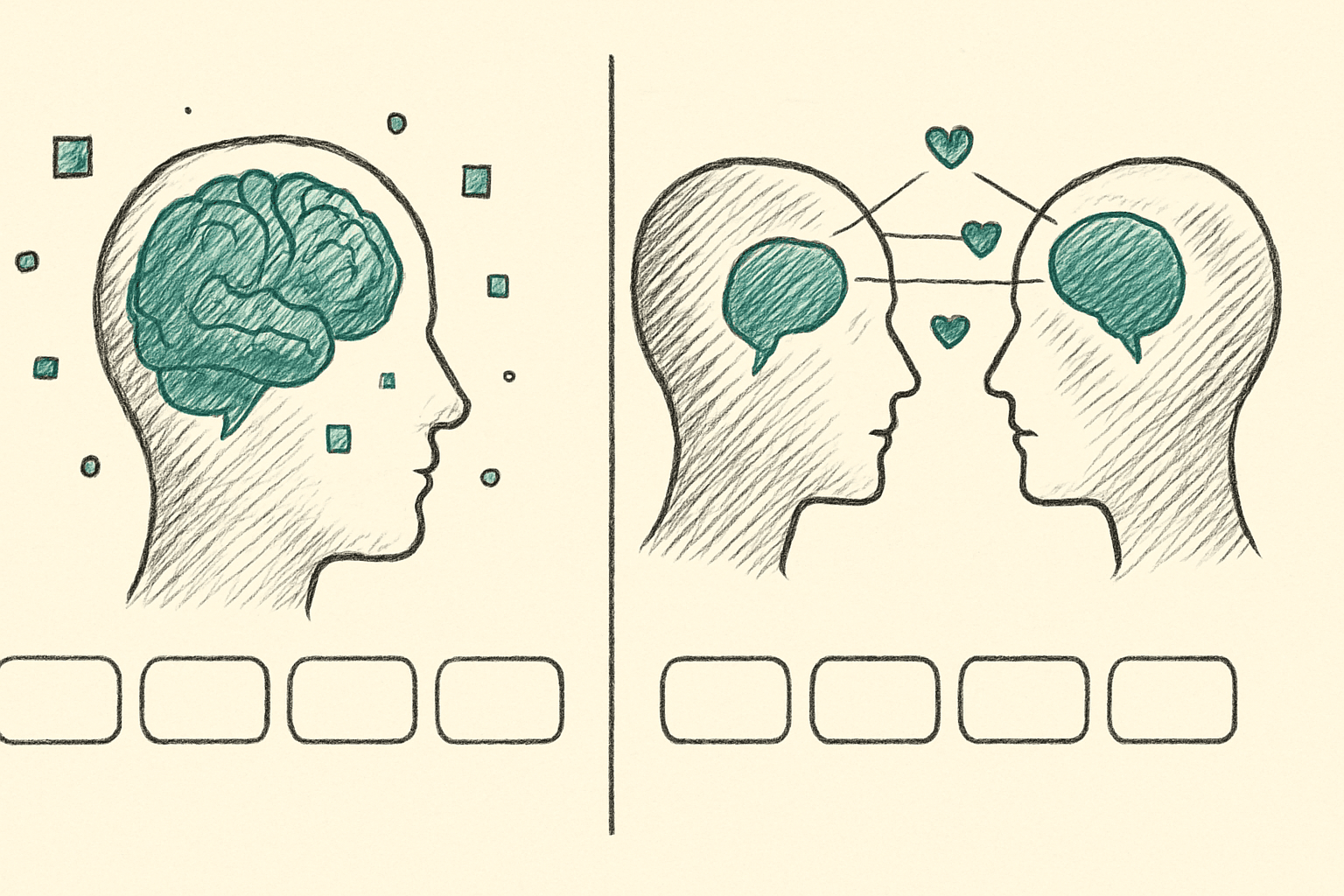
If you need a fast reference before diving into the rules, here is the single most important pattern: both verbs behave like regular -er verbs in every person except the first-person singular. Saber collapses to sé, while conocer adds a z to become conozco. Every other present-tense ending is completely predictable: -es, -e, -emos, -éis, -en. The chart below places both verbs side by side so you can see exactly where they diverge and where they mirror each other. I have also included the voseo forms used in Argentina, Uruguay, and parts of Central America, since many learners encounter them in media and conversation. Keep this table open as you work through the deeper explanations below.
| Subject Pronoun | Saber | Conocer | English Cue |
|---|---|---|---|
| yo | sé | conozco | I know |
| tú | sabes | conoces | you know |
| vos | sabés | conocés | you know (voseo) |
| él/ella/usted | sabe | conoce | he/she/you knows |
| nosotros | sabemos | conocemos | we know |
| vosotros | sabéis | conocéis | you all know (Spain) |
| ellos/ellas/ustedes | saben | conocen | they/you all know |
What Is the Difference Between Saber and Conocer?
The core distinction between saber and conocer is not about how deeply you know something, but about what kind of knowledge you are expressing. Saber handles intellectual content—facts, data, and learned abilities—while conocer handles experiential familiarity with people, places, and things. This difference drives every conjugation choice you make. If you can swap the English verb for “to be familiar with,” you almost always need conocer. If you can swap it for “to know that” or “to know how to,” saber is your verb. Both verbs are fully conjugated in every tense, but their meanings shift in the preterite, which makes the initial choice even more important than the ending you attach. The mnemonics below will help you lock in the correct verb before you reach for a conjugation chart.
Saber: Facts, Information, and Skills
Saber covers anything you can store in your head as data or demonstrate with a skill. Think of the mnemonic SALES: Skills, Abilities, Likes-as-known-facts, Expertise, and Savvy. When you talk about knowing a password, knowing that Madrid is in Spain, or knowing how to swim, saber is the only option. It also introduces indirect questions with words like dónde, cómo, and si.
Examples
- Sé la respuesta. (I know the answer.)
- No sé dónde está el banco. (I don’t know where the bank is.)
- Sé hablar español. (I know how to speak Spanish.)
- ¿Sabes si Juanita está casada? (Do you know if Juanita is married?)
Conocer: People, Places, and Things You Are Familiar With
Conocer expresses acquaintance. Use the mnemonic COCO: Connections, Origins you have visited, Characteristics you recognize, and Ongoing relationships. If you have met a person, visited a city, or experienced a film, conocer is the verb that captures that familiarity. It is also the verb that means “to meet someone for the first time” when used in the preterite, though that nuance is covered in the preterite section below.
Examples
- Conozco a María. (I know María.)
- No conocemos Madrid. (We don’t know Madrid / We aren’t familiar with Madrid.)
- ¿Conoces a mi amiga Melissa? (Do you know my friend Melissa?)
- Conoce una película que tal vez te interese. (He knows a film you might be interested in.)
The Quick Test: “Be Familiar With” vs “Know That”
When you are in doubt mid-sentence, run this three-step check to avoid swapping the verbs.
- Step 1: Look at what comes after the verb. Is it a person, place, or thing you have experienced? If yes, use conocer. Conozco Buenos Aires.
- Step 2: Try replacing “know” with “be familiar with.” If the sentence still makes sense, use conocer. I am familiar with that song → Conozco esa canción.
- Step 3: If the next word is an infinitive or a clause starting with que, cómo, or dónde, use saber. Sé cómo llegar.
Saber and Conocer Present Conjugations
The present tense is where most learners first collide with the irregular yo forms that define saber and conocer. Every other pronoun follows the standard pattern for -er verbs, but yo demands special attention: saber collapses into sé, and conocer gains a z to become conozco. These two forms are the gatekeepers of the entire conjugation system. Once you have them, the rest of the present tense is mechanical. Saber uses the stem sab- for every form except yo, while conocer uses the stem conoc- for all forms except yo, where the spelling adjustment to conoz- prevents the c from softening before o. The tables below break down each verb individually, followed by an explanation of why these irregularities exist and a note on the voseo forms used across the Southern Cone.
Saber Present Tense Conjugation Chart
| Subject Pronoun | Form | Pronunciation Hint |
|---|---|---|
| yo | sé | SEH (stressed, one syllable) |
| tú | sabes | SAH-bes |
| vos | sabés | sah-BES (stress on final syllable) |
| él/ella/usted | sabe | SAH-beh |
| nosotros | sabemos | sah-BEH-mos |
| vosotros | sabéis | sah-BAYS |
| ellos/ellas/ustedes | saben | SAH-ben |
Notice that sé carries the stress and drops the b entirely; no other regular -er verb behaves this way in the yo form.
Conocer Present Tense Conjugation Chart
| Subject Pronoun | Form | Pronunciation Hint |
|---|---|---|
| yo | conozco | koh-NOHS-koh |
| tú | conoces | koh-NOH-thes / koh-NOH-ses |
| vos | conocés | koh-noh-THES / koh-noh-SES (stress final) |
| él/ella/usted | conoce | koh-NOH-theh / koh-NOH-seh |
| nosotros | conocemos | koh-noh-THAY-mohs / koh-noh-SAY-mohs |
| vosotros | conocéis | koh-noh-THAYS / koh-noh-SAYS |
| ellos/ellas/ustedes | conocen | koh-NOH-then / koh-NOH-sen |
The -z- appears only in the yo form; after that, the -c- returns in conoces, not conozes.
Why Sé and Conozco Are Irregular
The yo form of saber—sé—is a historical survivor. It comes from the Latin scio and never merged into the regular -er paradigm, which is why the invented form “sabo” does not exist in any standard dialect. Conocer, on the other hand, follows a strict orthographic rule: when a verb ends in -cer or -cir preceded by a consonant, the yo form inserts a -z- before the -c- to keep the hard /k/ sound before o and a. Without the z, “conoco” would force the c to soften, breaking the pronunciation. If you see -cer or -cir, expect -zco in the yo form.
Voseo Forms: Sabés and Conocés (NEW)
In Argentina, Uruguay, Paraguay, and much of Central America, speakers use vos instead of tú, which changes the stress pattern in the present tense. The voseo forms are sabés and conocés, with the stress falling on the final syllable. These are not slang; they are the standard written and spoken forms in those regions. If you are reading Argentine literature or watching Uruguayan shows, you will see these spellings constantly.
Examples
- ¿Vos sabés dónde queda la estación? (Do you know where the station is?)
- Vos conocés a mi hermana, ¿no? (You know my sister, don’t you?)
Saber and Conocer Conjugations in the Preterite
The preterite is the tense where saber and conocer do the most semantic heavy lifting. A Spanish speaker does not use these verbs in the preterite to describe a general state of knowing; instead, the preterite pinpoints a specific moment when knowledge was acquired or when a first meeting took place. Supe does not mean “I knew” in an ongoing sense—it means “I found out” at a discrete point in time. Conocí does not mean “I was familiar with”—it means “I met” someone or something for the first time. This shift catches many English speakers off guard because the English verb “to know” rarely changes meaning based on tense. Mastering the preterite forms therefore requires memorizing not just the endings, but the new English equivalents that come with them.
Saber in the Preterite: Supe = “I Found Out”
| Subject Pronoun | Form |
|---|---|
| yo | supe |
| tú | supiste |
| él/ella/usted | supo |
| nosotros | supimos |
| vosotros | supisteis |
| ellos/ellas/ustedes | supieron |
Examples
- Supe la verdad ayer. (I found out the truth yesterday.)
- Mis padres nunca supieron la verdad. (My parents never found out the truth.)
Conocer in the Preterite: Conocí = “I Met”
| Subject Pronoun | Form |
|---|---|
| yo | conocí |
| tú | conociste |
| él/ella/usted | conoció |
| nosotros | conocimos |
| vosotros | conocisteis |
| ellos/ellas/ustedes | conocieron |
Examples
- Conocí a mi novio en un partido de fútbol. (I met my boyfriend at a soccer game.)
- ¿Conociste a la nueva profesora? (Did you meet the new teacher?)
Saber and Conocer in the Imperfect, Future, and Conditional
Once you move beyond the preterite and present, saber and conocer settle into more predictable behavior, though saber still hides a small trap in the future and conditional tenses. The imperfect describes ongoing or habitual knowledge in the past, and both verbs form it regularly: sabía and conocía simply add the imperfect endings to their stems. The future and conditional, however, reveal that saber is built on a shortened stem. Instead of adding the future endings to the full infinitive saber, the e drops out, giving sabré and sabrás. Conocer, by contrast, keeps its full infinitive and acts like a model regular verb in both tenses. The tables below show these side by side so you can see exactly where the two verbs diverge and where they mirror each other perfectly.
Imperfect: Sabía and Conocía
| Subject Pronoun | Saber | Conocer |
|---|---|---|
| yo | sabía | conocía |
| tú | sabías | conocías |
| él/ella/usted | sabía | conocía |
| nosotros | sabíamos | conocíamos |
| vosotros | sabíais | conocíais |
| ellos/ellas/ustedes | sabían | conocían |
Examples
- Sabía la respuesta, pero no quería decirla. (I knew the answer, but I didn’t want to say it.)
- Conocía bien la ciudad porque vivía allí. (I knew the city well because I lived there.)
Future: Sabré vs Conoceré
| Subject Pronoun | Saber | Conocer |
|---|---|---|
| yo | sabré | conoceré |
| tú | sabrás | conocerás |
| él/ella/usted | sabrá | conocerá |
| nosotros | sabremos | conoceremos |
| vosotros | sabréis | conoceréis |
| ellos/ellas/ustedes | sabrán | conocerán |
Examples
- Mañana sabré los resultados. (Tomorrow I will know the results.)
- Algún día conoceré Japón. (Someday I will know / visit Japan.)
Conditional: Sabría and Conocería
| Subject Pronoun | Saber | Conocer |
|---|---|---|
| yo | sabría | conocería |
| tú | sabrías | conocerías |
| él/ella/usted | sabría | conocería |
| nosotros | sabríamos | conoceríamos |
| vosotros | sabríais | conoceríais |
| ellos/ellas/ustedes | sabrían | conocerían |
Examples
- Con más tiempo, sabría qué hacer. (With more time, I would know what to do.)
- Me gustaría que conocieras a mi familia. (I would like you to meet my family.)
Saber and Conocer in the Present Subjunctive
The present subjunctive is the mood Spanish uses for doubt, emotion, and hypothetical situations, and both saber and conocer form it from their irregular yo stems. For saber, the subjunctive takes the stem sep-, producing forms like sepa and sepas that look nothing like the infinitive. For conocer, the subjunctive preserves the -zc- spelling from the yo form of the indicative, so every single subjunctive form contains a z: conozca, conozcas, conozca, and so on. This is a critical detail: while conocer only uses -zc- in the yo form of the present indicative, it uses -zc- in every form of the present subjunctive. If you are constructing a sentence with espero que, dudo que, or es posible que, the tables below give you the exact forms you need.
| Subject Pronoun | Saber | Conocer |
|---|---|---|
| yo | sepa | conozca |
| tú | sepas | conozcas |
| él/ella/usted | sepa | conozca |
| nosotros | sepamos | conozcamos |
| vosotros | sepáis | conozcáis |
| ellos/ellas/ustedes | sepan | conozcan |
Examples
- No creo que él sepa la verdad. (I don’t think he knows the truth.)
- Busco a alguien que conozca Madrid. (I’m looking for someone who knows Madrid.)
How to Choose the Right Verb (and Form) Every Time
Conjugation tables are useless if you select the wrong verb to begin with. The single most important skill in mastering saber and conocer is not memorizing endings—it is learning to recognize which verb conceptually fits the sentence. Start by looking at the object of the verb. If the object is a person, a geographic location, or a cultural work you have experienced, conocer is almost certainly the right choice, provided you are expressing familiarity rather than factual data. If the object is a piece of information, a skill, or an embedded clause starting with que, cómo, dónde, or si, saber is the verb you need. The decision rules below walk you through six common scenarios, followed by a closer look at the personal a and the difference between saber followed by an infinitive and saber followed by que.
Decision Rules with Example Sentences
Examples
- Fact: Sé que París está en Francia. (I know that Paris is in France.)
- Skill: Sé tocar la guitarra. (I know how to play the guitar.)
- Person: Conozco a tu hermano. (I know your brother.)
- Place: Conocemos Barcelona. (We know / are familiar with Barcelona.)
- Thing: Conozco esa canción. (I know that song.)
- Knowing about: ¿Sabes algo de astronomía? (Do you know anything about astronomy?)
The Personal A with Conocer
When conocer is followed by a specific person—or a pet treated as a person—Spanish requires the preposition a between the verb and the object. This is called the personal a, and it has no English equivalent, which is why English speakers constantly drop it. You must say Conozco a María; without the a, the sentence is ungrammatical. The personal a does not appear after saber, nor does it appear after conocer when the object is a place or an inanimate thing.
Examples
- Conozco a mi vecino. (I know my neighbor.)
- ¿Conoces a mi amiga Melissa? (Do you know my friend Melissa?)
- No conozco a nadie aquí. (I don’t know anyone here.)
Saber + Infinitive vs Saber + Que
Saber accepts two very different complements, and the meaning changes accordingly. When saber is followed directly by an infinitive, it expresses a skill: saber nadar means “to know how to swim.” When it is followed by que, it introduces a known fact: sé que es tarde means “I know that it is late.” This distinction is sharp, and using one structure for the other will confuse your listener.
Examples
- Sé tocar la guitarra. (I know how to play the guitar.)
- Sé que París está en Francia. (I know that Paris is in France.)
- No sé cómo llegar. (I don’t know how to get there.)
- ¿Sabes dónde hay un buen café? (Do you know where there is a good café?)
Reflexive Forms: Saberse and Conocerse
Many Spanish learners do not realize that adding a reflexive pronoun to saber or conocer changes the meaning in ways that standard conjugation charts rarely explain. Saberse shifts from general knowledge to knowing something by heart or from memory, as in a phone number or a poem. Conocerse turns the outward familiarity inward, meaning either to know oneself or for two people to know each other, and in the preterite it commonly describes the moment two people met each other for the first time. These reflexive constructions follow the same conjugation patterns as their non-reflexive counterparts—you still say me sé and nos conocimos—but the context and pronoun placement make all the difference. Understanding this layer will prevent you from sounding unnatural when you talk about memorized facts or mutual acquaintances.
Examples
- Me sé tu número de memoria. (I know your number by heart.)
- Todavía no nos conocemos muy bien. (We still don’t know each other very well.)
- Paulina y Santiago se conocieron en la universidad. (Paulina and Santiago met each other in college.)
- ¿Te sabes el poema? (Do you know the poem by heart?)
Why “Saber De” Is Not the Same as “Saber”
Another layer of nuance that conjugation charts rarely capture is the preposition de attached to saber. While saber alone means to know a fact or a skill, saber de translates roughly as “to know of” or “to have heard about,” and it often blurs the line toward conocer. For example, saying Sé de un buen restaurante implies you have heard about a good restaurant, whereas Conozco un buen restaurante means you are personally familiar with it. This distinction matters because saber de can introduce people, places, and things—categories normally reserved for conocer—without breaking grammar rules. Native speakers use saber de to express secondhand knowledge, and recognizing this construction will help you avoid overusing conocer in contexts where you only have indirect information.
Examples
- Sé de un médico que puede ayudarte. (I know of a doctor who can help you.)
- No sé nada de ese tema. (I don’t know anything about that topic.)
- ¿Sabes de algún hotel barato? (Do you know of any cheap hotel?)
Common Mistakes with Saber and Conocer Conjugation
Even after you understand the difference between saber and conocer, certain errors creep into production because English lacks a direct equivalent for the personal a and because the irregular yo forms feel arbitrary. English speakers frequently invent the form “sabo” by analogy with hablo or como, or they drop the z in conozco to create the non-existent conoco. Another common slip is adding the personal a after saber when talking about people—saber never takes a before its object, regardless of whether the object is human. In the future tense, learners often regularize saber into “saberé” instead of the correct sabré. Finally, many students use saber when they mean conocer for people, producing phrases like Sé a Juan which are grammatically impossible in Spanish. The warnings below highlight each mistake with the correction and a brief explanation.
- Mistake: Conozco María → Correct: Conozco a María (Always use personal a with people after conocer.)
- Mistake: Sabo → Correct: Sé (Saber is irregular in the yo form; “sabo” does not exist.)
- Mistake: Conozo → Correct: Conozco (The -z- is mandatory in the yo form of -cer verbs.)
- Mistake: Saberé → Correct: Sabré (Saber drops the infinitive -e- in the future and conditional.)
- Mistake: Sé a Juan → Correct: Conozco a Juan (Use conocer, not saber, for knowing people.)
Verbs Conjugated Like Conocer (-cer / -cir → -zco) (NEW)
One of the most efficient ways to accelerate your Spanish conjugation skills is to treat conocer not as an isolated irregular verb, but as the flagship member of a large orthographic family. Any verb whose infinitive ends in -cer or -cir preceded by a consonant will undergo the same zc spelling change in the yo form of the present indicative and throughout the present subjunctive. This means that if you can conjugate conocer, you already know how to handle verbs like agradecer, ofrecer, parecer, conducir, traducir, and producir. The pattern is remarkably consistent: drop the infinitive ending, insert -zc- before the regular ending for yo, and keep the c everywhere else. Seeing these verbs side by side reinforces the logic behind conozco and prevents you from treating every new verb as a separate memorization burden. The table below shows six high-frequency verbs that follow this exact pattern.
| Infinitive | Yo Form |
|---|---|
| agradecer | agradezco |
| ofrecer | ofrezco |
| parecer | parezco |
| conducir | conduzco |
| traducir | traduzco |
| producir | produzco |
Saber and Conocer Conjugation Practice Quiz (NEW)
Memorizing charts is only half the battle; the other half is applying the correct form under pressure. This ten-question quiz mixes present, preterite, future, and subjunctive forms with the personal a and the saber-plus-infinitive construction so you can spot your weak points immediately. Each question presents a sentence with a blank and three possible answers, but only one is both grammatically correct and semantically appropriate for the context. After you select an answer, a short explanation appears to remind you why the form works and why the distractors fail. Use this quiz to test whether you have truly internalized the difference between supe and sabía, between conozco a and conozco, and between sabré and the invented form saberé. When you finish, download the one-page PDF conjugation chart to keep the full paradigm within reach.
1. ¿Tú ________ a mi hermana? (Do you know my sister?)
- A. sabes
- B. conoces
- C. conocer
Answer: B. conoces — You need conocer for people, plus the personal a. Saber is for facts.
2. Yo no ________ la respuesta. (I don’t know the answer.)
- A. sé
- B. sabo
- C. conozco
Answer: A. sé — Saber is used for facts and information; sé is the irregular yo form.
3. Ellos ________ en Madrid el año pasado. (They met in Madrid last year.)
- A. supieron
- B. se conocieron
- C. conocieron
Answer: B. se conocieron — The reciprocal “met each other” requires the reflexive conocerse in the preterite.
4. Ayer yo ________ la verdad. (Yesterday I found out the truth.)
- A. sabía
- B. supe
- C. supo
Answer: B. supe — Supe is the preterite of saber, meaning “I found out” at a specific moment.
5. Nosotros ________ bien la ciudad. (We know the city well.)
- A. conocemos
- B. sabemos
- C. conocemos
Answer: A. conocemos — Places you are familiar with take conocer; remember the -c- in nosotros.
6. Espero que tú ________ qué hacer. (I hope you know what to do.)
- A. sabes
- B. sepas
- C. sepa
Answer: B. sepas — After espero que, use the present subjunctive; sepas is the tú form.
7. Mañana yo ________ los resultados. (Tomorrow I will know the results.)
- A. sabré
- B. saberé
- C. conoceré
Answer: A. sabré — Saber drops the -e- in the future; results are facts (saber).
8. Busco a alguien que ________ Madrid. (I’m looking for someone who knows Madrid.)
- A. conoce
- B. conozca
- C. conozco
Answer: B. conozca — After busco a alguien que, use the subjunctive; conocer takes -zc- in all subjunctive forms.
9. ________ tocar el piano desde niño. (I have known how to play piano since childhood.)
- A> Conozco
- B. Sé
- C. Sabo
Answer: B. Sé — Skills use saber + infinitive; sé is the correct yo form.
10. ¿Vos ________ dónde queda la estación? (Do you know where the station is?)
- A. sabés
- B. sabes
- C. conocés
Answer: A. sabés — With voseo, the stress shifts to the final syllable: sabés, not sabes.
Frequently Asked Questions About Saber and Conocer Conjugation
Even after working through the charts and the quiz, a few questions tend to resurface. This section addresses the exact queries that learners type into search engines when they are stuck on a homework exercise or preparing for a DELE exam. Each answer is self-contained, so you can jump straight to the issue that is bothering you without reading the entire article again.
Frequently Asked Questions
Saber conjugates as sé, sabes, sabe, sabemos, sabéis, saben. Conocer conjugates as conozco, conoces, conoce, conocemos, conocéis, conocen. Only the yo forms are irregular.
Sé is a historical form derived from Latin scio. It does not follow the regular -er pattern, and “sabo” does not exist in standard Spanish.
Verbs ending in -cer or -cir insert a -z- in the yo form to preserve the hard /k/ sound. Without the z, the c would soften before o, so conozco is mandatory.
In the preterite, supe means “I found out” and conocí means “I met” (someone for the first time). They describe single completed events, not ongoing states.
No. Conocer is regular (conoceré), but saber drops the infinitive -e-, giving sabré, sabrás, sabrá, etc.
Use conozco a whenever the direct object is a specific person or pet. You do not use the personal a before places or inanimate objects: Conozco Madrid, but Conozco a María.
Yes. They are standard voseo forms used in Argentina, Uruguay, Paraguay, and parts of Central America. They are not considered slang.
Conclusion: Lock In the Two Irregular Forms First
If you take one thing away from this guide, let it be the two irregular yo forms that anchor everything else: sé and conozco. Once those forms are automatic, every other tense becomes easier to navigate because the rest of the paradigm is either regular or follows a predictable stem change. Remember the golden rule of selection: facts and skills travel with saber, while people and places travel with conocer. Keep the preterite shift in mind—supe means a moment of discovery, and conocí marks a first encounter—so you do not accidentally describe a general state of knowledge using a completed past tense. Run through the quiz one more time, and trust that with these two verbs mastered, a whole family of -cer and -cir verbs is already within your reach.