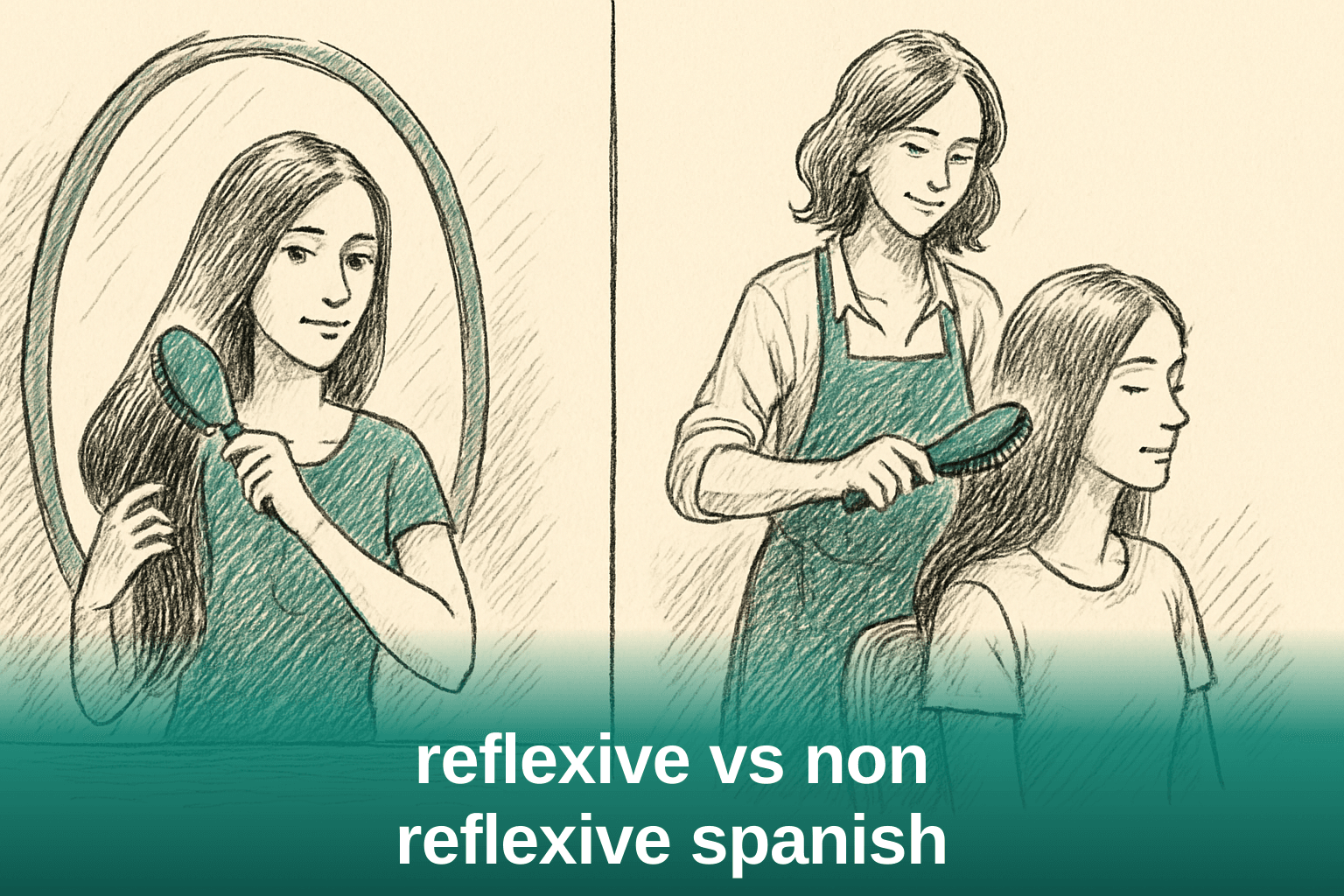

Reflexive verbs in Spanish describe an action the subject performs on itself (me baño — I bathe myself), while non-reflexive verbs describe an action directed at someone or something else (baño al perro — I bathe the dog). This single distinction sits at the heart of reflexive vs non reflexive spanish, yet learners often freeze when choosing between bañar and bañarse. You already know the vocabulary; what trips you up is deciding who receives the action. The reflexive pronouns me, te, and se look small, but they completely redirect the sentence. In the next few minutes, you will learn a one-question test, clear sentence patterns, twelve verb pairs that flip meaning entirely, and hands-on exercises to lock in the difference.
- Reflexive verbs in Spanish carry a -se ending in the infinitive, as in lavarse or despertarse.
- Non-reflexive Spanish verbs use the standard -ar, -er, or -ir endings, such as lavar or despertar.
- The reflexive pronoun must match the subject: me for yo, te for tú, se for él/ella/usted, nos for nosotros, and os for vosotros.
- Only transitive verbs—those that can take a direct object—can be turned into reflexive forms.
- Several Spanish verb pairs change meaning entirely between reflexive and non-reflexive uses, including despedir versus despedirse.
- Reflexive pronouns may attach to infinitives and gerunds, but in compound tenses they appear before the auxiliary verb.
What Is the Difference Between Reflexive and Non-Reflexive Verbs in Spanish?
A reflexive verb in Spanish indicates that the subject both performs and receives the action, so it always needs a pronoun that mirrors the subject. According to Jaime Suances Torres, nearly 30 percent of the 523 most common Spanish verbs are reflexive, totaling 154 verbs you will meet daily. When you say “Ella se mira en el espejo,” she is both looking and being looked at. The infinitive ends in -se, such as mirarse or lavarse, and the pronoun changes to me, te, se, nos, or os. Non-reflexive verbs describe actions where the subject acts upon a different person or thing, so the sentence includes a separate direct object. If you say “Ella mira a su hermana,” the sister receives the action, and no reflexive pronoun appears. These verbs keep standard -ar, -er, or -ir endings. Understanding this split prevents the habit of sprinkling se randomly across sentences. Once you see that grammar revolves around who receives the action, the choice becomes logical rather than random.
The One-Question Test: Who Receives the Action?
Instead of memorizing lists, ask one simple question: who receives the action? If the answer is the same person or thing performing it, you need a reflexive verb and its matching pronoun. If the recipient is someone or something else, stick with the non-reflexive form. This test works because Spanish grammar ties the pronoun directly to the subject-object relationship. Consider the pair: Sandra se baña versus Sandra baña a su bebé. In the first sentence, Sandra is bathing herself, so se is required. In the second, the baby receives the action, so no reflexive pronoun appears.
- Step 1: Identify the subject of your sentence.
- Step 2: Ask “Who or what receives the action?”
- Step 3: If the subject and recipient are the same, add the matching reflexive pronoun; if they differ, use the non-reflexive form without the pronoun.
Reflexive vs Non-Reflexive at a Glance
| Feature | Reflexive | Non-Reflexive |
|---|---|---|
| Who receives the action | The subject itself | A different person or object |
| Infinitive ending | -se (lavarse) | -ar, -er, -ir (lavar) |
| Pronoun required? | Yes (me, te, se, nos, os) | No |
| Typical sentence pattern | Subject + pronoun + verb | Subject + verb + object |
| Example | Me lavo las manos. | Lavo el coche. |
This side-by-side view shows that the grammar shift is small, but the meaning change is significant.
Reflexive vs Non Reflexive Spanish Sentence Structure
The fastest way to spot whether a Spanish verb is reflexive or non-reflexive is to look at the sentence structure around it. In a reflexive construction, the reflexive pronoun appears either directly before the conjugated verb or attached to the end of an infinitive or gerund, creating a compact clause where the subject and the object are the same entity. Non-reflexive sentences follow a more open pattern: the subject acts, the verb carries the tense, and then a separate object receives that action, often introduced by the preposition a when the object is a person. Because the pronoun placement rules are strict, misplacing me or se can make a sentence sound unnatural even if the vocabulary is correct. Recognizing these two patterns early will save you from hesitation during conversation. Once you can see the structural slots—pronoun before verb versus object after verb—you will read and produce Spanish sentences with far more confidence.
Reflexive Verb Sentence Pattern
Reflexive sentences follow a simple formula: the subject comes first, then the reflexive pronoun, then the conjugated verb. This keeps the action tightly bound to the person performing it.
Examples
- Me baño cada mañana. (I bathe myself every morning.)
- Te despiertas tarde. (You wake yourself up late.)
- Se viste elegante. (He dresses himself elegantly.)
- Nos acostamos temprano. (We put ourselves to bed early.)
Non-Reflexive Verb Sentence Pattern
Non-reflexive sentences place the conjugated verb right after the subject, followed by a separate direct object that receives the action.
Examples
- Baño al perro los sábados. (I bathe the dog on Saturdays.)
- Despierto a mi hermano. (I wake my brother up.)
- Visten a los niños. (They dress the children.)
- Lavo los platos. (I wash the dishes.)
Where the Reflexive Pronoun Goes (placement rules)
Spanish reflexive pronouns are mobile, but they obey strict placement rules that depend on the verb form you are using. Before a conjugated verb, the pronoun stands alone; with infinitives and gerunds, it can attach to the end or remain before the conjugated helper verb; in compound tenses, it must sit before the auxiliary verb. These rules apply consistently across moods and tenses, so memorizing the four positions once will cover most situations you encounter.
| Verb Form | Pronoun Placement | Example |
|---|---|---|
| Conjugated verb | Before the verb | Me lavo. |
| Infinitive | Attached to end OR before conjugated helper | Voy a lavarme. / Me voy a lavar. |
| Gerund | Attached to end OR before conjugated helper | Estoy lavándome. / Me estoy lavando. |
| Compound tense | Before the auxiliary verb | Me he lavado. |
When to Use Reflexive vs Non Reflexive Verbs in Spanish
Reflexive verbs appear most predictably in four everyday contexts, while non-reflexive verbs cover everything else where the action moves outward toward another target. Reflexive verbs appear most predictably in four everyday contexts. Daily routines and personal care almost always use reflexive forms because you perform those actions on your own body, from showering to getting dressed. Emotional and physical states also rely on reflexive constructions when the subject experiences an internal shift, such as getting angry or falling ill. When two or more people perform an action on one another, Spanish uses reflexive pronouns in a reciprocal sense, effectively replacing the phrase each other. Finally, a subset of verbs is inherently pronominal, meaning they always carry a reflexive pronoun even though the action is not literally directed back at the subject. Outside of these four zones, you will usually default to the non-reflexive form unless you are deliberately turning the action back onto yourself. Keeping these categories in mind prevents the guesswork that makes spoken Spanish feel halting.
Daily Routines and Personal Care
This is the context every beginner meets first. Actions you do to yourself follow the reflexive pattern.
Examples
- Me ducho a las siete. (I shower at seven.)
- Me levanto temprano. (I get myself up early.)
- Me cepillo los dientes. (I brush my teeth.)
- Me peino antes de salir. (I comb my hair before leaving.)
- Me visto rápido. (I dress myself quickly.)
Emotional and Physical States
Reflexive forms often signal a change in emotional or physical condition that happens within the subject. Waking up follows the same pattern: despertarse signals the internal transition from sleep to alertness, whereas despertar usually requires a separate object, as in despierto a los niños.
Examples
- Me enojo cuando llega tarde. (I get angry when he arrives late.)
- Me siento feliz hoy. (I feel happy today.)
- Se enfermó después del viaje. (He got sick after the trip.)
- Te preocupas demasiado. (You worry too much.)
Reciprocal Actions (each other)
When plural subjects act on one another, the reflexive pronoun takes on a reciprocal meaning.
Examples
- Nos abrazamos. (We hug each other.)
- Se besan. (They kiss each other.)
- Os ayudáis siempre. (You all always help each other.)
Inherently Reflexive (Pronominal) Verbs
Some Spanish verbs are pronominal by nature and always require a reflexive pronoun, even though the action is not literally directed back at the subject.
Examples
- Me arrepiento de nada. (I regret nothing.)
- Se atreve a cantar. (He dares to sing.)
- Se queja del ruido. (He complains about the noise.)
- Nos acordamos de todo. (We remember everything.)
12 Verb Pairs That Change Meaning in Reflexive vs Non-Reflexive Form
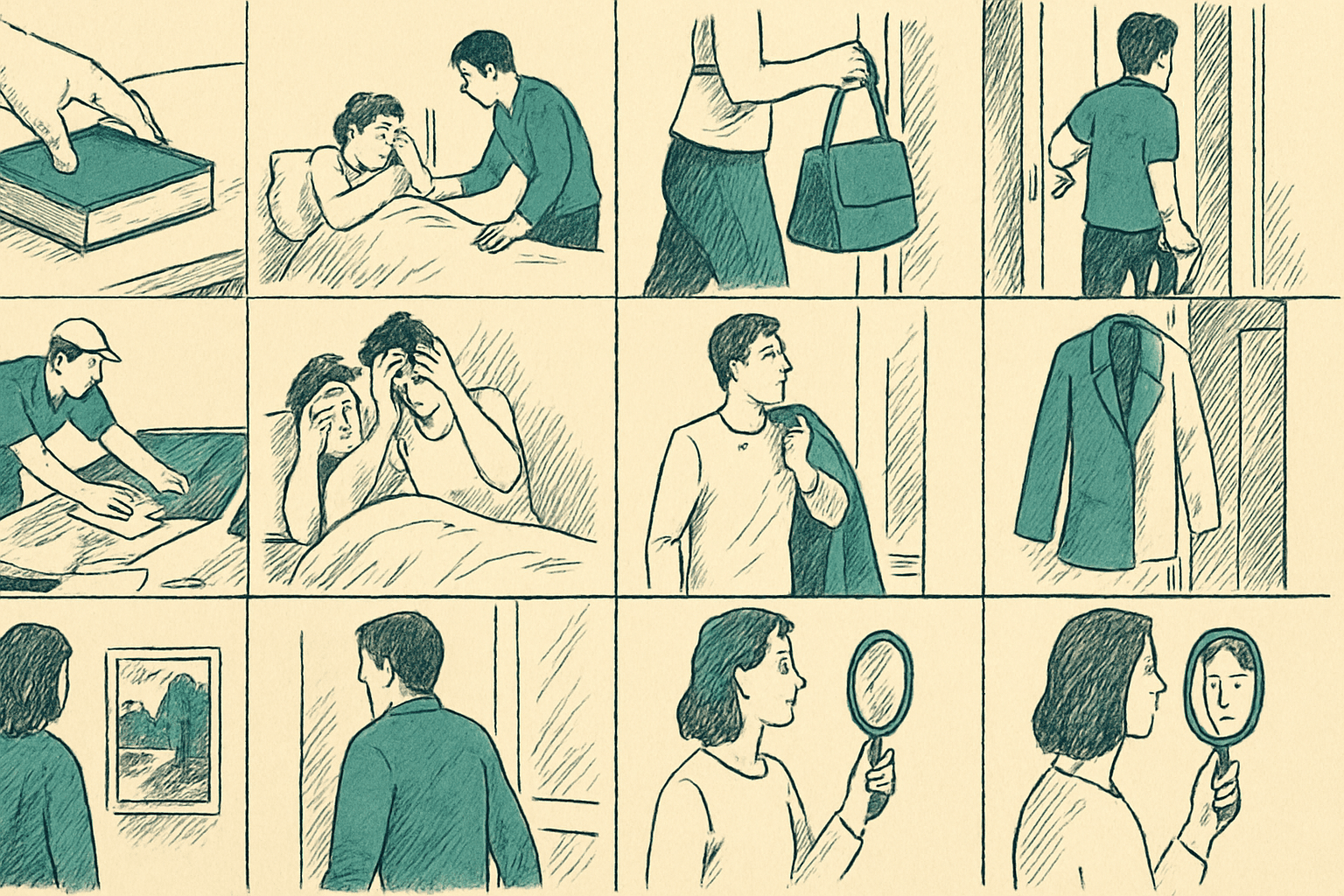
Beyond daily routines, the reflexive vs non reflexive spanish distinction becomes truly treacherous with verbs that completely change meaning when you add or remove the pronoun. The shift from standard to reflexive form can turn a neutral action into a departure, a meeting into a memory, or a job dismissal into a farewell. Because the logic of who receives the action does not always explain the new meaning, intermediate learners must treat these twelve pairs as individual vocabulary items rather than grammatical variations. Memorizing them side by side is far more effective than trying to deduce the reflexive meaning from the non-reflexive root. In the table below, you will see the non-reflexive form with its typical meaning and example sentence, followed by the reflexive counterpart that Spanish speakers use in everyday conversation. Study them as fixed pairs and you will avoid the embarrassing mix-ups that happen when you translate word for word.
| Non-Reflexive (meaning + example) | Reflexive (meaning + example) | Note |
|---|---|---|
| ir — to go (Voy a la escuela.) | irse — to leave, to go away (Me voy a casa.) | Irse implies departure from a place. |
| quedar — to arrange to meet / to be left over (Quedamos a las cinco.) | quedarse — to stay, to remain (Me quedo en casa.) | Quedarse focuses on remaining somewhere. |
| llamar — to call (Llamo a mi madre.) | llamarse — to be named (Me llamo Ana.) | Llamarse is used for names and identities. |
| encontrar — to find (Encuentro las llaves.) | encontrarse — to meet / to feel (Nos encontramos en el café.) | Encontrarse often means meeting by chance. |
| probar — to try, to taste (Pruebo la sopa.) | probarse — to try on (Me pruebo los zapatos.) | Probarse is used with clothing and accessories. |
| levantar — to lift, to raise (Levanto la caja.) | levantarse — to get up (Me levanto temprano.) | Levantarse refers to getting out of bed. |
| acordar — to agree (Acordamos un precio.) | acordarse — to remember (Me acuerdo de ti.) | Acordarse always takes de in standard use. |
| dormir — to sleep (Duermo ocho horas.) | dormirse — to fall asleep (Me duermo en clase.) | Dormirse emphasizes the moment of falling asleep. |
| despedir — to fire, to dismiss (Despide al empleado.) | despedirse — to say goodbye (Se despide de sus amigos.) | Despedirse is social; despedir is administrative. |
| parar — to stop something (Paro el coche.) | pararse — to stand up / to stop oneself (Se para en la esquina.) | Pararse can mean standing or coming to a halt. |
| poner — to put, to place (Pongo el libro aquí.) | ponerse — to put on clothes / to become (Me pongo el abrigo.) | Ponerse also expresses sudden changes in state. |
| sentir — to feel, to sense (Siento la vibración.) | sentirse — to feel a certain way (Me siento feliz.) | Sentirse describes emotional or physical condition. |
These pairs do not follow a single predictable rule, so you cannot always deduce the reflexive meaning simply by looking at the base verb. Instead, treat each pair as a separate lexical entry that deserves its own flashcard. Fluent speakers learn them through repetition and context rather than logic, and they rarely stop to analyze why irse means to leave while ir means to go. Your goal is to build the same automatic association through deliberate practice.
Can Every Spanish Verb Be Reflexive? (transitive vs intransitive)
No, not every Spanish verb can take a reflexive form, and understanding why will stop you from inventing verbs that do not exist. Only transitive verbs—those that naturally accept a direct object—can be made reflexive, because the reflexive pronoun essentially replaces that direct object with the subject itself. Intransitive verbs like trabajar, llegar, or nacer describe actions that do not transfer to an external recipient, so there is nothing to send back to the subject. If you try to add se to an intransitive verb, the result is either ungrammatical or belongs to highly regional slang that you should avoid as a learner. This rule explains why you will never hear a native speaker say trabajarse in the standard sense of working. Before you reflexivize a verb, ask whether it can carry a direct object in its non-reflexive form. If the answer is no, keep the pronoun in your pocket and use the verb as it is.
Reflexive Pronouns with Usted and Vosotros
Choosing the correct reflexive pronoun becomes trickier when you shift between informal and formal address, or when you move from Latin America to Spain. While most beginners practice with yo and tú, real conversations quickly introduce usted, which shares the third-person reflexive pronoun se even though you are directly addressing someone. This means usted se levanta uses the same se as él se levanta, a detail that often causes hesitation. If you are learning European Spanish, you will also need os for the plural informal you, as in vosotros os levantáis, whereas Latin American Spanish relies on the third-person plural se for ustedes se levantan. The grammar rule itself never changes—the pronoun still reflects the subject—but the social context dictates which pronoun shape you select. Recognizing these address patterns early will prevent awkward switches mid-conversation and help you absorb regional materials without confusion. Memorize the five forms as subject-pronoun pairs rather than isolated words, and the formal register will feel like a natural extension of what you already know.
Reflexive vs Non Reflexive Spanish Practice
Reading rules is helpful, but the real breakthrough happens when you apply them under pressure. The two exercises below are designed to force an immediate choice between reflexive and non-reflexive forms, first by selecting the correct verb in context and then by correcting sentences that contain common learner errors. Making and fixing a mistake cements the rule more effectively than passive review. Work through each item before checking the answer key, because the struggle of deciding is what builds automaticity. If you hesitate, return to the one-question test: who receives the action? Keep that question in mind as you fill in the blanks, and you will notice your speed and accuracy improving after just a few rounds. These drills also expose the specific contexts where your intuition still relies on English word order rather than Spanish grammar. Use them as a diagnostic tool whenever you feel unsure about whether a sentence needs me, te, se, or no pronoun at all.
Exercise 1: Choose the Correct Form
- Step 1: Yo ___ (baño / me baño) al perro.
- Step 2: Ella ___ (levanta / se levanta) a las seis todos los días.
- Step 3: Nosotros ___ (encontramos / nos encontramos) en el parque a las cinco.
- Step 4: Tú ___ (lavas / te lavas) las manos antes de comer.
- Step 5: Ellos ___ (despiden / se despiden) de sus abuelos.
- Step 6: Usted ___ (acuerda / se acuerda) de la fecha de la reunión.
Exercise 2: Fix the Mistake
- Step 1: Me lavo el coche cada semana.
- Step 2: Nos enfermos ayer por la noche.
- Step 3: Voy a me lavar las manos ahora.
- Step 4: Me siento la música en el concierto.
- Step 5: Llamo me Carlos desde niño.
Answer Key
Answer Key
- 1. baño — The dog is the separate object.
- 2. se levanta — She gets herself up.
- 3. nos encontramos — We meet each other there.
- 4. te lavas — You wash your own hands.
- 5. se despiden — They say goodbye to their grandparents.
- 6. se acuerda — Remembering uses the reflexive form.
- 7. Lavo el coche. — The car receives the action.
- 8. Nos enfermamos ayer. — Correct reflexive conjugation.
- 9. Voy a lavarme las manos. / Me voy a lavar las manos. — Pronoun attaches to infinitive or precedes helper.
- 10. Siento la música. — Non-reflexive to sense something externally.
- 11. Me llamo Carlos. — Names require llamarse.
Common Mistakes with Reflexive vs Non Reflexive Spanish
Even after you understand the rules, certain reflexive vs non reflexive spanish errors appear again and again because they are driven by English habits rather than Spanish logic. The five mistakes below represent the most frequent traps that intermediate learners fall into, from treating se as a universal suffix to placing pronouns in positions that break Spanish sentence structure. Each wrong example is followed by its correction and a brief explanation so you can see exactly where the logic slips. Reviewing these errors regularly will sharpen your internal monitor and help you self-correct during conversation. Pay special attention to the cases where a reflexive pronoun changes the verb meaning entirely, because translating word for word from English is usually the culprit there. Once you recognize your personal pattern of error, you can target it directly instead of drilling rules you already know.
- Adding se to intransitive verbs. Wrong: Me trabajo los fines de semana. → Right: Trabajo los fines de semana. (Trabajar cannot be reflexive.)
- Mismatching the pronoun to the subject. Wrong: Te lavo las manos. → Right: Me lavo las manos. (The pronoun must match the subject.)
- Placing the pronoun after the past participle. Wrong: He lavadome. → Right: Me he lavado. (In compound tenses, place the pronoun before the auxiliary verb.)
- Confusing the passive se with a reflexive verb. Wrong: Interpreting Se vende casas as reflexive. → Right: Recognize it as passive or impersonal. (The passive se has no reflexive subject.)
- Translating meaning-changing pairs literally. Wrong: Using despedirse as to fire oneself. → Right: Despedirse means to say goodbye. (Learn these pairs as distinct vocabulary.)
Avoiding these five mistakes will clean up your Spanish faster than memorizing new vocabulary.
Reflexive vs Non Reflexive Spanish: Quick Decision Flow
When you are speaking in real time, you need a fast mental checklist rather than a long grammar lecture. The five-step flow below is designed to sit in your working memory during conversations, guiding you from the first spark of a sentence to the correct verb form in under three seconds. Start by asking whether the action folds back onto the subject; if yes, you are already in reflexive territory. If the situation involves a daily routine or an internal state, double-check the verb pair against your mental list. Next, confirm the verb is transitive, because intransitive verbs refuse reflexive forms. Then scan for se and make sure it is not a passive construction. Finally, if the verb belongs to one of the twelve meaning-changing pairs, let memory override logic and insert the pronoun that matches the intended meaning. Running through these checkpoints will feel mechanical at first, but with practice they fade into automatic reflexes.
- Step 1: Is the action directed at the subject itself? If yes → reflexive.
- Step 2: Is this a daily routine, personal care, or emotional/physical state? If yes → check the reflexive pair.
- Step 3: Is the verb transitive (can it take a direct object)? If no → do not use a reflexive form.
- Step 4: Does the sentence contain se? If yes, confirm it is reflexive and not passive or impersonal.
- Step 5: Is the verb one of the twelve meaning-changing pairs? If yes → choose the form that matches your intended meaning.
FAQ
Frequently Asked Questions
Use a reflexive verb when the subject performs and receives the action, as in me baño (I bathe myself). Use a non-reflexive verb when the action targets a separate object or person, as in baño al perro (I bathe the dog).
Reflexive verbs end in -se in the infinitive and require a matching pronoun, while non-reflexive verbs end in -ar, -er, or -ir and do not need a reflexive pronoun because the action moves outward.
No. Only transitive verbs that can take a direct object may have a reflexive form. Intransitive verbs like trabajar or llegar do not.
Check the infinitive: reflexive verbs end in -se (e.g., lavarse). In a sentence, the reflexive pronoun must agree with the subject (me, te, se, nos, os).
Common pairs include ir (to go) versus irse (to leave), llamar (to call) versus llamarse (to be named), and dormir (to sleep) versus dormirse (to fall asleep).
Place it before the conjugated verb (me lavo), attach it to an infinitive (voy a lavarme) or gerund (estoy lavándome), or put it before the auxiliary verb in compound tenses (me he lavado).
Final Verdict on Reflexive vs Non Reflexive Spanish
The real challenge in reflexive vs non reflexive spanish is not conjugation; it is deciding who receives the action. If the subject acts on itself, reach for me, te, se, nos, or os. If the action travels outward to another person or thing, leave the pronoun out and structure the sentence with a direct object. Memorize the twelve verb pairs that shift meaning, run the five-step flow when you hesitate, and drill the practice exercises until the choice feels automatic. Over time, the reflexive pronoun will stop looking like a mysterious suffix and start behaving like the clear, logical marker it is.