
The correct phrase is bear with us; bare with us is a misspelling born from homophones. Bear means to endure or tolerate, whereas bare means to uncover or expose. If you can replace the phrase with be patient with us, you need bear every time.
You draft an email apologizing for a delayed shipment. Your fingers hover over the keyboard. You know you need to ask for patience, but suddenly you freeze—is it please bear with us or please bare with us? This single letter separates a professional request from an accidental invitation to undress. In the next few minutes, you will learn exactly why bear is correct, why the error trips up even fluent writers, and how to lock in the right spelling for emails, chats, and conversations.
The phrase bear with us is correct; bare with us is a misspelling. In this expression, bear functions as a verb meaning to endure or tolerate a short delay, while bare means to uncover or reveal. Use bear with us when asking a group to be patient, and bear with me when the request is personal.
Bear With Us or Bare With Us: The Short Answer
Bear with us is the only correct form when you want to ask someone for patience. The verb bear carries the sense of enduring, tolerating, or supporting a burden, which fits perfectly when a team needs a customer to wait through a delay. If you write bare with us, you are literally using the verb bare, which means to uncover, expose, or undress—an entirely different action that turns your polite request into an absurd or even offensive statement. For example, a shipping company might write, “Please bear with us while we resolve tracking issues,” and every reader instantly understands the appeal for patience. Swap in bare, and the sentence implodes into nonsense. The confusion persists only because bear and bare share identical pronunciation, not because both options are ever acceptable in standard English. In every professional, academic, or casual context, the spelling remains bear. Even Benjamin Franklin used the verb bear in this enduring sense back in 1763, proving the usage has been standard for centuries.
Why People Mix Up Bear and Bare
People confuse bear and bare because the two words are perfect homophones—they sound exactly alike but carry completely unrelated meanings. English is packed with these soundalike traps, and even experienced writers pause when they cannot hear a difference to guide their spelling. The mistake rarely signals poor grammar; it simply reveals how heavily native speakers rely on auditory memory when they write. Once you realize the mix-up is phonetic, not intellectual, the error becomes easier to prevent. Most homophone pairs, such as peak and pique or their and there, share this same challenge, so the bear versus bare struggle is part of a broader pattern in English orthography. The key is to stop trusting your ears alone and start linking each spelling to its distinct meaning. When you visualize the definition instead of hearing the sound, you break the homophone trap and choose the right word automatically.
Same Sound, Different Meaning
Bear functions as a verb meaning to endure or carry, while bare serves as a verb or adjective meaning to uncover or leave exposed. Their identical pronunciation hides a sharp semantic divide that causes writers to reach for the wrong spelling in high-pressure moments like sending a client email.
The Animal Trap
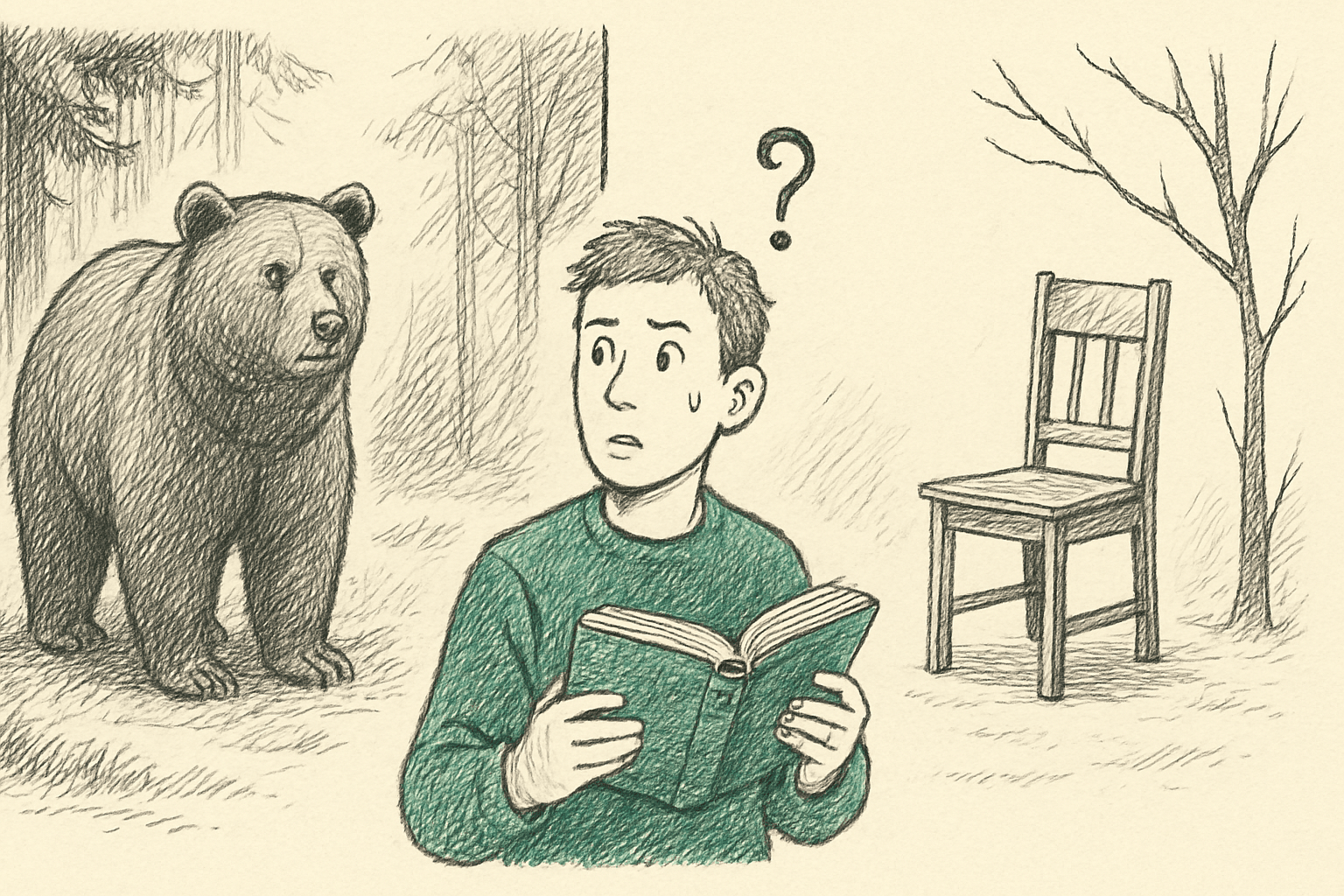
The word bear also names a large furry mammal, and that image can hijack your mental search when you are trying to write the verb. Many writers freeze because they picture the animal and assume the verb must look different, or they feel the animal connection makes no sense in a business sentence. The verb bear and the noun bear share the same spelling but have separate etymological roots, so the creature in the forest is irrelevant to the phrase bear with us. What matters is the verb’s core idea of endurance, not claws and fur.
What “Bear With Us” Actually Means
When you write bear with us, you are issuing a polite request for patience and asking the reader to tolerate a temporary inconvenience. The phrase softens the sting of delays, errors, or long loading times by framing the wait as a shared burden that the audience generously helps you carry. It frequently appears with conjunctions such as while or as, which explain exactly what is happening during the requested delay. For instance, a project manager might say, “Bear with us as we finalize the report,” clearly linking the appeal for patience to a specific action. The tone stays professional yet warm, making it ideal for customer service, team updates, and public announcements. Importantly, the phrase implies gratitude in advance; it assumes the reader will cooperate, which builds goodwill even when the news is frustrating. Whether the delay lasts ten seconds or ten minutes, bear with us signals respect for the other person’s time.
Bear as a Verb: Endure, Carry, Tolerate
The verb bear carries several related meanings that all circle back to endurance. You can bear pain, bear responsibility, bear weight, or bear with someone who needs extra time. In the phrase bear with us, the verb specifically means tolerate or be patient, drawing on a sense that appears in English texts as far back as the sixteenth century. The word also produces the past tense bore and the past participle borne, though those forms rarely appear in the patience-related expression.
Examples
- The columns bear the weight of the entire roof.
- She bore the bad news with remarkable calm.
- I cannot bear the noise from the construction site.
- Please bear with us while we update our systems.
When to Use “Bear With Us” vs “Bear With Me”
Choosing between us and me depends entirely on who is speaking. When a company, team, or group representative addresses an audience, bear with us is the natural choice because the speaker acts on behalf of multiple people. When a single individual asks for patience during a presentation, phone call, or personal email, bear with me is correct. Customer-service agents almost always use the plural form because they represent the organization, whereas a freelancer might use the singular when apologizing for a personal delay.
| Bear with us | Bear with me |
|---|---|
| “Please bear with us while we check your account.” | “Bear with me for a moment; I need to find the file.” |
| Used by teams, companies, and groups. | Used by individuals speaking for themselves. |
What “Bare With Us” Would Mean (and Why It’s Wrong)
If you write bare with us, you are not asking for patience—you are asking people to uncover themselves or reveal something alongside you. The verb bare means to expose, strip, or make naked, which collapses into absurdity the moment it enters a professional sentence. Imagine an airline sending a message that says, “Please bare with us during boarding”; passengers would rightfully assume a typo or a very unconventional flight experience. The error is not just embarrassing—it can undermine credibility because it signals a lack of proofreading in high-stakes communication. Unlike some spelling mistakes that pass unnoticed, bare with us creates a vivid and unwelcome mental image that distracts from your actual message. In every context where patience is required, bare is the wrong tool for the job, and no style guide or dictionary recognizes the phrase as valid English.
Bear vs Bare: Quick-Check Table
Because bear and bare collide so often in fast typing, a single glance at a comparison table can rescue your sentence before you click send. The table below breaks each word down by its part of speech, its core definition, and a quick example that anchors the meaning in real usage. Keep this reference handy when you edit emails, support tickets, or blog posts where the homophone trap lurks. Scanning the rows takes less than five seconds, yet it prevents the kind of typo that makes readers pause, laugh, or lose trust in your professionalism. Memorizing the patterns here turns a recurring doubt into an automatic choice. Once you associate the spelling bear with endurance and bare with exposure, the table becomes a mental checkpoint you can run in under a second. Print it, bookmark it, or paste it into your notes—whichever method keeps your writing clean and your reputation intact.
| Word | Part of speech | Core meaning | Example |
|---|---|---|---|
| bear | verb | endure, tolerate | Please bear with us during the delay. |
| bear | noun | large mammal | A brown bear wandered near the campsite. |
| bare | verb | uncover, expose | She had to bare her arm for the vaccine. |
| bare | adjective | uncovered, plain | The room felt cold with its bare walls. |
| bear | verb (phrase) | keep in mind | Bear in mind that prices may change. |
| bare | adjective (phrase) | absolute minimum | He packed only the bare essentials. |
Bear With Us in Real Sentences
Seeing a phrase in context cements the rule far better than memorizing definitions alone. The following sections show exactly how bear with us behaves in three distinct environments: formal business writing, live customer-service chats, and everyday spoken English. Each example mirrors language you will actually encounter or produce, so you can borrow the structure with confidence. Notice how the phrase often pairs with a brief explanation of the delay, which softens the request and keeps the reader informed. Whether you are calming an angry client or buying time during a presentation, these real-world sentences provide a template you can adapt immediately. Pay attention to the surrounding politeness markers, because they reveal how native speakers cushion the inconvenience without over-apologizing. Once you internalize these patterns, you will stop second-guessing the spelling every time patience is required from your audience.
Email and Business Writing Examples
In corporate inboxes, precision matters. A single typo can redirect attention from your apology to your spelling. The pairs below show how the correct phrase preserves professionalism while the misspelling undermines it.
Examples
- Correct: Please bear with us while we process your refund.
- Incorrect: Please bare with us while we process your refund.
- Correct: We apologize for the inconvenience and ask you to bear with us.
- Incorrect: We apologize for the inconvenience and ask you to bare with us.
- Correct: Bear with us as we upgrade our servers this weekend.
- Incorrect: Bare with us as we upgrade our servers this weekend.
- Correct: Thank you for bearing with us during the transition.
- Incorrect: Thank you for baring with us during the transition.
Customer Service and Chat Examples
Support agents use the phrase dozens of times per shift to bridge awkward silences. These lines keep the tone respectful without sounding robotic.
Examples
- Please bear with us while we check your account details.
- Thank you for bearing with us while the system restarts.
- We appreciate your patience—please bear with us for just a moment.
Spoken English Examples
In face-to-face conversations, the phrase often shrinks and speeds up, but the spelling stays the same when you write it down later.
Examples
- “Bear with me a second; I need to pull up the file.”
- “Could you bear with us while the presenter reconnects?”
- “I know this is frustrating—bear with us for one more minute.”
Please Bear With Us vs Kindly Bear With Us: Politeness Levels
Both please bear with us and kindly bear with us ask for patience, but they broadcast slightly different tones to the reader. Please sits comfortably in the middle of the politeness scale; it sounds warm, natural, and appropriate for almost any business audience without feeling stiff or pushy. Kindly, on the other hand, carries a more formal, almost old-fashioned weight that can tip into abruptness if the surrounding sentences are short. British English uses kindly more frequently than American English, yet even in the UK, modern customer-service training often favors please or replaces the entire phrase with thank you for your patience. If you want to sound approachable and contemporary, stick with please or reframe the delay as gratitude already given. Save kindly for formal legal notices or highly traditional correspondence where distance is actually the goal.
Email & Chat Playbook: How to Ask for Patience Without Sounding Rude
Asking for patience is an art: too blunt and you sound dismissive; too wordy and you waste the very time you are apologizing for. The playbook below gives you ready-made phrases for the five situations where delays strike most often, from a slow email reply to a frozen chat queue. Each line balances brevity with warmth, and every one uses bear correctly so you never have to guess. Copy them directly, or tweak the tone to match your brand voice. The list also includes two traps to avoid: never write bare with us, and reserve kindly for contexts where formality truly matters. With these sentences in your toolkit, you can turn a frustrating delay into a moment of professional reassurance. Review the five steps before you draft your next support message, and your tone will stay calm even when the situation is not.
- Step 1: Identify the situation—email delay, technical outage, chat queue, call hold, or meeting pause.
- Step 2: Choose a phrase that matches your company’s tone: “Please bear with us” for neutral warmth, or “Thank you for your patience” for softer reassurance.
- Step 3: Add a brief reason so the reader knows the delay has a purpose: “…while we verify your details.”
- Step 4: End with gratitude: “We appreciate your understanding” or “Thanks for waiting.”
- Step 5: Proofread for homophones—scan for bear versus bare before you hit send.
Memory Tricks That Actually Work
When homophones refuse to behave, a vivid mnemonic can lock the correct spelling into long-term memory faster than repeated drills. The best tricks connect the spelling to an image or emotion that you can summon in under a second while staring at a blinking cursor. One popular method pictures a grizzly bear enduring a brutal winter in its den; the animal tolerates the cold, and so does the verb bear. Another approach focuses on bare by linking it to bare skin—both are exposed, uncovered, and missing that extra layer. If you prefer psychological pressure, remember that writing bare with us in a company-wide email will leave you em-bare-assed, which is exactly how you will feel when the typo is spotted. Finally, some writers note that bear contains ear, and a bear has ears, while bare has nothing extra to cover itself. Pick the device that makes you smile, because laughter is the best glue for grammar.
Sent “Bare With Us” Already? Here’s How to Recover
Discovering that you sent bare with us to a client, a manager, or an entire mailing list can trigger a wave of embarrassment, but the damage is usually smaller than you fear. Most readers automatically correct the typo in their heads because the intended meaning is obvious from context; they know you were not inviting them to undress. If the email went to a close colleague, a lighthearted follow-up works better than a formal apology: a quick “Apologies for the typo—I meant bear with us, not a wardrobe change” defuses tension and shows you care about accuracy. For high-stakes external clients, send a brief correction that restates the message professionally without over-explaining. The key is to avoid drawing more attention to the error than necessary; a simple “Please see the corrected version below” line preserves dignity while fixing the record. Treat it as a reminder to add bear versus bare to your personal proofreading checklist rather than as a career-defining catastrophe.
Common Mistakes Audit: Bear/Bare and Friends
The bear versus bare confusion rarely travels alone; once your ear is tuned to this homophone pair, you will start spotting its relatives in every draft you edit. Writers who hesitate over bear with us often second-guess themselves on bear in mind, bearing with me, and the past forms bore and borne. Each expression relies on the same verb meaning endure or carry, yet the shifting spellings create enough uncertainty that errors slip through even rigorous proofreading. This audit walks through the four most common sibling mistakes, giving you the correct form and a quick rationale for each. Run through the list before you publish anything that contains one of these phrases, and you will catch the typo that spellcheck cannot see because both words are valid English—just not in these contexts. A two-second scan now saves the awkwardness of a correction later.
Tips
- Scan for “bare” whenever you write “bear with us” or “bear in mind”.
- Use “bearing” for tolerance, never “baring”.
- Link “barely” to “hardly” and remember “bearly” is not a real word.
- Check past forms: “bore” (past) and “borne” (participle), not “bared”.
Bear In Mind, Not Bare In Mind
You need bear in mind because the verb bear carries the idea of holding or keeping something in your thoughts. If you write bare in mind, you suggest stripping a thought naked, which makes no sense in standard English. The phrase appears frequently in formal instructions and friendly reminders alike, so mastering it now prevents errors later.
Bearing With Me, Not Baring With Me
When you thank someone for their patience, the correct participle is bearing, not baring. Bearing with me means tolerating my delay, while baring with me would mean undressing alongside me. The distinction matters in closing lines such as “Thank you for bearing with us during this transition.”
Bore and Borne: The Past Forms
The simple past tense of bear is bore, and the past participle is borne. You might write, “She bore the extra workload without complaint,” or “The cost has been borne by the department.” These forms rarely appear in the patience phrase, but they reinforce the verb family that excludes bare entirely.
Barely, Not Bearly
The adverb barely means only just or hardly, and it is the only correct form. Bearly is not a word in standard English, though it sometimes appears as a pun involving bears. If you mean scarcely, you always need the adverb built on bare.
Bear With Us or Bare With Us in UK vs US English
On both sides of the Atlantic, the correct spelling is bear with us, and bare with us remains a mistake. British and American English agree on this point completely, so you do not need to memorize two versions or worry about regional dictionaries contradicting each other. The only noticeable difference lies in how often each variety reaches for kindly bear with us; British business writing retains kindly slightly more frequently, while American English often finds it old-fashioned or even brusque. Both regions, however, are shifting toward thank you for your patience or thanks for waiting as warmer alternatives. Whether your audience sits in London, New York, or Sydney, the rule stays the same: bear when you mean endure, bare when you mean uncover, and never swap them when patience is on the line. If you write for an international audience, this consistency is a relief—one less variable to juggle across borders.
Frequently Asked Questions
Bear with us is correct. Bare with us is a common misspelling caused by the identical pronunciation of the two words.
It means “be patient with us” or “tolerate a short delay” while the speaker resolves an issue.
People write bare with us because bear and bare are homophones—they sound exactly the same but have different meanings and spellings.
It is neutral and polite. You can use it in formal business emails as well as casual conversation without sounding stiff or overly familiar.
Yes. Adding “please” makes the request more polite: “Please bear with us while we finalize your order.”
Use “bear with us” when a group or company asks for patience. Use “bear with me” when a single individual asks for patience.
Yes. Both UK and US English use bear with us. The rule is identical in both varieties.
Final Verdict on Bear With Us or Bare With Us
Choosing between bear with us and bare with us is not a style preference—it is a matter of using real English versus a misspelling. The verb bear brings the necessary meaning of endurance to the phrase, while bare introduces an entirely unrelated idea of exposure that derails your message. Lock in one mnemonic, run the quick-check table through your mind before sending, and you will never again hesitate at the keyboard. Your readers will see a confident professional who respects their time, not a typo waiting to go viral.