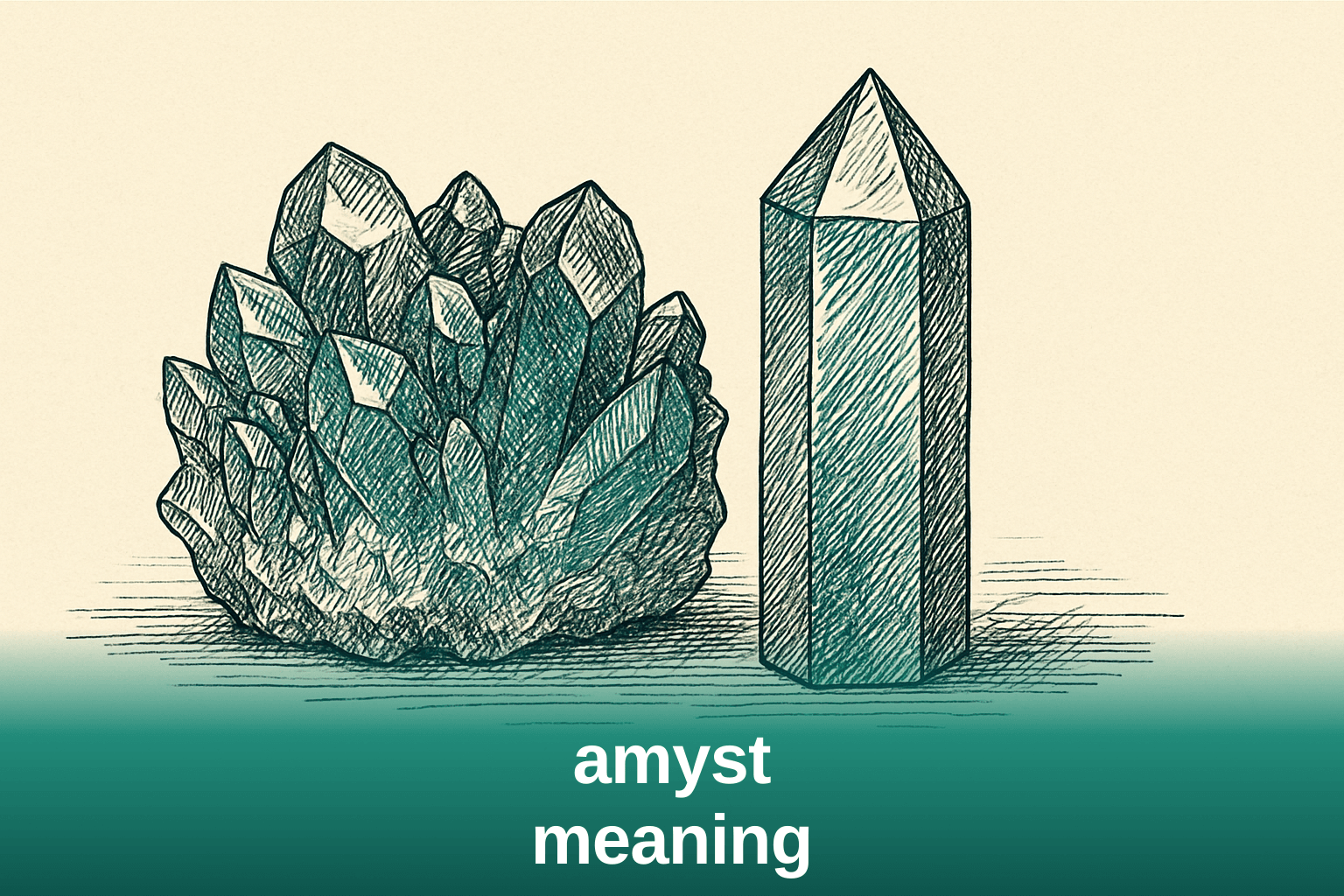

Amyst is a variant spelling of amethyst, a purple quartz whose name derives from the Greek amethystos meaning “not drunk.” The stone symbolizes calm, clarity, and spiritual protection, and it is recognized as the February birthstone and the gemstone for the 6th wedding anniversary. With a Mohs hardness of 7 and a chemical composition of SiO₂, amethyst is durable enough for daily wear but can fracture under impact.
You have probably stumbled across “amyst” in a hashtag, a jewelry listing, or a username and wondered whether it is a real word. Most people hesitate between typing amyst and amethyst, unsure if the shorter version hides a separate meaning. This article clears up the spelling confusion, traces the name back to its Greek roots, and explains what the purple gemstone actually symbolizes in spirituality, gifting, and daily life.
What Does “Amyst” Mean? The Short Answer
If you look up “amyst” in major English dictionaries, you will not find it as a standalone entry. The spelling “amyst” is not a standard dictionary entry in any major English lexicon. It does not appear in the Oxford English Dictionary or Merriam-Webster as an independent lexeme. In practice, nearly every occurrence of the word points back to amethyst, the well-known purple variety of quartz. Writers and shoppers often drop the internal syllable when they are in a hurry, treating amyst as a phonetic shortcut rather than a distinct term. That said, language always bleeds into personal use. A handful of people adopt Amyst as a given name, a social media handle, or a small brand label. In those cases, the word carries whatever meaning the owner assigns to it. For everyone else, amyst meaning simply collapses into amethyst meaning. The distinction matters mostly in formal writing, where the full spelling is expected, and in search queries, where the shorter form reflects how people actually type.
Because the spelling sits in a gray zone, readers should check the surrounding context before assuming a mineral reference. If the text talks about color, birthstones, or chakras, the writer almost certainly means amethyst.
Examples
- She searched for the amyst meaning after seeing the word in a caption.
- The listing spelled it amyst, but the stone was amethyst.
- Amyst is often used as a short handle online.
Amyst vs Amethyst: Spelling, Origin and Confusion Explained
The confusion between amyst and amethyst is easy to understand once you hear both forms aloud. One spelling is centuries old, chemically precise, and backed by every major mineralogical reference book and English dictionary. The other is a modern truncation born from smartphones, autocorrect slips, and strict social-media character limits. Yet they cross paths constantly in online marketplaces, Instagram captions, and Google search bars, leaving readers unsure which version to trust or whether the shorter form signals a different gemstone altogether. Amyst is a modern truncation of amethyst, not a separate word with its own definition. To sort them out and understand why amyst meaning remains tied to the longer word, you need to look at where the original word came from, why human fingers naturally skip the middle syllable, and whether amyst ever stands for something else entirely. The following sections break down the Greek etymology, the typographical habits that create the shorter form, and the rare but real cases where amyst is genuinely its own name rather than a simple misspelling.
| Term | Status | Origin | Where you see it | Correct usage |
|---|---|---|---|---|
| Amyst | Informal variant / shorthand | Modern phonetic clipping | Social media, search typos, usernames | Casual contexts only; not for scientific or jewelry certification writing |
| Amethyst | Standard English dictionary word | Greek amethystos | Gemology, jewelry, birthstone lists, geology | Universal standard for the purple quartz gemstone |
| Amethystos | Ancient Greek root | Greek a- (not) + methyein (to be drunk) | Historical texts, etymology references, mythology | Scholarly or linguistic discussion of word origin |
Where the Word “Amethyst” Comes From (Greek amethystos)
The name amethyst travels straight back to ancient Greece. The Greek word amethystos combines the private prefix a-, meaning “not,” with methyein, “to be drunk.” Together they form the concept of sobriety, and classical Greeks believed that wearing or drinking from amethyst vessels could prevent intoxication. Archaeologists have uncovered carved amethyst cups and talismans from both Greek and Roman sites, suggesting the belief was widespread and practical rather than merely poetic. The Greek word amethystos literally means “not drunk,” linking the stone to sobriety for millennia. The myth behind the color is just as compelling. According to legend, the nymph Amethystos rejected the advances of Dionysus, the god of wine. To protect her, the goddess Artemis turned the nymph into a white stone. When Dionysus later poured his wine over the stone in remorse, it absorbed the purple hue. That story locked the color and the anti-intoxication meaning together for millennia.
Why People Type “Amyst” Instead of “Amethyst”
Human fingers and phone keyboards are built for speed, not for classical Greek. The middle syllable “-eth-” in amethyst is soft and easy to skip in rapid speech, so the ear hears something closer to “am-ist” or “ay-mist.” On a touchscreen, the letters T-H-E sit in a cluster that autocorrect sometimes resolves poorly, especially if the user misspells the first half. People type “amyst” mainly because phonetic clipping and autocorrect habits erase the middle “-eth-” syllable. Social platforms reinforce the trend because short handles and hashtags reward brevity. A creator selling crystal jewelry on TikTok or Instagram often prefers #Amyst to #Amethyst simply because it is faster to type and easier to fit in a caption. Search behavior mirrors this: people type what they hear, and they hear five syllables collapsed into four.
Examples
- A TikTok seller tags a video #amyst to save character space in the caption.
- A shopper types “amyst ring” into Google because that is how the stone sounds in conversation.
- An online game automatically shortens a long username to Amyst, creating a new handle.
Other Meanings of “Amyst” (Names, Brands, Handles)
Outside the mineral aisle, Amyst occasionally functions as a proper noun. Parents seeking a rare name sometimes choose Amyst as a phonetic twist on Amethyst, stripping the geological ending to create something that sounds more like a contemporary first name. Independent musicians, Etsy shop owners, and Twitch streamers have also adopted the spelling as a brand or handle, drawn by its brevity and the soft hiss of the final consonant. Outside geology, “Amyst” can function as a personal name, brand, or social media handle with no mineral connection. In these contexts, the word carries no fixed mineral meaning. It becomes a blank slate for personal identity. The key is to read the surrounding signals. If you see Amyst next to a birthstone chart, the writer meant amethyst. If you see it beside a SoundCloud link, it is almost certainly a creative alias.
Amethyst Meaning and Symbolism: The Full Picture
Amethyst is far more than a pretty purple rock sitting in a museum case. For thousands of years, successive cultures have layered it with meanings that range from spiritual protection and religious piety to emotional clarity and romantic fidelity. Today it sits at a busy intersection of geology and metaphysics, valued by scientists for its silicon dioxide crystal structure and by wellness practitioners for its purported calming energy. Understanding the full symbolism requires looking at three distinct angles: the spiritual associations tied to the crown chakra, the historical roles it played across civilizations from Egypt to medieval Europe, and the modern calendar landmarks that keep it relevant every February and at every sixth wedding anniversary. Amethyst consistently symbolizes calm, clarity, and protection across both scientific and spiritual contexts. Together these threads explain why a single gemstone can feel both ancient and urgently personal to the people who wear it.
Spiritual Meaning and the Crown Chakra
In contemporary crystal practice, amethyst is most often linked to the crown chakra, the energy center that sits at the top of the head. Practitioners associate this chakra with higher consciousness, spiritual insight, and inner wisdom. They place amethyst on or near the head during meditation to encourage mental quiet and to filter out distractions. Amethyst is most commonly associated with the crown chakra and the pursuit of higher consciousness. The deep violet color is thought to resonate with the highest frequencies of the subtle body, bridging everyday awareness and deeper intuition. While these ideas are central to many wellness traditions, they belong to metaphysical belief systems rather than clinical science.
Cultural Meanings Across History
Different eras and regions have assigned their own values to amethyst. In ancient Greece and Rome, soldiers and revelers alike carried it as a charm against drunkenness. Medieval European bishops wore amethyst rings and crosses, earning it the nickname “Bishops’ Stone” as a mark of piety and celibacy. Egyptian nobility placed carved amethyst scarabs in tombs, believing the stone could guard against fear and guilt in the afterlife. Medieval bishops wore amethyst as the “Bishops’ Stone,” marking it as a symbol of piety and celibacy. Buddhist traditions have long used amethyst beads for rosaries and meditation aids, trusting the color to promote focus. In modern Western culture, the gem has become a broad symbol of calm, clarity, and protection, often gifted during stressful life transitions.
| Culture | Period | Meaning |
|---|---|---|
| Greek / Roman | Classical Antiquity | Protection from intoxication and overindulgence |
| Medieval Europe | Middle Ages | Piety, celibacy, and episcopal authority (“Bishops’ Stone”) |
| Ancient Egypt | Pharaonic era | Talisman against fear and guilt in life and afterlife |
| Buddhist traditions | Historical to present | Meditation aid, focus, and spiritual discipline |
| Modern Western | Contemporary | Calm, mental clarity, and emotional protection |
Amethyst as the February Birthstone and 6th Anniversary Gem
If you were born in February, amethyst is your official birthstone. Jewelers and gift guides consistently pair the gem with the second month of the year, offering it as a symbol of sincerity and temperance. It also marks the sixth wedding anniversary, a milestone where couples often exchange gifts that represent durability and continued growth. Historically, amethyst enjoyed even greater prestige. It was once counted among the five cardinal gems, alongside diamond, ruby, sapphire, and emerald, reserved for royalty and clergy. Amethyst is the official February birthstone and the traditional gemstone for the 6th wedding anniversary. That status shifted in the nineteenth century when large Brazilian deposits made the stone more abundant. Its symbolic value, however, never faded.
Whether you approach amethyst through a geological lens or a spiritual one, its meaning consistently circles back to clarity and protection. The gemstone manages to be both a scientific specimen and a cultural touchstone.
Amethyst Meaning When Gifted
Giving someone an amethyst is rarely a random or last-minute choice. The gift traditionally signals love, loyalty, and a sincere wish for emotional peace and mental balance. Because the stone symbolizes calm clarity, it is often presented during moments of transition or stress: a friend starting a demanding new job, a partner moving to another city, or a family member recovering from burnout. Unlike some gems that carry exclusively romantic weight, amethyst travels comfortably across almost every relationship type. You can hand it to a colleague as a thoughtful housewarming token or to a spouse on a sixth wedding anniversary with equal sincerity. Giving amethyst signals love, loyalty, and a sincere wish for emotional peace. The underlying message is almost always the same: I want you to feel protected, balanced, and clear-headed.
Examples
- A friend gives an amethyst bracelet to someone starting therapy, symbolizing emotional support.
- A partner presents an amethyst pendant on a sixth anniversary to honor durability and growth.
- A coworker leaves a small amethyst cluster on a desk as a housewarming gesture for calm energy.
Amethyst Meaning When It Breaks or Cracks
Watching a favorite amethyst crack can feel unsettling, especially if you have assigned personal meaning to the stone. From a practical standpoint, amethyst is not indestructible. It ranks at 7 on the Mohs scale, which means everyday objects like hardened steel or a sharp countertop edge can chip it. Thermal shock—moving the stone quickly from hot sun to cold water—or prolonged exposure to direct sunlight can also weaken its structure and cause fractures. On the symbolic side, some crystal traditions interpret a broken amethyst as a sign that the stone has absorbed negative energy or deflected a psychic blow on behalf of its owner. They recommend cleansing the fragments or replacing the piece entirely. A broken amethyst usually indicates physical impact or thermal shock, not a supernatural omen. Others simply see a physical object that reached its material limit.
Amethyst Meaning in Hindi and Other Languages
Gemstones do not lose their symbolism when they cross linguistic borders, though their names often change dramatically to fit local phonetics and cultural reference points. In Hindi, amethyst is commonly called जामुनिया (Jamuniya), a vivid reference to the deep purple jamun fruit, or कटेला (Katela) in some regional North Indian markets. The underlying associations remain familiar: the stone represents peace, spiritual protection, and mental clarity within Indian metaphysical shops and astrological consultations. Spanish speakers know it as amatista, French as améthyste, and German as Amethyst. In Hindi, amethyst is commonly called Jamuniya, referencing the deep purple color of the jamun fruit. While pronunciation and spelling shift across alphabets and dialects, the core meaning tied to sobriety, calm, and February birthstone status travels with remarkable consistency from one language to the next.
| Language | Word | Notes |
|---|---|---|
| English | Amethyst | Standard term; “amyst” is an informal variant |
| Hindi | Jamuniya / Katela | Jamuniya references the purple jamun fruit |
| Spanish | Amatista | Drops the ‘h’ found in English and French |
| French | Améthyste | Retains the Greek-derived ‘th’ with an accent |
| German | Amethyst | Pronounced with a hard ‘t’ and distinct vowels |
Amethyst Meaning in Dreams and Everyday Use
Dream interpretation is subjective, yet amethyst appears in sleep symbolism with surprising regularity across cultural dream dictionaries. Most sources associate the stone with a need for mental rest, firmer emotional boundaries, or deeper spiritual insight. Seeing a polished amethyst in a dream often points to a conscious or unconscious desire for clarity in a waking-life decision. A broken amethyst may mirror anxiety about losing protection, stability, or a valued relationship. Receiving one as a gift in a dream can signal that the subconscious recognizes genuine support from someone close. In dream symbolism, amethyst typically represents a need for mental rest, clarity, or stronger emotional boundaries. In everyday waking life, keeping amethyst on a desk or bedside table is usually framed as a mindfulness cue rather than a magical instrument. The visible purple color simply serves as a tactile reminder to breathe, pause, and recenter before reacting to stress.
Examples
- Dreaming of a glowing amethyst cluster suggests a search for higher perspective or wisdom.
- A dream of dropping and cracking an amethyst may reflect waking fears about personal boundaries collapsing.
- Finding an amethyst ring in a dream often symbolizes unexpected emotional support or loyalty.
Amethyst Properties at a Glance (Table)
Understanding amethyst meaning becomes easier once you know its physical identity beneath the purple surface. Geologically, amethyst is simply the purple variety of quartz, colored by trace amounts of iron and aluminum exposed to natural radiation over millions of years inside volcanic rock cavities. Its measurable properties give hard context to its symbolic reputation for durability and permanence. A stone that survives intense heat, pressure, and slow crystallization in deep-earth geodes can naturally feel like a quiet guardian to the people who later wear it. The table below lays out the core facts that gemologists use to identify the stone and that careful buyers should check before purchasing. Amethyst is silicon dioxide (SiO₂) colored purple by iron and manganese, with a Mohs hardness of 7. These numbers separate genuine amethyst from cheap glass imitations and explain why the gem has remained a respected jewelry staple for thousands of years.
| Property | Value |
|---|---|
| Chemical Composition | SiO₂ (Silicon Dioxide) |
| Hardness | 7 on the Mohs scale |
| Specific Gravity | 2.66 |
| Refractive Index | 1.544 – 1.553 |
| Color | Purple to violet |
| Cause of Color | Manganese and iron with natural irradiation |
| Birthstone | February |
| Anniversary | 6th wedding anniversary |
These properties matter because they connect physical reality to metaphor. A Mohs hardness of 7 means amethyst resists scratches from daily wear but can still fracture under impact, echoing the symbolic idea that protection requires care.
How to Pronounce Amethyst and Amyst Correctly
Pronunciation often drives the spelling confusion that lands people on the query amyst meaning in the first place. The standard gemstone is pronounced AM-eh-thihst, with the stress firmly on the first syllable and a soft “th” sound sitting clearly in the middle. The final syllable is quick and relatively unstressed. When people shorten the word to amyst, they usually shift to AY-mist or AM-ist, dropping the middle consonant cluster entirely and collapsing the word into two beats. This clipped version feels natural in fast-paced dialects of American or Australian English, where unstressed syllables frequently disappear in casual speech. The standard pronunciation is AM-eh-thihst, with stress on the first syllable. If amyst is being used as a personal name or social handle, the owner might choose either pronunciation, so it is always worth asking. In every other context, reverting to the three-syllable amethyst signals that you are referring to the purple quartz gemstone and not to a creative brand or username.
Common Mistakes and Myths About Amethyst Meaning
Misinformation spreads quickly in the age of viral crystal content and abbreviated social media posts. Because amethyst sits at the busy crossroads of hard science and personal spirituality, it attracts myths from both sides of the aisle. Some buyers dramatically overestimate its rarity based on medieval history, while others underestimate its physical limits and proper care requirements. A few wellness claims have been amplified far beyond any peer-reviewed evidence, and the spelling variation amyst has spawned its own miniature category of confusion among new collectors and casual shoppers alike. Sorting fact from fiction protects both your wallet and your expectations when you shop or study this gemstone. The list below addresses the five most common mistakes people make when they research, clean, wear, or purchase amethyst in any form.
- Amethyst is always expensive. False. Large Brazilian deposits discovered in the 1800s moved amethyst from the cardinal-gem list to the semi-precious category, making it widely affordable.
- Ultrasonic cleaning will destroy it. Not necessarily. A flawless amethyst usually tolerates ultrasonic baths; damage typically occurs only when the stone already has fractures or inclusions.
- Amethyst never fades. Incorrect. Prolonged exposure to direct sunlight can bleach its purple hue to a pale yellow or near-clear quartz.
- Amyst is a separate mineral. No. Amyst is simply a variant spelling or shorthand for amethyst, not a distinct geological species.
- Amethyst cures insomnia or anxiety. Unproven. While many traditions use the stone for relaxation, no clinical trial confirms it as a medical treatment for sleep or mood disorders.
How to Cleanse and Recharge Your Amethyst
Once you have invested personal meaning in an amethyst, keeping it physically and energetically clean becomes part of the relationship. Most collectors distinguish between mundane cleaning and metaphysical cleansing. For everyday dirt, warm water with mild soap and a soft brush safely remove skin oils and dust without damaging the surface. Ultrasonic cleaners can work on flawless stones but should be avoided if the gem has visible fractures. For those who follow crystal traditions, cleansing often involves moonlight—particularly during a full moon—burying the stone briefly in dry earth, or resting it on a clear quartz cluster. These methods are believed to reset the stone’s energetic field after intense emotional work or long periods of wear. Direct sunlight is generally discouraged because it can fade the purple color over time, turning a deep violet into a pale yellowish quartz. Whichever method you choose, consistency matters more than ritual complexity.
Frequently Asked Questions
It is not a standard dictionary word. In most contexts, amyst is a variant spelling or shorthand for amethyst. In rare cases, it functions as a personal name, brand, or username.
In the vast majority of contexts, yes. The shorter spelling usually reflects a typo, phonetic clip, or hashtag abbreviation. If it appears as a brand or handle, it may carry a separate, personal meaning.
Amethyst traditionally symbolizes calm, mental clarity, and protection. In chakra systems, it is linked to the crown chakra and spiritual insight. These are metaphysical beliefs, not medical facts.
It conveys love, loyalty, peace, and emotional support. The gift is appropriate for partners, friends, colleagues, and anyone going through a stressful transition.
Practically, it means the stone suffered impact, thermal shock, or structural stress. Symbolically, some traditions believe it absorbed negative energy and should be cleansed or replaced.
In Hindi, amethyst is commonly known as जामुनिया (Jamuniya) or कटेला (Katela), depending on the region.
Yes. Amethyst is the official birthstone for February and the traditional gemstone for the 6th wedding anniversary.
Final Verdict: What “Amyst Meaning” Comes Down To
At its core, amyst meaning is simply amethyst meaning in disguise. The shorter spelling is a product of fast fingers and phonetic laziness, not a separate dictionary entry. When you strip away the typos and hashtags, you are left with a purple quartz whose Greek name promised sobriety and whose modern reputation promises calm. Whether you value it as the February birthstone, a crown chakra symbol, or a thoughtful gift, the gemstone delivers the same message across centuries and languages. If you encounter amyst in the wild, check the context, trust the three-syllable spelling for formal use, and remember that the stone itself is far older than any keyboard abbreviation.