
This article is for general informational purposes only and does not constitute legal advice. Laws vary by jurisdiction, and you should consult a qualified criminal defense attorney about your specific situation.
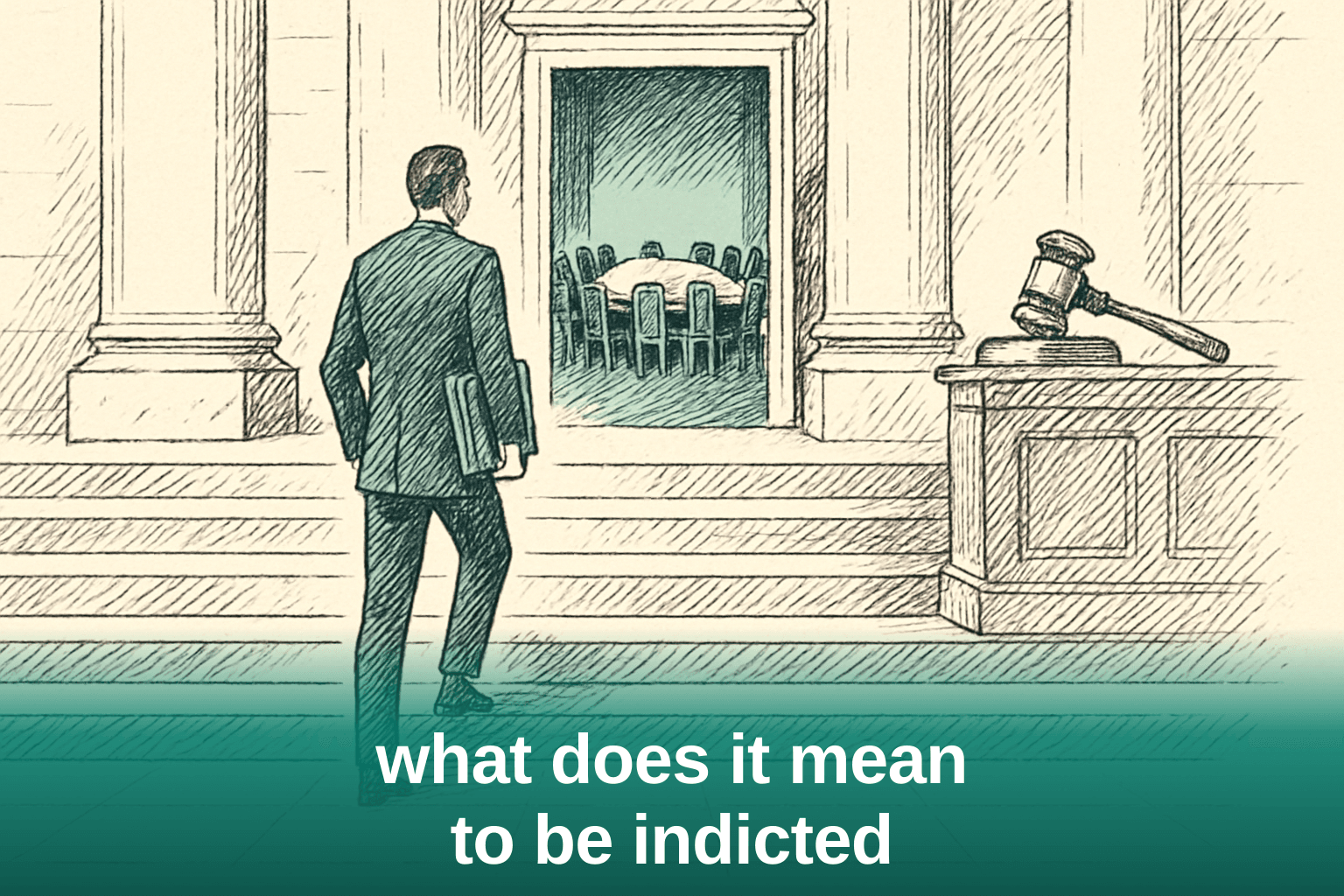
To be indicted means a grand jury has formally accused you of a crime after finding probable cause. It is a formal accusation that opens a criminal case, but it is not a conviction and does not mean a judge or jury has found you guilty.
- An indictment is a formal accusation issued by a grand jury based on probable cause.
- Probable cause is a lower standard than beyond a reasonable doubt.
- The defendant is usually not present during grand jury proceedings.
- Being indicted is not the same as being convicted.
- After an indictment, the next step is typically arraignment, plea entry, and bond.
- Federal felony charges require a grand jury indictment under the Fifth Amendment.
Key takeaway: an indictment is a formal accusation, not proof of guilt.
You see a headline that a well-known figure was indicted, and the word itself sounds like a final judgment. Many people quietly assume it means the person is already guilty. If you or someone close to you just received that news, the uncertainty can feel overwhelming. This article breaks down what an indictment actually is, how a grand jury reaches that decision, and what practical steps unfold in the hours and days after the charges are filed.
What Does It Mean to Be Indicted? The Plain-English Definition
In the simplest terms, to be indicted means a grand jury has issued a written statement saying there is enough evidence to charge you with a crime. This document is called an indictment, and it serves as the official trigger that moves a suspect into the role of a defendant in a criminal case.
Black's Law Dictionary defines it as “a written accusation of one or more persons of a crime or misdemeanor, presented to, and preferred upon oath or affirmation, by a grand jury legally convoked.” Once the indictment is filed with the court, the government must list the specific charges, known as counts, and the accused must respond through the formal court process.
At the federal level, the Fifth Amendment requires a grand jury indictment for what it calls “capital or infamous crimes,” which courts interpret as federal felonies. That constitutional rule, however, applies only to federal prosecutions, not automatically to every state. An indictment does not assign guilt; it merely announces that a panel of citizens decided the prosecutor presented sufficient facts to justify a trial.
Examples
- “The grand jury charges that on or about [date], in the District of [X], the defendant did knowingly…” — This opening line identifies the alleged date, location, and the defendant’s intentional conduct underlying the count.
- “COUNT 1: Wire Fraud (18 U.S.C. § 1343)” — This labels the specific statute the prosecution believes was violated, turning a general allegation into a precise legal claim.
- “A TRUE BILL — Foreperson” — This signature means the grand jury foreperson certifies that the required majority voted to approve the indictment.
Indictment vs. Criminal Charge vs. Conviction — What Is the Difference?
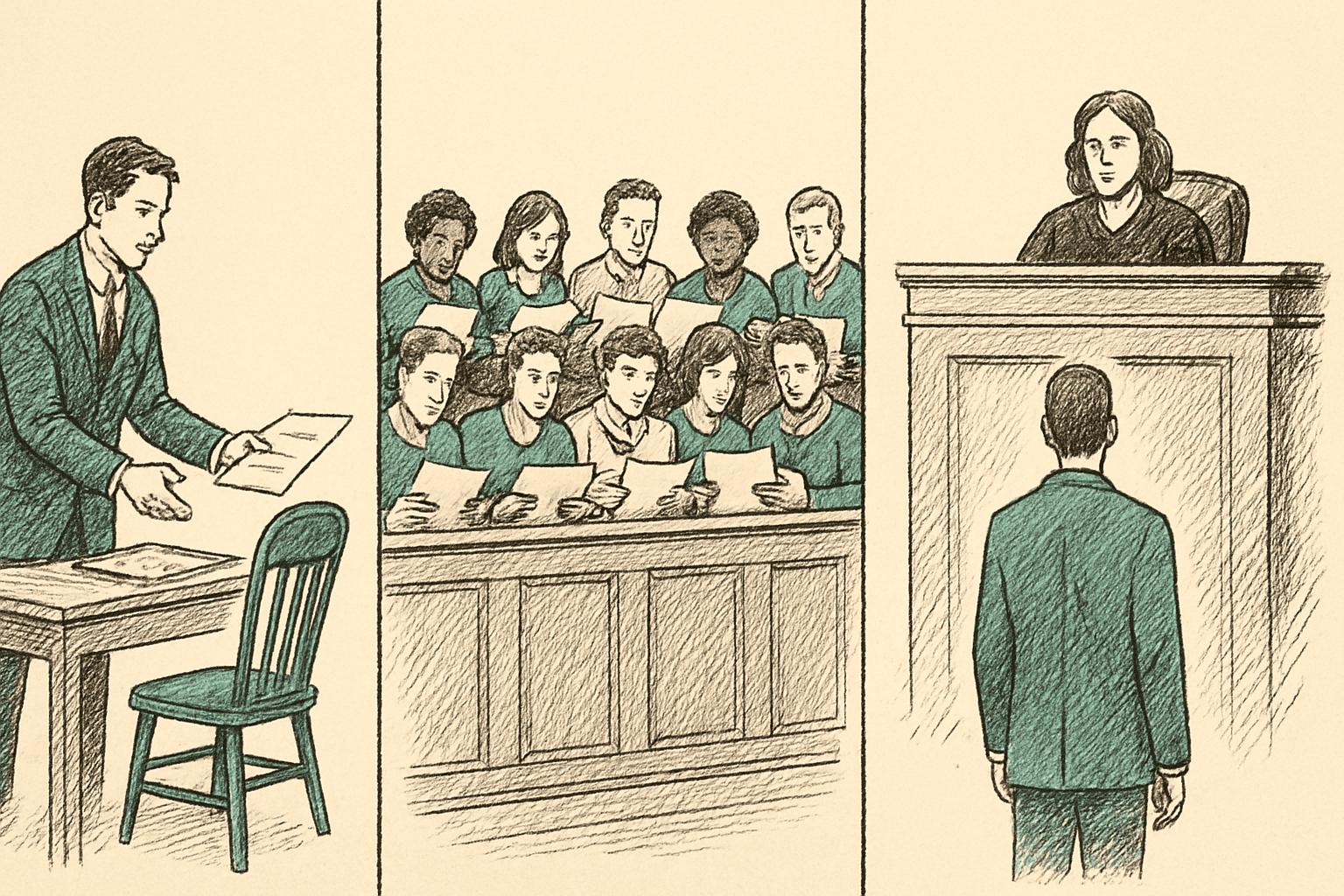
In the simplest terms, an indictment is one specific way to bring a criminal charge, yet not every charge begins with an indictment. A prosecutor can file a criminal complaint or an information directly with a judge, especially for misdemeanors or in states that do not require grand jury review for every felony.
A conviction, on the other hand, happens only after a guilty plea is accepted by the court or after a trial jury finds the defendant guilty beyond a reasonable doubt. In short, the indictment kicks the door open, the charge is the formal allegation walking through it, and the conviction is the final judgment that closes the room.
Because an indictment is merely a procedural gateway, it can be dismissed later if evidence weakens or legal defects appear. Understanding this hierarchy helps answer the common question: is being indicted the same as being charged? The answer is that an indictment is a type of charge, but being charged does not always mean you were indicted.
| Factor | Indictment | Criminal Charge | Conviction |
|---|---|---|---|
| Who issues it | Grand jury | Prosecutor or grand jury | Judge or jury at trial |
| Standard of proof | Probable cause | Probable cause or prima facie | Beyond a reasonable doubt |
| Who decides | Grand jury vote | Prosecutor or judge | Jury or judge (bench trial) |
| Creates a criminal record | No | Arrest/charging record only | Yes |
| Can it be reversed | Can be dismissed | Can be dropped or dismissed | Appeals process only |
| What it means for the defendant | Must respond in court | Must respond in court | Sentence is imposed |
How a Grand Jury Decides to Indict
A grand jury is not a trial jury. Its members do not hear competing arguments from both sides, and they do not decide whether a defendant is guilty or innocent. Instead, they serve as a screening panel that reviews evidence presented solely by the prosecutor to determine whether there is probable cause to believe a crime occurred and that the suspect committed it.
The proceedings are secret, the defendant is rarely in the room, and the rules of evidence are noticeably looser than at trial. If the panel finds sufficient grounds, it approves the formal written accusation and the case moves into the court system.
Who Sits on a Grand Jury and How Many Votes Are Needed
Federal grand juries are made up of sixteen to twenty-three citizens drawn from voter rolls and lists of licensed drivers. To return an indictment, at least twelve of those members must vote in favor of finding probable cause. States set their own rules. In Ohio, for example, a grand jury contains nine members, and at least seven must agree before an indictment can be issued.
Jurors typically serve for a set term that can last several months, and they may review many cases during that period. The defendant and defense counsel are generally not allowed inside the grand jury room while evidence is being presented or while the panel deliberates. These secret proceedings are designed to encourage witnesses to speak freely and to protect the reputations of individuals who are not ultimately indicted.
Only the jurors, the prosecutor, court reporters, and interpreters may be present during testimony. This closed process often shocks people who learn they were indicted without ever having a chance to testify or rebut the evidence in person. Because the process is one-sided, the prosecutor controls what the jury sees and hears. There is no judge in the room to rule on objections in the same way a trial judge would, and the defense cannot cross-examine witnesses.
The Probable Cause Standard vs. Beyond a Reasonable Doubt
Probable cause is the threshold a grand jury uses, and it is far lower than the standard required to convict. Think of it this way: probable cause is like noticing thick smoke drifting from under a door and reasonably believing a fire is burning on the other side, even though you have not seen the flames yourself.
Beyond a reasonable doubt is what the prosecution must prove at trial—akin to walking into the room, smelling the smoke, feeling the heat, and confirming beyond any sensible question that a fire is indeed raging and that no other explanation fits the facts. Legally, probable cause means there are reasonable grounds to believe a crime was committed and that a specific person committed it.
It does not require proof so strong that it eliminates every other possible explanation. At trial, the prosecution must persuade a unanimous jury that no reasonable doubt exists regarding the defendant's guilt. Because the gap between these two standards is wide, grand jury proceedings focus on the quantity and basic credibility of evidence rather than on defeating every potential defense.
True Bill vs. No Bill
When a grand jury votes to approve an indictment, the document is marked with the words “true bill,” signed by the foreperson, and forwarded to the court. That label means the panel found probable cause and the charges are formally active.
If the jury does not find sufficient evidence, it returns a “no bill,” which means the proposed charges are rejected and the indictment is not issued. A no bill is not an acquittal, and it does not prevent the prosecutor from presenting the case again later with additional witnesses or new evidence.
Because no trial ever began, constitutional protections against double jeopardy do not apply at this stage. The prosecutor can convene a new grand jury or seek charges through another method if the investigation continues to produce stronger proof. For the suspect, a no bill offers temporary relief, but it does not guarantee permanent closure unless the statute of limitations expires or the prosecutor formally declines to proceed.
Can You Stop an Indictment Before It Happens?
Not every indictment arrives without warning. In federal cases, suspects sometimes receive a target letter informing them that they are the focus of a grand jury investigation and that charges may follow.
If you learn you are under investigation, the window before an indictment is returned can be critical. Most defendants retain counsel as soon as they suspect exposure, and experienced attorneys often reach out to the prosecutor to present exculpatory evidence—facts that suggest the suspect did not commit the crime—or to argue that the conduct does not meet the elements of the offense.
In some situations, early cooperation against higher-level participants can lead to prosecutors declining to seek an indictment altogether. Attorneys may also request a proffer session, a carefully structured meeting where the suspect shares information under limited immunity agreements. The key is speed: once the indictment is returned, the procedural train has left the station, and negotiations move from pre-charge prevention to post-charge damage control.
What Happens After You Are Indicted — Step by Step
An indictment is the starting pistol, not the finish line. Once the document is filed and made public, the court acquires jurisdiction, and the defendant must be brought before a judge to answer the charges. The process that follows is highly structured, and the first few days often determine whether the defendant remains in custody or returns home while the case proceeds.
The two immediate phases that demand attention are the critical first seventy-two hours and the arraignment, where the formal charges are read, a plea is entered, and bond is decided. Understanding this sequence helps reduce fear and replaces panic with a clear checklist of legal deadlines.
The First 72 Hours After an Indictment
The hours immediately following an indictment are chaotic, but the actions you take—or refuse to take—can shape the entire trajectory of the case. Panic leads many people to contact investigators to explain their side, delete old text messages, or reach out to co-defendants in hopes of coordinating stories.
Each of those impulses can create new legal exposure rather than solve the underlying problem. Some defendants even try to move assets or change travel plans, not realizing that such behavior can trigger additional charges or cause a judge to deny bond later. Instead, the focus should shift to preservation, silence, and rapid legal mobilization.
The first seventy-two hours are not the time to prove innocence; they are the time to protect rights and avoid compounding the situation. Below are the six steps that most defense attorneys emphasize before arraignment.
- Step 1: Do not speak with federal agents or police without an attorney present. Anything you say can be used as evidence, and even innocent misstatements can be presented as intentional falsehoods.
- Step 2: Do not delete, move, or destroy documents, emails, or devices. Obstruction of justice charges can be added if the government believes evidence was tampered with after the indictment.
- Step 3: Avoid contact with potential witnesses, co-defendants, or associates. Even a casual text message can be interpreted as witness tampering.
- Step 4: Refrain from public statements, social media posts, or media interviews. Prosecutors routinely monitor public comments for admissions or contradictions.
- Step 5: Preserve every document, receipt, email, or record related to the allegations. Your attorney will need a complete picture to build a defense or negotiate a bond.
- Step 6: Contact a criminal defense attorney immediately. Most defendants retain counsel before arraignment so that counsel can negotiate surrender, prepare for the bond hearing, and review the indictment for defects.
Following these steps does not guarantee a particular outcome, but it prevents the common mistakes that turn a defensible case into an uphill battle.
Arraignment, Bail, and the Charges You Will Face
Arraignment is the first official court appearance after an indictment. During this hearing, a judge reads the charges aloud, confirms that the defendant understands the accusations, and asks for an initial plea.
Most defendants enter a plea of not guilty at this stage, which preserves the right to challenge the evidence later through motions and potentially a trial. After the plea, the judge turns to the question of release.
Bond is not automatic; the court weighs several factors, including the severity of the charges, the defendant’s criminal history, ties to the local community, employment status, and the risk of flight. In federal cases, the presumption of detention sometimes applies to specific offenses, meaning the defendant must rebut the idea that no conditions of release can assure safety or appearance.
If bond is granted, it may come with restrictions such as travel limitations, electronic monitoring, or regular check-ins with pretrial services. The arraignment also sets the schedule for future deadlines, including discovery exchanges and motion cutoff dates.
| Stage at Arraignment | What Happens |
|---|---|
| Charges read | The judge reads the indictment counts so the defendant understands each accusation. |
| Plea entered | The defendant states guilty, not guilty, or no contest; not guilty is the most common initial plea. |
| Bond set | The judge decides release conditions based on flight risk, danger to the community, and charge severity. |
| Next court date | The schedule is set for pre-trial conferences, motion deadlines, and potential trial dates. |
Federal vs. State Indictments — Where the Rules Differ
The Fifth Amendment to the United States Constitution requires a grand jury indictment for capital or infamous crimes, but the Supreme Court has not incorporated that requirement against the states. As a result, each state decides whether a grand jury indictment is mandatory for felony cases.
States such as Ohio, Texas, Massachusetts, and New York still require grand jury indictments for felonies, preserving the traditional screening function. Other states allow prosecutors to file felony charges directly through a criminal complaint or information, though they may still use grand juries in complex matters. This difference matters because procedural safeguards, timing, and vocabulary change depending on where the case is filed.
A defendant facing federal charges will almost always see a “true bill,” while a defendant in a state that bypasses the grand jury may be summoned based on a prosecutor’s sworn complaint without citizen panel review. Federal indictments often carry stricter pretrial detention rules and higher penalties, which is why being indicted on federal charges frequently makes national news.
State systems vary widely: some use grand juries for all felonies, some only for capital offenses, and others leave the choice to the prosecutor's discretion. Because the federal grand jury pool is drawn from a larger geographic area, it may reflect a broader demographic mix than a county-level state panel. Additionally, federal grand juries often sit for eighteen months and can hear hundreds of cases, whereas state grand juries may convene for shorter terms and review fewer matters. Understanding whether your case is state or federal helps set expectations about bond, sentencing ranges, and the pace of the proceedings.
| Feature | Federal Indictment | State Indictment |
|---|---|---|
| Who must indict | Grand jury required by Fifth Amendment | Varies by state; grand jury optional in many |
| Grand jury size | 16 to 23 members | Typically 7 to 23 members depending on state law |
| Votes needed | 12 votes for a true bill | Varies; e.g., Ohio requires 7 of 9 |
| Defendant present | Almost never | Almost never |
| Typical use | All federal felonies | Felonies in some states; misdemeanors usually by complaint |
What an Indictment Does Not Mean
Because the word “indicted” appears in serious news coverage and carries heavy social weight, it is easy to treat it as a final judgment. It is not.
An indictment is simply a procedural green light, and several important things are still undecided at this stage. First, it is not a finding of guilt. The presumption of innocence remains fully intact until a guilty plea is accepted or a trial jury returns a verdict of guilty.
Second, it does not automatically create a criminal record in the sense of a conviction; background checks may show an arrest or pending charges, but they do not list a finalized offense unless the case ends in conviction. Third, the case is far from over. Defendants can file motions to dismiss, suppress evidence, or challenge the sufficiency of the indictment itself.
Prosecutors sometimes drop counts, and judges occasionally dismiss cases for constitutional violations or insufficient pleadings. Fourth, an indictment does not mean the defendant will automatically sit in jail until trial. Bond is regularly granted, especially for non-violent charges and for defendants with steady employment and strong community ties.
Understanding these boundaries helps reduce the panic that often follows the initial news and allows the accused to focus on the actual legal steps ahead rather than assumptions about an inevitable outcome.
What a Prosecutor Actually Does Inside the Grand Jury Room
Outside of legal circles, few people realize that a grand jury room has no judge and no defense attorney to balance the prosecutor’s presentation. The prosecutor acts as both the narrator and the gatekeeper of evidence, deciding which witnesses to call, which documents to display, and which legal standards to explain.
Grand jurors can ask questions, but they rarely have the tools to investigate independently or to challenge the reliability of the evidence placed before them. The prosecutor also drafts the indictment language that the jury is asked to approve, often presenting multiple counts for a single course of conduct.
Because the rules of evidence are relaxed, hearsay—statements made outside the courtroom by people who are not testifying—can be offered freely. This one-sided environment does not mean prosecutors act in bad faith; it simply means the grand jury process was designed to screen cases, not to adjudicate them. Recognizing this dynamic helps explain why an indictment reflects the prosecutor’s theory of the case rather than a neutral verdict on guilt or innocence.
Collateral Consequences of an Indictment
An indictment is not a conviction, but it can still flip your professional life upside down before any trial begins. Federal contractors may find themselves suspended from SAM.gov, the government’s procurement database, which halts existing contracts and blocks new bids.
Healthcare workers can trigger an Office of Inspector General exclusion review, threatening Medicare and Medicaid reimbursement privileges. Individuals who hold a security clearance often face an automatic administrative review that can downgrade or revoke access while the case is pending.
For public figures, the fallout is frequently reputational and immediate: board seats dissolve, speaking engagements vanish, and employment agreements contain morality clauses that allow termination based merely on being charged. These consequences flow from the accusation itself, not from a verdict.
Because they operate outside the criminal courtroom, they often move faster than the justice system and receive no formal remedy even if the defendant is later acquitted. Employers, licensing boards, and federal agencies typically rely on the indictment as sufficient grounds to act, which is why early legal strategy must account for both the criminal case and the administrative damage it can cause.
Professional licenses for attorneys, nurses, accountants, and real estate brokers can also come under review the moment an indictment is publicized. Some state licensing boards issue emergency suspensions based solely on the felony charge, leaving the licensee without income while fighting the underlying case. Banks and payment processors may freeze accounts or terminate merchant relationships, treating the indictment as a red flag for fraud or money laundering risk regardless of whether those specific counts are eventually dropped.
An indictment can trigger administrative consequences before any trial begins.
Indictment Timeline: From Investigation to Trial
Every indictment is the product of a longer timeline that usually stretches back months or even years. While no two cases move at identical speeds, most follow a recognizable sequence from the first hint of trouble to the courtroom door.
Understanding these stages helps defendants and their families set realistic expectations about how long each phase lasts and where opportunities for intervention might appear. Some investigations remain dormant for long stretches before accelerating, and grand jury terms can extend across multiple seasons. The timeline below is not a calendar; it is a map of the legal terrain that shows where an indictment sits in relation to everything that came before and everything that follows.
- Step 1: Investigation — Law enforcement gathers evidence through surveillance, subpoenas, interviews, and forensic analysis. This phase is often invisible to the suspect.
- Step 2: Target letter — In federal cases, the suspect may receive official notice that they are a target of the grand jury probe, signaling that an indictment could follow.
- Step 3: Grand jury convenes — The prosecutor presents evidence to the grand jury over multiple sessions. Witnesses testify, documents are reviewed, and jurors deliberate in secret.
- Step 4: Indictment returned — If the grand jury finds probable cause, it votes a true bill. The indictment is filed with the court and usually becomes public.
- Step 5: Arraignment — The defendant appears before a judge, hears the charges, enters a plea, and learns whether bond will be granted.
- Step 6: Pre-trial motions and trial — The defense files motions to suppress evidence or dismiss counts. If the case is not resolved by plea or dismissal, it proceeds to trial.
Skipping any of these stages is rare, and each checkpoint shapes the options available to both sides as the case matures.
Common Misconceptions About Being Indicted
Misinformation spreads quickly when legal terms enter the headlines. Because indictments sound severe, people often assume they carry consequences that do not actually exist at this stage.
Friends and relatives may offer well-meaning but inaccurate advice, and social media commentary rarely distinguishes between an accusation and a verdict. Clearing up these myths is essential for anyone trying to understand what an indictment really means for their future and their freedom. Here are five of the most common misunderstandings that defense attorneys encounter in the first days after an indictment becomes public.
- Indicted means guilty. This is perhaps the most widespread myth. An indictment is only an accusation approved by a grand jury based on probable cause. It carries no formal finding of guilt, does not assign a sentence, and does not strip the defendant of the presumption of innocence that applies to every person accused of a crime.
- A no bill means you can never be charged again. When a grand jury returns a no bill, it simply means the panel did not find enough evidence at that moment. Because no trial occurred, double jeopardy does not block the government from convening a new grand jury or seeking a fresh indictment later if additional witnesses or evidence surface.
- You have a right to testify before the grand jury. Most jurisdictions do not guarantee the suspect an opportunity to appear. In federal cases, any testimony is arranged through the prosecutor and is often risky for the defense because the suspect waives immunity and faces cross-examination without their attorney present.
- Your lawyer can accompany you into the grand jury room. Defense attorneys are generally excluded from grand jury proceedings. If a suspect testifies, they may step outside to consult counsel between questions, but counsel cannot sit inside during questioning or object to the prosecutor's line of inquiry.
- An indictment disappears if you are acquitted. An acquittal ends the criminal case and prevents retrial on the same charges, but the record of the arrest and the indictment may remain visible in court files or background checks depending on state expungement and sealing laws.
Frequently Asked Questions
It means a grand jury has issued a formal accusation after finding probable cause. It is not a verdict and does not mean you have been found guilty.
It means the criminal process has officially begun. You will be scheduled for an arraignment where charges are read, a plea is entered, and a judge decides on bond.
The defendant is arrested or surrenders, then appears at arraignment to enter a plea. The court sets bond and schedules future dates for motions and possibly trial.
An indictment is one way to bring a criminal charge, but not all charges require an indictment. A prosecutor can also file charges through a criminal complaint.
It means the indictment lists specific counts, each describing an alleged violation of a particular law. The phrase “on charges” simply refers to those listed allegations.
It means a federal grand jury has found probable cause to accuse you of violating United States law. The case proceeds in federal court, and administrative consequences such as contract suspension or security clearance review may begin immediately.
If a grand jury returns a no bill, the prosecutor may seek a new indictment later with new evidence because double jeopardy does not apply. Once you are acquitted at trial, however, double jeopardy bars a second prosecution for the same offense.
Final Verdict on What It Means to Be Indicted
Being indicted means a grand jury has found probable cause to formally accuse you of a crime, but it remains a starting point, not an ending. The word carries significant weight because it opens the courthouse door and triggers strict deadlines, yet it does not erase the presumption of innocence, guarantee a conviction, or automatically strip away your freedom.
What happens next—arraignment, bond, motions, and possibly trial—depends on the specific facts, the jurisdiction, and the legal strategy you build with qualified counsel. For bystanders reading the news, understanding this distinction helps separate procedural milestones from moral judgments. For the accused and their families, it provides a practical map through the first seventy-two hours and a reminder that administrative consequences can begin before any verdict is reached. If there is one idea to hold onto, it is that an indictment is an accusation written on paper and voted by citizens who heard only one side; it is not a conclusion reached in open court. The path between those two points is where the real legal fight takes place.
This article is for general information only and is not legal advice. Laws vary by jurisdiction — consult a licensed attorney about your specific situation.