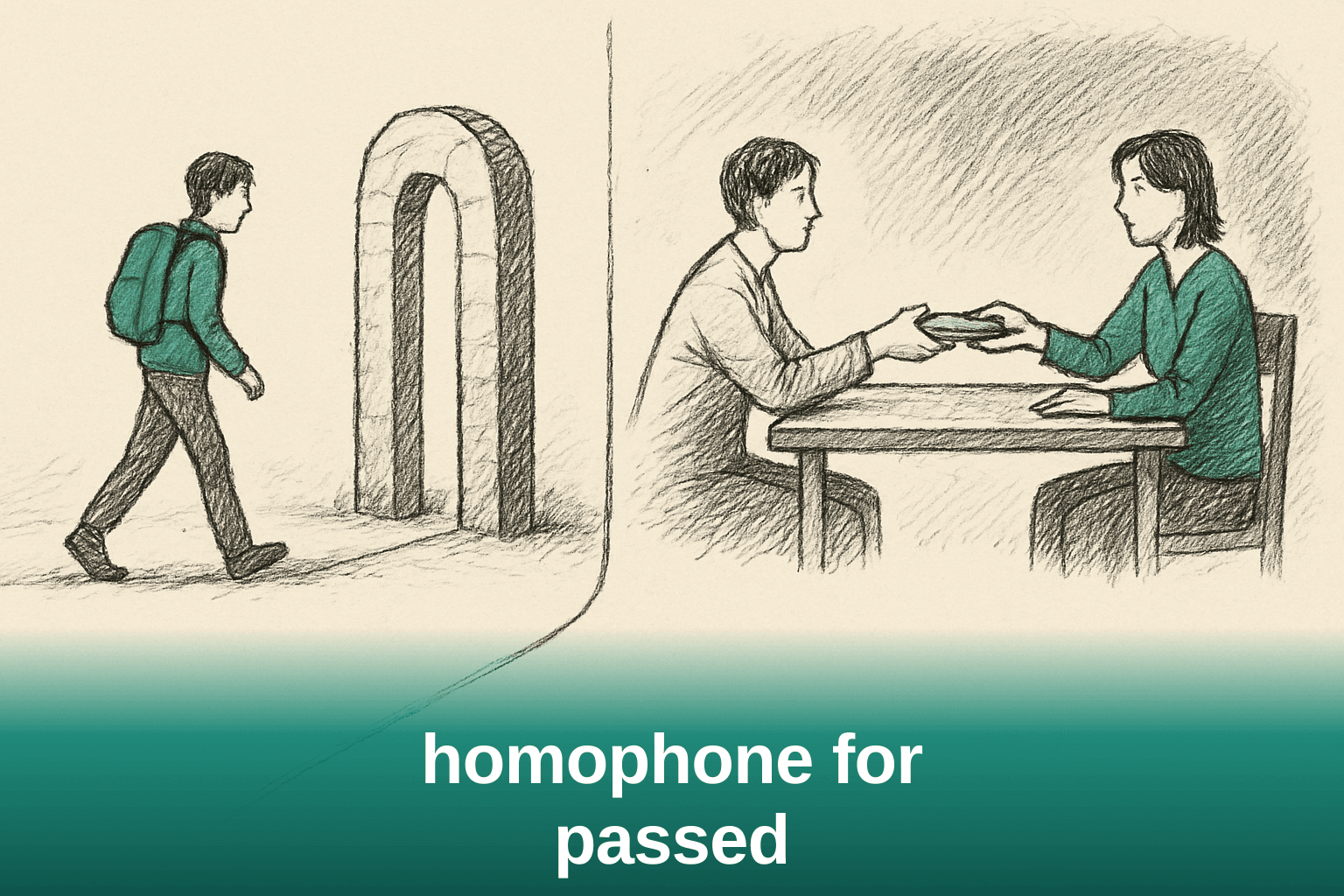

The homophone for passed is past. Both words share the pronunciation /pæst/, but they belong to entirely different grammatical categories. Passed is always a verb, while past functions as a noun, adjective, adverb, or preposition. This single distinction is the master key to choosing correctly every time.
- The homophone for passed is past; both are pronounced /pæst/.
- Passed is the past tense and past participle of the verb “to pass.”
- Past operates as a noun, adjective, adverb, or preposition, but never as a verb.
- Ask “Is it a verb?” If yes, write passed; otherwise, write past.
- Passed out is a verb phrase meaning to faint or to distribute.
You have probably stared at a text message for thirty seconds, thumb hovering, wondering whether you drove “past” the bridge or “passed” it. This hesitation strikes native speakers and learners alike because the two words are perfect homophones. In this article, you will learn a dead-simple verb test, see thirty paired sentences, and explore the literary quotes and tricky phrases that finally make the difference stick.
What Is the Homophone for Passed? The Short Answer
The homophone for passed is past, and understanding why requires looking at grammar rather than pronunciation. These two words are heterographs, which means they sound identical when spoken but carry separate spellings and meanings. Passed functions exclusively as a verb form, specifically the simple past tense and past participle of the infinitive “to pass.” It always describes an action, whether that action involves moving through space, handing an object, succeeding at an exam, or elapsing time. Past, on the other hand, never acts as a verb. Instead, it serves four distinct grammatical roles: it can name a previous period as a noun, modify a noun as an adjective, describe motion as an adverb, or introduce a temporal or spatial relationship as a preposition. Because they occupy completely different grammatical territories, confusing them is fundamentally a spelling error rather than a vocabulary gap. Once you accept that passed owns the verb category and past owns everything else, the choice becomes mechanical rather than mysterious.
Passed vs Past at a Glance
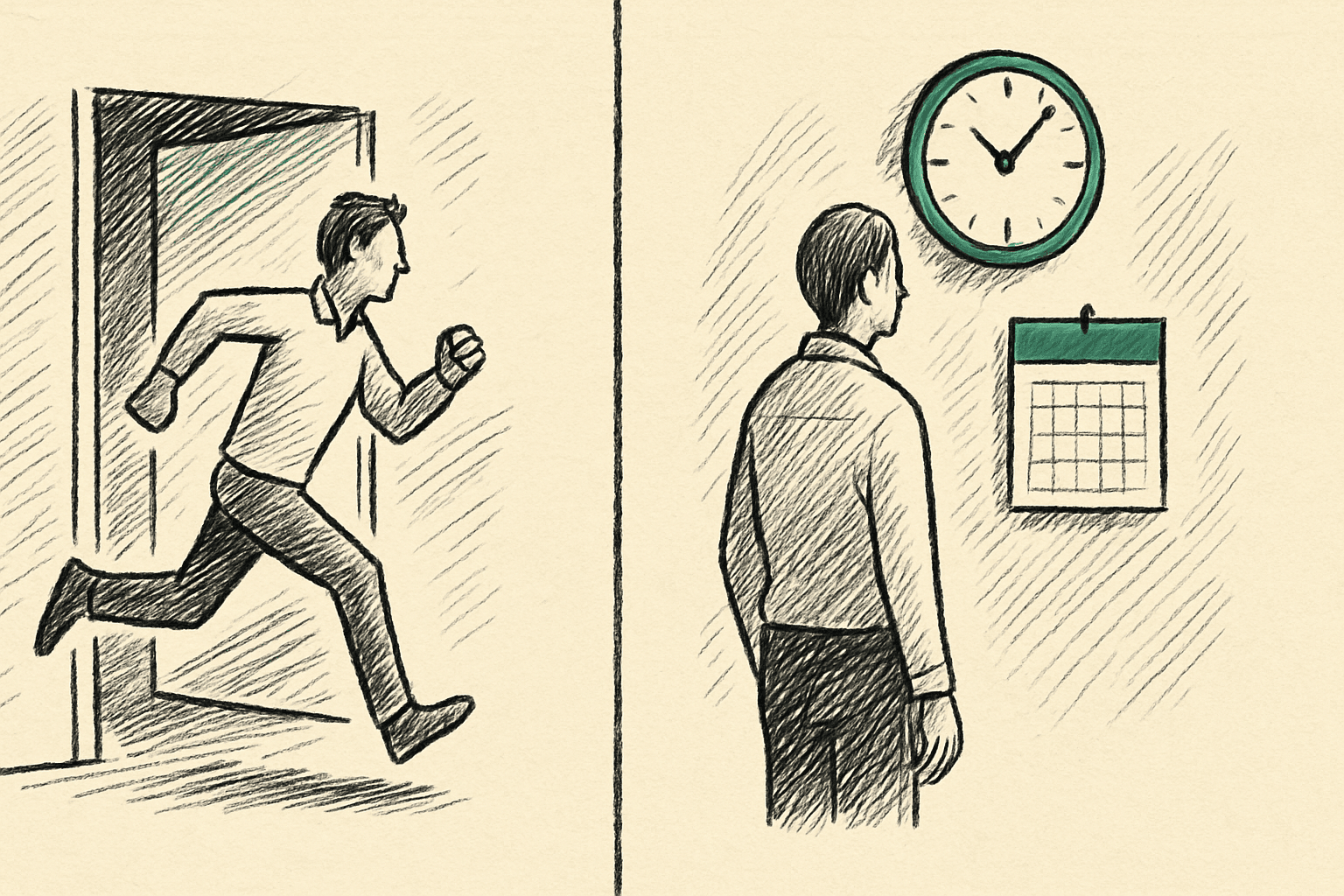
If you need a snapshot of how these two words diverge, the comparison comes down to one question about sentence function. Passed always signals a completed action because it is the past-tense form of a verb. You will find it where someone or something did something: they passed a law, passed a ball, or passed through a village. Past refuses to behave like a verb under any circumstance. It sits comfortably as a noun referring to history, an adjective describing former times, an adverb telling you which way something moved, or a preposition placing you beyond a point in time or space. Their positions in a sentence differ accordingly. Passed typically appears where an action verb is required, often with a direct object or an auxiliary verb. Past tends to stand near nouns, after verbs like “walked” or “drove,” or before numbers on a clock face. Past refuses to behave like a verb under any circumstance, and keeping this structural split in mind prevents most spelling mistakes before your fingers even touch the keyboard.
| Feature | Passed | Past |
|---|---|---|
| Part of speech | Verb (past tense / past participle) | Noun, adjective, adverb, preposition |
| Core meaning | Completed action of moving, handing, or succeeding | Time gone by, beyond a point, or former |
| Typical position | Where a verb belongs, often with an object | Before nouns, after motion verbs, or with time |
| Example | She passed the salt. | He walked past the gate. |
| Can it be a verb? | Yes — always | No — never |
Use this table as a quick checkpoint whenever you are unsure which spelling fits your sentence.
What Does “Passed” Mean?
Passed is the inflected form of the verb “to pass,” and it carries every shade of meaning that the base verb implies, only anchored in completed time. When you use passed, you are describing something that has already happened: movement from one side to another, transfer of an item from hand to hand, success in an examination, or the quiet finality of death in the euphemism “passed away.” The regular -ed ending is your visual cue that this word is doing the heavy lifting of a past-tense verb. It will often take a direct object, as in “He passed the letter,” or pair with an auxiliary to form perfect tenses, as in “The storm has passed.” Because passed is locked into the verb family, it cannot describe a time period on its own, nor can it sit in front of a noun to modify it. That restriction is actually a relief: if the word you need is performing an action, passed is almost certainly the spelling you want, regardless of whether the action is literal or metaphorical.
Passed as the Past Tense of “To Pass”
Watch how the base verb shifts into its past form. When you pass a test today, yesterday you passed it. When a car passes your house every morning, this morning it passed your house. The addition of -ed does not change the core idea; it simply anchors the action in time that is already finished. This pattern holds steady across every meaning of the verb.
Examples
- I pass the ball → I passed the ball. (transfer)
- She passes the exam → She passed the exam. (success)
- The deadline passes → The deadline passed. (time elapsing)
- We pass through the tunnel → We passed through the tunnel. (movement)
- He passes away peacefully → He passed away peacefully. (death)
Common Phrases with “Passed”
English has baked passed into dozens of idiomatic expressions. Some are cheerful, like passing a test; others somber, like passing away. A few carry double meanings that can confuse even fluent speakers. Learning these phrases in context protects you from the most common collocation errors.
Examples
- passed away — The old sailor passed away during the night. (died)
- passed a test — Maya passed her driving test on the first try.
- passed the butter — Please pass the potatoes; he passed them an hour ago.
- passed out — Two soldiers passed out from heat exhaustion. (fainted)
- passed out — The teacher passed out worksheets to the class. (distributed)
- passed by — Opportunities passed by while he waited.
- passed through — We passed through Denver without stopping.
- passed up — She passed up a promotion to stay remote.
- passed along — I’ll pass the message along when I see her.
What Does “Past” Mean?
Past is the chameleon of this pair because it holds down four separate grammatical jobs without ever slipping into verb territory. That flexibility makes it feel more complicated than passed, but the complexity is only surface deep. Every usage of past revolves around the concept of time or space that has already gone by. As a noun, it names the repository of yesterday. As an adjective, it labels things that are no longer current. As an adverb, it describes the direction of motion beyond a point. As a preposition, it establishes a relationship meaning later than or beyond. Because past never carries the burden of an action, you will never see it change form for tense or agree with a subject. Its spelling stays frozen, which is fitting for a word that describes what is already fixed and unchangeable. Once you map each role to a specific sentence position, past becomes as predictable as passed.
Past as a Noun
When past names a thing, it refers to the collective body of time that came before this moment. It can be personal or universal, distant or recent.
Examples
- It’s all in the past now, so we can move forward.
- The past is a foreign country; they do things differently there.
- In the past, people wrote letters instead of emails.
Past as an Adjective
As an adjective, past modifies nouns to show that they belong to a former period. It always appears directly before the noun it describes.
Examples
- The past month has been unusually rainy.
- Past events shaped the city’s architecture.
- In past years, the festival lasted three days.
Past as an Adverb
Here, past tells you where motion happened. It answers the question “where?” in relation to movement, and it needs no object to complete its meaning.
Examples
- He walked past without saying hello.
- The bus drove past our stop this morning.
- She hurried past the crowd and into the building.
Past as a Preposition
This usage often causes the most trouble because it sits where English speakers sometimes expect a verb. Prepositional past introduces a noun or number and means beyond or later than.
Examples
- Meet me at half past three by the fountain.
- It is already a quarter past noon.
- This is past my bedtime, and I am exhausted.
- The milk is past the sell-by date.
Common Phrases with “Past”
Native speakers bundle past into set phrases that are worth memorizing as units. Because past is not a verb, these phrases behave differently than passed collocations.
Examples
- the past — We cannot rewrite the past.
- past tense — The verb appears in the past tense.
- past caring — After the third delay, I was past caring.
- walked past / drove past — He drove past the accident scene.
- the past few days — I have slept poorly the past few nights.
- a quarter past noon — Lunch starts at a quarter past noon.
- past midnight — The conversation lasted past midnight.
- past the sell-by date — Throw away anything past the sell-by date.
The One-Question Test: Is It a Verb?
Grammar books sometimes overwhelm readers with diagrams and terminology, but you only need one question to solve the passed versus past dilemma every single time: is the word acting as a verb? If the answer is yes, you must spell it passed, because passed is the only past-tense form available for the verb “to pass.” If the answer is no, and the word is functioning as a noun, adjective, adverb, or preposition, then past is your only option. This test works because the grammatical territories are completely non-overlapping. You will never find passed describing a former era, and you will never find past indicating that someone handed you a salt shaker. When you are typing quickly and feel doubt creeping in, freeze and identify the grammatical job. If the word is doing something, it is passed. If it is labeling, pointing, or relating, it is past. That single distinction resolves nearly every scenario you will encounter in everyday writing.
- Step 1: Identify the main action in your sentence. Look for the word that tells you what happened.
- Step 2: If that action word is “passed,” check whether you can replace it with “pass” or “passes.” If the sentence still makes sense, you have chosen correctly.
- Step 3: If the sentence already contains another verb — such as “walked,” “drove,” or “is” — and the doubtful word sits near a noun or time expression, use “past.”
The Present-Tense Swap Test
Another reliable method for choosing the right spelling is the present-tense swap test, which forces the base verb “to pass” into your sentence so you can hear whether it belongs. Take your sentence and mentally replace the doubtful word with “pass” or “passes.” If the resulting sentence sounds logical and grammatical, then you are dealing with a verb, and passed is the correct past-tense spelling. If inserting “pass” creates nonsense, then the word you need is not a verb at all, and past is the right choice. This test is especially helpful when you are tired or rushing, because it bypasses abstract grammar labels and relies on your intuitive sense of how English sentences should sound. It works beautifully on phrases like “I passed the shop” versus “I drove past the shop.” One accepts “pass” naturally; the other rejects it violently. Training your ear with this swap takes only minutes, but the payoff lasts a lifetime and protects you from embarrassing public errors.
Examples
- Correct: I passed the shop. → I pass the shop. (Logical: passed)
- Incorrect: I drove pass the shop. → I drove past the shop. (Illogical: past)
- Correct: She passed the exam. → She passes the exam. (Logical: passed)
- Incorrect: It is pass my bedtime. → It is past my bedtime. (Illogical: past)
- Correct: Time passed slowly. → Time passes slowly. (Logical: passed)
- Incorrect: In the pass, we wrote letters. → In the past, we wrote letters. (Illogical: past)
Passed and Past in the Same Sentence
Seeing passed and past locked in separate sentences is instructive, but watching them share the same sentence is unforgettable. When both words appear together, their different grammatical roles light up like neon. Passed continues to do the work of a verb, describing an action that someone or something completed, while past settles into its supporting role as a noun, adjective, adverb, or preposition. These paired appearances are not rare curiosities; they show up in ordinary speech and literature whenever a speaker recounts moving through a former time or place. By studying these dual appearances, you train your brain to process both words simultaneously without confusion. The contrast becomes visceral rather than theoretical. Once you can read a sentence that contains both spellings and instantly know why each one is there, you have moved beyond memorization and into genuine mastery of these heterographs. That confidence will show up in every email and essay you write.
Examples
- In past years, I passed time drawing maps of imaginary cities. (past = adjective; passed = verb)
- When I passed through town, the era of small bookshops was already in the past. (passed = verb; past = noun)
- I’m past caring whether the milk has passed its expiration date. (past = adjective/preposition; passed = verb)
- The bus drove past the stop where my childhood friend had passed away. (past = adverb/preposition; passed = verb)
- She walked past the mural that her grandfather had passed down through generations. (past = adverb; passed = verb)
Passed vs Past: 30 Example Sentences Side by Side
Nothing cements a rule like repetition, and nothing clarifies a contrast like parallel examples. The thirty sentences below are split evenly between passed and past, organized by the situations where they most commonly appear. Each sentence is new and self-contained, so you can study them in clusters or skim for the exact scenario that matches your current writing problem. Pay attention to the words that surround each spelling. Passed usually sits next to an object or an auxiliary verb, while past tends to cling to nouns, time expressions, or verbs of motion. Reading these examples aloud will reinforce the auditory sameness and the grammatical difference. Use this list as a personal reference sheet whenever you are drafting an email, editing a report, or helping a student with homework. After working through these thirty models and hearing the patterns, your confidence in choosing the right spelling should feel automatic and completely unshakable.
Examples
- Passed — Movement: The hiker passed through three valleys before sunset.
- Passed — Movement: A strange car passed our driveway slowly.
- Passed — Movement: The parade passed the reviewing stand at noon.
- Passed — Movement: We passed the border without being stopped.
- Passed — Movement: The rumor passed from classroom to classroom.
- Passed — Time: The afternoon passed in comfortable silence.
- Passed — Time: Three decades have passed since the renovation.
- Passed — Time: The deadline passed while we were in the meeting.
- Passed — Time: Winter passed, and the orchards bloomed again.
- Passed — Time: Another year passed without any major incidents.
- Passed — Exam/Transfer: Ethan finally passed his chemistry practical.
- Passed — Exam/Transfer: Please pass the remote; she passed it gently.
- Passed — Exam/Transfer: The Senate passed the bill by a narrow margin.
- Passed — Exam/Transfer: He passed the family business to his niece.
- Passed — Exam/Transfer: I passed on the dessert, but thanked the host.
- Past — Noun: The past holds both pride and painful lessons.
- Past — Noun: Living in the past prevents new adventures.
- Past — Noun: Historians study the past to explain the present.
- Past — Adjective: Sales figures improved over the past quarter.
- Past — Adjective: Past regrets should guide future choices.
- Past — Adjective: The museum displays past fashions from the 1920s.
- Past — Adverb: A cyclist sped past the waiting pedestrians.
- Past — Adverb: The owl glided past the barn in total silence.
- Past — Adverb: We stood aside and let the ambulance speed past.
- Past — Preposition: It is ten past eight; hurry downstairs.
- Past — Preposition: The project is past the initial planning phase.
- Past — Preposition: She is past the age of worrying about trends.
- Past — Preposition: The ship sailed past the lighthouse at dawn.
- Past — Phrases: I have been restless the past few nights.
- Past — Phrases: By the time we arrived, it was already past midnight.
Passed vs Past in Literature: 6 Quotes That Show the Difference
Great authors have been navigating the passed and past distinction for centuries, and their published works offer unimpeachable evidence of how each word behaves in the wild. Because professional editors vet every line, literary quotes function as authoritative demonstrations of standard usage. When you see passed in a novel, it is invariably performing an action: crossing a threshold, elapsing time, or exiting a scene. When you see past, it is anchoring a character in history, pushing motion beyond a point, or fixing a clock. These six quotations come from widely taught classics and contemporary bestsellers, covering a range of genres and periods. Studying them side by side gives you a feel for rhythm and context that isolated dictionary entries cannot provide. Copy the sentence structures you find here, and you will sound natural in your own essays, stories, and professional correspondence. Literary mastery begins with observing how the masters handled these small but crucial choices.
Examples
- “The ship passed beyond the harbor and vanished into the mist.” — Victor Hugo, Les Misérables (passed = verb: movement beyond)
- “A current of air passed through the narrow gap.” — Charlotte Brontë, Jane Eyre (passed = verb: movement through)
- “The procession passed slowly, each tribute a silent farewell.” — Suzanne Collins, The Hunger Games (passed = verb: movement by)
- “So we beat on, boats against the current, borne back ceaselessly into the past.” — F. Scott Fitzgerald, The Great Gatsby (past = noun: former time)
- “Who controls the past controls the future.” — George Orwell, 1984 (past = noun: history)
- “The Ghost of Christmas Past rose before him like a gentle mist.” — Charles Dickens, A Christmas Carol (past = noun: former time)
Tricky Cases: “Passed Out,” “Past Caring,” and Other Traps
Certain phrases act like linguistic landmines because they pair passed or past with words that feel counterintuitive. Passed out, for instance, can mean either fainting or distributing items, and both meanings rely on the verb passed. Past caring looks strange if you expect caring to be a verb, but here past is an adjective meaning beyond, and caring is a gerund functioning as a noun. The phrase half past three traps people who assume the word must be a verb because it follows a number; in reality, past is a preposition telling you where the minute hand sits. Meanwhile, passed up tempts some writers to create the nonexistent past up, and passed its date gets misspelled as past its date because the word follows a possessive pronoun. These five traps account for the majority of advanced errors. Learning them as discrete units, rather than as grammatical abstractions, will save you from the embarrassment of a typo in a professional email or social post.
Examples
- Passed out: She passed out cold during the sermon. (OR: The organizer passed out 4,000 hot dogs.) Rule: passed is the verb in both cases.
- Past caring: After the delay, I was past caring. Rule: past means “beyond”; caring acts as a noun.
- Passed up: He passed up the chance to study abroad. Rule: never write “past up.”
- Half past: Meet at half past two. Rule: past is a preposition for clock time; “half passed” is always wrong.
- Past the sell-by date: The yogurt is past the sell-by date. Rule: past describes the relationship; passed would require a subject performing the passing.
Quick Quiz: Choose Passed or Past
Testing yourself is the fastest way to move knowledge from short-term memory into long-term habit. The eight questions below cover every grammatical role that past plays, alongside the three most common meanings of passed. Each sentence is designed to feel like something you might actually write or say, so the quiz doubles as realistic practice. Do not simply guess; apply the verb test or the present-tense swap before you choose. If you get one wrong, scroll back to the relevant section and read the examples aloud until the pattern locks in. A perfect score means you are ready to proofread other people’s work. A few mistakes simply mean you need another pass through the trickier phrases. Either way, treat this quiz as a diagnostic tool rather than a final exam. Your goal is speed and accuracy under real writing conditions, not perfection on the first isolated attempt.
1. I ___ the library on my way to work.
Answer: past. “Drove” is already the verb; “past” functions as a preposition/adverb here.
2. She ___ her final exam with honors.
Answer: passed. The sentence needs a verb, and passed is the past tense of “to pass.”
3. The train rumbled ___ the old factory.
Answer: past. “Rumbled” is the verb; “past” tells you where the train moved.
4. Time ___ more slowly in the mountains.
Answer: passed. Time is the subject performing the action of elapsing.
5. It is already a quarter ___ noon.
Answer: past. This is the prepositional phrase for clock time.
6. He ___ away peacefully in his sleep.
Answer: passed. “Passed away” is a verb phrase meaning died.
7. I am ___ worrying about things I cannot control.
Answer: past. “Past” means beyond; “caring” functions as a gerund here.
8. They ___ through security without any issues.
Answer: passed. The sentence needs the verb “to pass” in past tense.
Common Mistakes and How to Avoid Them
Even after learning the rules, most writers slip into the same predictable errors because the ear hears /pæst/ and the hand wants to spell it the first way that feels familiar. The five mistakes below appear in student essays, business emails, and published articles with equal frequency. Each one follows a pattern: a verb is mistaken for a preposition, a preposition is forced to act like a verb, or a set phrase is distorted by analogy. The good news is that these errors are systematic, which means they are also systematically fixable. By studying the wrong version next to the corrected version, you train your eye to spot the visual cues that separate passed from past. Keep this list bookmarked and run through it before you submit any important document. One final glance is usually enough to catch a typo that would otherwise undermine your credibility with readers who know the difference and judge accordingly.
- Wrong: I past the test. Right: I passed the test. Why: “Pass” is the verb; the past tense needs -ed.
- Wrong: I drove passed the shop. Right: I drove past the shop. Why: “Drove” is the verb; “past” describes the direction.
- Wrong: In the passed, people walked everywhere. Right: In the past, people walked everywhere. Why: The noun for former time is “past.”
- Wrong: Meet me at half passed three. Right: Meet me at half past three. Why: “Past” is the preposition for clock time.
- Wrong: She is passed caring. Right: She is past caring. Why: “Past” means beyond; “passed” cannot modify a gerund this way.
Passed vs Past in Professional Writing
Office emails, client reports, and social media captions are where the passed versus past battle actually costs you credibility. Autocorrect frequently guesses wrong because it lacks context, and speech-to-text software transcribes both words as “passed” by default. In a professional setting, writing “I am passed the deadline” or “We drove passed the venue” signals inattention to detail that clients and supervisors notice. Copywriters and ESL teachers should treat these two spellings as high-stakes proofreading priorities rather than casual typos. The fastest fix is to search your draft for every instance of “passed” and ask whether an action is truly taking place. If you see “passed” sitting where a noun, adjective, or preposition should be, swap it immediately. Likewise, if “past” appears where a verb belongs, you have found an error. Establishing a two-minute review ritual for these homophones will keep your professional communication crisp and authoritative every time you hit send.
Examples
- Email: “I am writing about the invoice that passed its due date.” (passed = verb: gone beyond)
- Report: “Over the past quarter, revenue passed all projections.” (past = adjective; passed = verb)
- Social post: “We just passed 10,000 followers. The past year has been incredible.” (passed = verb; past = adjective)
- Memo: “Please do not send messages passed business hours.” → Wrong. “Past business hours” is correct.
How to Remember the Difference: 4 Memory Tricks
When you are under pressure and grammar logic fails, a simple mnemonic can rescue you from a spelling crisis. The four memory tricks below are battle-tested by editors and English teachers because they link spelling to something visual or tactile. None of them require grammatical expertise; they rely on pattern recognition and first-letter associations. Pick the one that feels most natural, or rotate through all four until the correct spelling becomes muscle memory. The goal is not to memorize a rule but to create an automatic reflex that fires faster than doubt. With enough repetition, you will find yourself typing the right word without consciously choosing it. That is the moment these homophones stop being a problem and start being a minor background detail in your otherwise fluent writing. Keep one mnemonic taped to your monitor until the habit sticks permanently and you no longer need the reminder.
- “Past” ends in T, like “Time.” If you are talking about time, former events, or moving beyond a moment, think T for Time.
- “Passed” ends in -ed, like most past-tense verbs. The spelling literally contains the sound of completed action.
- “Past” is never a verb. If the word is doing something active, it cannot be past.
- Use the “pass/passes” swap. If you can substitute “pass” and the sentence still works, you need the verb form “passed.”
Frequently Asked Questions
The homophone for passed is past. Both words are pronounced /pæst/, but passed is a verb form while past serves as a noun, adjective, adverb, or preposition.
Use passed. The sentence needs a verb, and passed is the past tense of “to pass.”
No. Past is never a verb. If your sentence requires a verb, passed is the only correct spelling.
Passed away is a polite euphemism meaning someone has died. Passed functions as the verb in this phrase.
People write half passed because the two words sound identical. However, half past is the only correct form because past acts as a preposition telling time.
They are homophones, specifically heterographs: they share the same pronunciation but have different spellings and meanings.
Final Verdict on the Homophone for Passed
The homophone for passed will always be past, and the master rule will always be grammar. Passed owns every verb slot, while past claims every other role in a sentence. When you feel uncertain, run the present-tense swap or simply ask whether the word is performing an action. That single question resolves nearly every case you will encounter. Keep the comparison table and the thirty example sentences nearby, and you will never need to second-guess this spelling pair again.