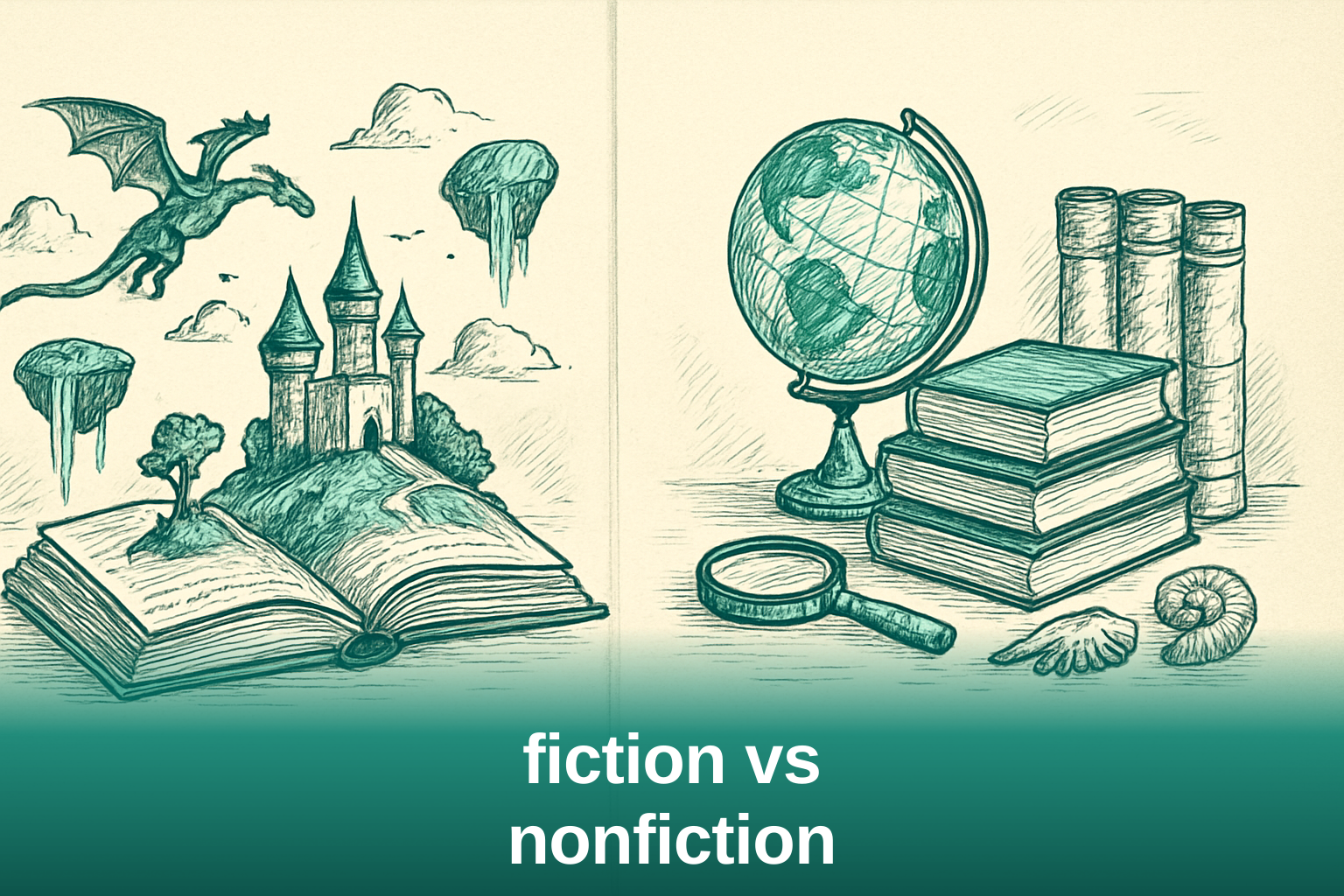

Fiction is writing invented from the author's imagination — characters, events, and worlds that didn't actually happen. Nonfiction is writing grounded in fact — real people, real events, and real information. Yet the line blurs more often than you might think, especially when a novel feels so authentic that readers ask, "Did this really happen?" That middle ground is realistic fiction, a genre that borrows the plausibility of real life but keeps the creative freedom of invention. In the sections ahead, we will break down each category, walk through side-by-side examples, and give you practical tricks to tell them apart.
Fiction vs Nonfiction: Quick Answer
Fiction springs entirely from imagination. It encompasses novels, short stories, fairy tales, and any narrative where the author constructs characters, dialogue, and plot from scratch. The reader enters an implicit contract: they know the events did not happen, yet they suspend disbelief to experience emotional truth. According to Joseph Salvatore, Associate Professor of Writing & Literature at The New School, fiction achieves this through “the use of rich, evocative sensory detail; the different pacing tempos of dramatic and non-dramatic events; and the deliberate withholding of information to heighten suspense.” Nonfiction, by contrast, is anchored to verifiable reality. It includes memoirs, biographies, journalism, and essays that assert factual accuracy about the world. The reader trusts that the people existed, the conversations are documented or reconstructed with integrity, and the information can be checked. Realistic fiction occupies a unique middle space—it reads like true life, with believable settings and ordinary problems, but the author retains the freedom to reshape events for narrative impact. The single most important distinction is that fiction’s core obligation is emotional or thematic resonance, while nonfiction’s core obligation is factual accuracy. Whether you are browsing a bookstore or drafting your own manuscript, recognizing this split is the first step toward meaningful reading and writing. Be aware, however, that mislabeling a manuscript can trigger a formal content review from major retailers and libraries, delaying publication and eroding credibility before a single review is posted.
The Difference Between Fiction and Nonfiction at a Glance
If you need a shorthand, think of fiction as the land of “what if” and nonfiction as the land of “what is.” One builds castles from air; the other inventories the stones. Both can be beautiful. Both can change how you see the world. But they ask for different kinds of attention, and they reward that attention in different currencies—empathy versus knowledge, immersion versus verification. Fiction usually explores its themes implicitly, letting readers discover meaning through action and symbol, while nonfiction tends to state its themes explicitly, guiding the reader toward a clear argument or insight.
Fiction is invented storytelling meant to entertain, provoke emotion, or explore ideas through imagined characters and events. Nonfiction is factual storytelling that documents reality, demands accuracy, and informs or persuades the reader. Realistic fiction is a subset of fiction that mimics real life without claiming factual truth.
What Is Fiction? Definition and Examples
Fiction is narrative prose born entirely from the author’s creative mind. Its defining trait is invention: even when a novel borrows the texture of real life, every scene, sentence, and subplot is orchestrated by the writer rather than recorded from reality. This category sprawls across novels, short stories, novellas, fairy tales, fantasy, science fiction, mystery, romance, thriller, and horror. Because the author is not bound by factual fidelity, fiction can bend time, invent interior monologues, and place imaginary figures inside historical catastrophes. The goal is rarely to deceive; rather, it is to illuminate human experience through metaphor, tension, and imagined consequence. A fictional story can feel truer than a news report because it distills emotion into a shape reality rarely provides. From the speculative dystopia of George Orwell’s "1984" to the wizarding world of J.K. Rowling’s "Harry Potter," fiction builds universes that never existed yet reveal something profound about our own.
Consider Harper Lee’s "To Kill a Mockingbird." The town of Maycomb, the trial of Tom Robinson, and the moral education of Scout Finch are all inventions. They did not appear in any Alabama courthouse record. Yet the novel’s emotional truth about racial injustice and childhood awakening resonates because fiction is permitted to arrange reality into patterns that life itself seldom offers. The same freedom allows a fantasy epic to explore loyalty through dragons or a sci-fi thriller to examine surveillance through sentient machines. The common thread is imaginative authorship. Fiction writers integrate research into the story itself: a novelist might write that a character “took the L train” without ever footnoting a source, because the detail serves atmosphere rather than argument. This seamless absorption creates immersion, though it places the burden of credibility entirely on the author’s craft.
Examples
- Literary quote: “So we beat on, boats against the current, borne back ceaselessly into the past.” — The Great Gatsby by F. Scott Fitzgerald. These words are entirely invented, yet they evoke regret and longing that millions of readers recognize as emotionally real.
- 1984 by George Orwell — a dystopian novel exploring totalitarianism through purely fictional constructs.
- Harry Potter series by J.K. Rowling — fantasy fiction set in a magical world parallel to our own.
- To Kill a Mockingbird by Harper Lee — realistic fiction addressing racial injustice through the eyes of a child narrator.
What Is Nonfiction? Definition and Examples
Nonfiction is literature that asserts a truthful relationship with the real world. It encompasses memoir, biography, autobiography, journalism, essays, history, self-help, travel writing, and science communication. Unlike fiction, where the author reigns as sole architect of reality, the nonfiction writer acts as a curator and interpreter of facts that exist independently of the page. Even when the prose is lyrical or suspenseful, the underlying claim remains: this happened, this person existed, this data is verifiable. The genre allows for stylistic flair—particularly in creative nonfiction—but it does not grant license to invent scenes, fabricate dialogue, or conjure characters who were never there. The defining obligation of nonfiction is factual accuracy, and breaching that trust can destroy a book’s credibility overnight. Readers approach nonfiction with a different contract: they expect to learn, to witness genuine experience, and to encounter the world as it is rather than as it might be.
Is Non-Fiction Real or Fake?
Nonfiction is real in the sense that it pledges to describe actual events, people, and information. It is not “fake,” nor is it simply opinion dressed as fact. When a memoirist writes about a childhood fire, the expectation is that the fire occurred. When a historian describes a treaty signing, the expectation is that the treaty was signed by the individuals named. Creative nonfiction may reconstruct dialogue from memory or compress timelines for clarity, but the core facts remain tethered to reality. As Lee Gutkind, creator of Creative Nonfiction magazine, explains, “The goal is to make nonfiction stories read like fiction so that your readers are as enthralled by fact as they are by fantasy.” However, the genre’s integrity depends on that tether. All creative nonfiction is an exploration of the truth, and honesty matters more than absolute factual accuracy because memory is fallible; research on flashbulb memories proves that no one remembers exactly how they experienced their own lives. The writer must aim for the truth of the experience while acknowledging the limits of recollection.
Examples abound across every discipline. Tara Westover’s "Educated" documents her upbringing in a survivalist family and her eventual escape into academia. Truman Capote’s "In Cold Blood" reconstructs a Kansas murder with journalistic precision. Anne Frank’s diary needs no introduction as a firsthand account of hiding during the Holocaust. Yuval Noah Harari’s "Sapiens" synthesizes anthropology and history into a sweeping narrative of humankind. Each book asks to be measured against the real world. Nonfiction writers typically state their themes openly, guiding the reader toward an explicit insight, whereas fiction allows themes to emerge implicitly through plot and character.
Examples
- Memoir quote: “You can love someone and still choose to say goodbye to them.” — Educated by Tara Westover. The power of this line comes from knowing it emerged from a documented life, not an imagined character arc.
Fiction vs Nonfiction: Key Differences (Comparison Table)

When you place fiction and nonfiction side by side, the contrast runs deeper than simple labels. Fiction prioritizes narrative cohesion and emotional resonance; it may research medieval weaponry or Victorian dress, but that research serves the story rather than standing as the story itself. Nonfiction prioritizes verification and transparency; every assertion can be traced to a source, and the author’s presence is often acknowledged. Fiction invites the reader into a hypothetical—what if a whale pursued a captain to the ends of the earth? Nonfiction insists on the indicative—this is how whales actually behave, and this is what happened to a specific vessel. The core distinction lies in the author’s obligation: fiction must honor internal logic, while nonfiction must honor external reality. These divergent purposes shape everything from sentence rhythm to chapter architecture, and they determine how a book is marketed, reviewed, and shelved.
| Aspect | Fiction | Nonfiction |
|---|---|---|
| Source material | Invented by the author | Real people, events, information |
| Core obligation | Emotional or thematic resonance | Factual accuracy |
| Reader's expectation | Understood as imagined | Understood as true |
| Common forms | Novels, short stories, novellas | Memoir, biography, journalism, essays |
| Can it use real events? | Yes, as inspiration or backdrop | Yes, as the actual subject matter |
| Research | Woven into the story | Cited and verified |
| Themes | Usually implicit | Usually explicit |
| Plot | Created by the author | Organized from real events |
These differences also affect how authors work. A fiction writer might spend months inventing a city’s geography, while a nonfiction writer spends months confirming that a real city’s geography looked a certain way in 1973. The tools are similar—interviews, archives, observation—but their relationship to the final text is fundamentally different. Fiction writers integrate research into the narrative fabric; nonfiction writers cite research to bolster and verify their stories. One hides the scaffolding; the other displays it.
Fiction vs Nonfiction: Examples Side by Side
Great literature often circles the same human obsessions—war, identity, love, survival—but fiction and nonfiction approach them through different doors. A novel can place us inside a soldier’s hallucinations during bombardment; a history can show us the general’s strategy through decrypted cables and after-action reports. The emotional temperature may be equally high, yet the reader’s trust is calibrated differently. In fiction, we accept the horror because the author has earned our suspension of disbelief; in nonfiction, we accept it because the archives confirm the casualties. Side-by-side reading reveals that subject matter is neutral—it is the author’s contract with the reader that changes everything. The following pairs demonstrate how the same theme generates distinct experiences depending on whether the narrative is invented or reported.
Examples
- War: Fiction — All Quiet on the Western Front by Erich Maria Remarque invents Paul Bäumer’s disillusionment to universalize trench trauma. Nonfiction — Band of Brothers by Stephen Ambrose documents Easy Company’s actual campaigns from Normandy to Hitler’s Eagle Nest.
- Coming of age: Fiction — The Catcher in the Rye by J.D. Salinger constructs Holden Caulfield’s voice to explore adolescent alienation. Nonfiction — I Know Why the Caged Bird Sings by Maya Angelou recounts her own childhood trauma and resilience.
- Space exploration: Fiction — The Martian by Andy Weir imagines an astronaut stranded on Mars using scientifically plausible but invented crises. Nonfiction — An Astronaut's Guide to Life on Earth by Chris Hadfield draws directly from his career aboard the International Space Station.
Each pair invites a different question. With Remarque, we ask, “What did it feel like?” With Ambrose, we ask, “What actually occurred?” Both questions matter. Neither genre owns the truth outright; they simply trade in different species of it. The fiction offers emotional truth through invented specificity, while the nonfiction offers documented truth through verified testimony.
What Is Realistic Fiction? (NEW)
Realistic fiction is a subset of fiction that refuses the spectacular. There are no wands, no faster-than-light travel, and no conversations with the dead—only the complications of ordinary life rendered with precision and care. The characters attend real-world schools, hold plausible jobs, and navigate conflicts that could appear in tomorrow’s newspaper: divorce, grief, social exclusion, first love, financial pressure. Because the settings and scenarios mirror lived experience so closely, readers frequently mistake realistic fiction for memoir or reportage. Walk into any bookstore and you will see realistic fiction covers photographed with muted domestic imagery—kitchen tables, suburban streets, folded laundry—precisely because the genre markets itself as “the world you know, with the stakes turned up.” Yet the author retains the freedom to compress timelines, composite secondary characters, and sculpt dialogue for maximum impact. The hallmark of realistic fiction is plausibility without documentation: it feels true because it could be true, not because it is true. Works like R.J. Palacio’s "Wonder," Celeste Ng’s "Little Fires Everywhere," and John Green’s "The Fault in Our Stars" all operate in this space, using invented figures to explore universal human conditions.
Contemporary fiction, literary fiction, coming-of-age stories, and family dramas often fall under this umbrella. The characters might live in suburbs you recognize, speak in idioms you have heard, and suffer setbacks that resemble your neighbor’s. But their names, their precise conversations, and the resolutions they reach are all authorial choices. The genre’s power comes from accessibility; its danger comes from being mistaken for something it is not. When a realistic novel uses a first-person present tense and a protagonist with a common name, the illusion of memoir becomes almost unavoidable for the casual reader.
Realistic Fiction vs Nonfiction: How to Tell Them Apart (NEW)
Separating realistic fiction from nonfiction can feel like distinguishing two nearly identical shades of paint. Both genres favor naturalistic dialogue, recognizable neighborhoods, and problems that resist magical solutions. The difference is not in the texture of the prose but in the foundation beneath it. Nonfiction asserts that the narrative corresponds to verifiable events; realistic fiction merely asks you to believe that such events could occur. When an author writes about a family crumbling under the weight of a secret, the emotional beats may be identical across genres, yet one version is sworn testimony and the other is a crafted simulation. The most reliable separator is authorial intent: nonfiction promises fidelity to reality, while realistic fiction promises fidelity to possibility. Learning to spot that promise—on the cover, in the flap copy, and in interviews—is an essential skill for any serious reader.
- Step 1: Check the cover and description. If the book is labeled “a novel,” it is fiction, even if it reads like autobiography.
- Step 2: Research the author’s statements. Writers of nonfiction usually affirm that their story is true; realistic fiction writers openly discuss invention.
- Step 3: Examine the characters’ names. If they do not match real, documented individuals, you are likely reading fiction.
- Step 4: Look for interviews or author’s notes. Jeannette Walls openly identifies The Glass Castle as memoir (nonfiction), whereas Celeste Ng presents Little Fires Everywhere as a novel (realistic fiction). Both stories depict flawed mothers and suburban unrest, but one is documented and the other is imagined.
When you apply these steps, you stop guessing and start reading with confidence. The genres may look alike, but their contracts are written in different ink. Be aware that realistic fiction can still provoke genuine emotional responses; the fact that it is invented does not make the grief or joy on the page less real to the reader. Conversely, nonfiction can feel dry or disjointed precisely because life does not follow a neat three-act structure.
Fiction vs Nonfiction vs Realistic Fiction: Full Comparison (NEW)
To understand how these three categories interact, it helps to view them not as a straight line but as a set of nested circles. Fiction is the largest ring; inside it sits realistic fiction, sharing the same invented DNA but restricting itself to everyday plausibility. Nonfiction stands adjacent, overlapping only in subject matter, never in ontological status. A realistic novel about a teacher’s strike may draw on actual labor history, yet its protagonist, her specific choices, and the climactic boardroom confrontation are all authorial constructions. A nonfiction account of the same strike must tether every major claim to testimony, records, or reportage. Realistic fiction is not “soft nonfiction”; it is fiction with self-imposed boundaries, and breaking those boundaries does not turn it into memoir—it turns it into fantasy or magical realism. The triple comparison below clarifies where each genre stands on truth, obligation, and form.
| Aspect | Fiction | Realistic Fiction | Nonfiction |
|---|---|---|---|
| Based on real events? | No, invented | No, invented but plausible | Yes, real |
| Could it happen in real life? | Not necessarily | Yes | Yes, it did |
| Characters | Invented | Invented but believable | Real people |
| Author's obligation | Emotional truth | Emotional truth + plausibility | Factual accuracy |
| Examples | Fantasy, sci-fi, fairy tales | Contemporary novels, literary fiction | Memoir, biography, journalism |
These categories matter because they set reader expectations before the first page is turned. A person picking up a memoir expects witness; a person picking up a novel expects art. Realistic fiction asks for both, but it ultimately delivers the latter. Recognizing that delivery mechanism helps you appreciate the craft without confusing it with reportage. At the same time, realistic fiction offers a safe middle ground for writers who want to explore painful real-world dynamics without exposing actual individuals.
Fiction vs Nonfiction: Why Shelf Labels and Metadata Matter
The distinction between fiction and nonfiction is not merely an academic exercise; it directly affects how books are sorted, sold, and discovered by readers around the world. Retailers and libraries rely on precise genre metadata—such as BISAC subject codes—to place titles in front of the right audiences, and algorithms use these categories to generate recommendations. When a memoir is miscoded as a novel—or when autofiction is labeled as straight biography—distribution channels falter and readers feel deceived by the mismatch between promise and content. In some cases, major retailers have initiated formal content reviews when a book’s metadata contradicted its marketing claims, delaying publication schedules and damaging author credibility before a single review was posted. Mislabeling can trigger a content review from a retailer, delay publication schedules, and erode author credibility before a single review is posted. For self-published authors, choosing the correct category is therefore a business decision as much as an artistic one. Understanding whether your manuscript is invented, reported, or a hybrid ensures that it reaches the audience willing to read it on its own terms.
Think of genre labeling as a promise. When that promise is broken, the reader feels betrayed, not merely surprised. Maintaining clear boundaries protects both the consumer and the creator. However, some authors deliberately exploit blurred categories for marketing buzz, which can generate short-term sales at the cost of long-term trust.
Hybrid Genres: When Fiction and Nonfiction Blend
Literary history is full of border crossings. Historical fiction stages invented characters inside verifiable battles; creative nonfiction borrows novelistic pacing and scene-setting to animate true stories; autofiction mines the author’s life but freely distorts chronology and dialogue for thematic effect. These hybrids fascinate readers precisely because they refuse tidy categorization, yet they do not erase the underlying boundary. A historical novel set during the French Revolution invents its lovers and its private intrigues; the revolution itself remains a borrowed backdrop. Conversely, a creative nonfiction piece about a childhood summer may render sensory details with poetic intensity, but the cousins who appear on the page must have existed in some form. The genre is determined by the dominant intent: if the specific story is invented, it is fiction, no matter how heavily researched; if the content is factual, it is nonfiction, no matter how beautifully written. Authors who understand this rule can experiment with form without betraying reader trust.
Elif Batuman’s "The Idiot" is often cited as autofiction because it borrows the author’s own academic milieu but reshapes it into a plotted narrative. Meanwhile, Truman Capote’s "In Cold Blood" is creative nonfiction because, despite its cinematic scenes, the murders it describes were real and its reporting was factual. The hybrid is a mode, not a mask. Writers should note that hybrid genres carry risks: historical fiction can be criticized for distorting facts, while creative nonfiction can be challenged on memory accuracy.
How to Remember the Difference: Fiction vs Nonfiction Tricks
For students, educators, and casual readers, the terminology itself can become a stumbling block. The words “fiction” and “nonfiction” offer no intrinsic mnemonic, so memory aids must be deliberately constructed. One simple trick is phonetic: “Fiction” and “Fake” share the same opening letter, while “Nonfiction” contains the prefix “non,” signaling negation—not fake, therefore real. Another approach is functional: fiction flows from imagination, and both words start with “Fi.” Visual learners might picture a library shelf where novels wear bright, illustrated jackets and biographies display solemn photographs of their subjects. Teachers often use a fiction vs nonfiction anchor chart in elementary classrooms, listing dragons and fairies on one side and presidents and planets on the other. The strongest memory hook is the reader’s contract: fiction asks “what if,” and nonfiction asks “what is.” Repeating that pairing—what if versus what is—creates an immediate mental test for any book you encounter.
Children often grasp the distinction faster when it is framed as make-believe versus telling-true. A dragon is fiction. A book about how real dragons are studied by zoologists—were they to exist—is nonfiction about a myth. The frame matters more than the subject. That said, these mnemonics have limits: realistic fiction looks like telling-true, and narrative nonfiction can feel like make-believe when the facts are stranger than invention.
Fiction or Nonfiction: Which Should You Write?
Choosing a genre for your manuscript begins with an honest inventory of your raw material. If the central events occurred to you or to documented individuals, and your purpose is to inform, bear witness, or inspire, nonfiction is likely the appropriate vehicle. If, however, you find yourself rearranging facts, inventing composite characters, or imagining interior lives you cannot verify, you have already crossed into fiction. The decision also hinges on emotional safety: some truths are too raw, too legally sensitive, or too fragmentary to render as reportage, and the imaginative veil of fiction can protect both the writer and the subjects. Ask yourself what you want the reader to feel; if the answer requires absolute creative control over cause and effect, fiction offers freedoms that nonfiction cannot permit.
Harold Thorpe offers a compelling case study. When his mother’s memoir was published in 1999, she was 93 years old. By 2003, when Writer’s Digest responded to Thorpe’s inquiries, she was 97. Thorpe eventually transformed that family history into what he termed “family fiction,” limiting the cast to the mother and two sisters he knew best while excluding a brother and another sister. He discovered that nonfiction tells the story, while fiction mostly shows it: instead of writing “Walter is a kindly man,” he showed Walter volunteering and caring for animals. This shift from telling to demonstrating allowed him to root the narrative in relationships he understood deeply while still shaping scenes for dramatic effect. The main difference between writing nonfiction and fiction is that nonfiction tells the story while fiction mostly shows the story.
Consider your ideal reader. Do you want them to close the book saying, “I never knew that happened,” or “I never imagined it could feel that way”? The first response belongs to nonfiction; the second to fiction. Both are noble ambitions, but they require different architectures. Fiction grants maximum creative freedom and emotional distance from painful material, but it demands that you invent everything from whole cloth. Nonfiction arrives with built-in credibility and structure, yet it restricts your ability to composite events or invent dialogue.
Fiction vs Nonfiction: How Research Lives on the Page
Research functions differently depending on which side of the genre divide you occupy, and recognizing that difference can transform both your reading and your writing. A novelist who writes about Brooklyn in the 1990s might mention the L train, the smell of bodega coffee, and the precise rent of a Williamsburg loft without ever footnoting a source; the details are absorbed into the scenery like dye into cloth, serving atmosphere rather than argument. A nonfiction writer making the same observations must eventually point to the housing survey, the transit archive, or the oral history that confirms them, because the reader’s trust depends on verifiability. In fiction, research dissolves into atmosphere; in nonfiction, research stands as evidence. This distinction explains why historical novels can feel immersive without feeling documentary, and why investigative memoirs can feel gripping without feeling fabricated. Both genres demand curiosity and rigor, but only one demands a bibliography that can withstand scrutiny.
The trade-off is real. Fiction’s seamless integration of research creates a dreamlike immersion that sweeps the reader along, yet it can inadvertently mislead when historical details are compressed or altered for plot convenience. Nonfiction’s citations and attributions build unshakeable authority, but they can also disrupt narrative momentum, forcing the reader to pause and verify rather than feel. The next time you encounter a richly detailed scene, ask whether the detail is there to convince you of reality or to deepen a fictional dream. The answer will tell you which set of rules the author is following.
Fiction vs Nonfiction: Which Is Better for Readers?
The question of superiority misses the point. Fiction and nonfiction are different tools in the same cognitive workshop. Fiction builds empathy by thrusting readers into unfamiliar consciousnesses—studies conducted at institutions like The New School suggest that immersion in imagined lives improves social perception and emotional intelligence. Nonfiction sharpens critical thinking by demanding that readers evaluate evidence, follow arguments, and distinguish between primary observation and secondary interpretation. A diet of only novels may leave you eloquent but underinformed; a diet of only essays may leave you knowledgeable but imaginatively stiff. The healthiest reading life balances both: fiction supplies the emotional vocabulary, and nonfiction supplies the factual framework. Rather than asking which genre is better, ask which gap you are trying to fill—understanding yourself, understanding others, or understanding the world.
Many of the most influential thinkers and leaders have been voracious readers of both. They credit novels with teaching them compassion and long-form journalism with teaching them discernment. The genres are not rivals; they are teammates. That said, each has drawbacks. Fiction can create echo chambers if readers only choose stories that confirm their worldview, and it can blur moral boundaries when readers become too attached to unreliable narrators. Nonfiction can overwhelm with data, reduce complex human experiences to statistics, and create a false sense of certainty when sources are biased or incomplete. The best readers approach both genres with skepticism and openness in equal measure.
FAQ: Fiction vs Nonfiction
Readers often arrive at the same handful of questions when they first grapple with genre boundaries. Some wonder whether a novel can smuggle in real history without forfeiting its fiction status; others ask if memoir is merely a true story dressed in lyrical prose. The confusion is natural, especially when marketing departments blur lines with phrases like “based on a true story” or “novelized biography,” and when realistic fiction imitates the granular texture of lived experience so convincingly that it feels like reportage. The following answers address the most common points of uncertainty in plain language, drawing on publishing conventions, reader expectations, and the ethical obligations that separate invention from documentation. The core principle is that marketing language never overrides genre obligations: a book is fiction if its specific narrative is invented, and nonfiction if its specific narrative is documented. They are designed to settle debates, clarify shelf categories, and give you confidence the next time someone hands you a book and asks, “Is this real, or did the author make it up?”
Frequently Asked Questions
Check whether the events, characters, and details are invented or documented. Nonfiction is based on real people and verified events; fiction is invented, even when inspired by reality. Authors and publishers usually label the genre clearly on the cover or in the description. If the book is marked “a novel,” it is fiction; if it is marked “memoir” or “biography,” it is nonfiction.
Fiction is invented rather than documented, but it is not “fake” in the sense of deception. Both author and reader agree that the content is imagined. The emotional truths within fiction can be profoundly real even when the plot is not. As Joseph Salvatore notes, fiction uses sensory detail, pacing, and withheld information to create a distinct emotional reality.
Novels are fiction by definition. A novel is a long, invented narrative created by the author’s imagination. Even historical novels, which use real settings, are classified as fiction because their specific characters and plots are made up. The label “novel” is a clear signal of invention.
Memoir is nonfiction. It documents the author’s real experiences. While memoir may use literary techniques like scene-setting and reconstructed dialogue, its core events and reflections are expected to be true. The genre allows for fallible memory, but it does not permit wholesale invention of characters or events.
Realistic fiction is invented. Its stories are plausible and grounded in everyday life, but the characters and events are fictional. It is a subset of fiction, not a form of nonfiction. The “realistic” label refers to style and plausibility, not to documentary fact.
Realistic fiction describes invented but plausible events, while nonfiction describes events that actually occurred. If the author claims the story really happened, it is nonfiction. If the author says it could have happened, it is realistic fiction. The distinction rests on authorial intent and documentary evidence, not merely on how lifelike the prose appears.
There are hybrid genres—such as historical fiction, creative nonfiction, and autofiction—but a book is usually classified by its dominant intent. Historical fiction is fiction with a real backdrop; creative nonfiction is factual content told with literary style. Readers should identify which obligation dominates: factual accuracy or imaginative invention.
Final Verdict on Fiction vs Nonfiction vs Realistic Fiction
At the bookstore and the blank page, the choice boils down to contract: nonfiction pledges an honest account of what happened, fiction pledges an honest exploration of what could happen, and realistic fiction splits the difference by imagining what probably would happen.