

If you have ever stared at the screen wondering whether to type peices or pieces, you are not alone. The correct spelling is pieces. Peices is a common misspelling and is never correct. The word follows the standard English rule of “i before e except after c,” which keeps the vowels in the right order. In this article, you will learn why this mistake happens, how to use pieces correctly in sentences, and simple memory tricks to lock the spelling into your memory.
The correct spelling is always “pieces”. “Peices” is a common misspelling that does not exist in English dictionaries. The word follows the “i before e” rule, placing the letter “i” before “e” in the sequence p-i-e-c-e.
Quick Answer: Pieces Is the Only Correct Spelling
When you need to write about parts, portions, or fragments of something, the only spelling you should ever use is pieces. This form is the plural of the noun piece, and it appears in every major English dictionary, including Merriam-Webster and the Oxford English Dictionary. Despite its clear authority, writers frequently transpose the second and third letters, producing the nonword peices. This error appears in emails, social media, and even printed materials, yet it has zero acceptance in standard English. The confusion usually stems from the proximity of the letters i and e on the keyboard and the misleading phonetics of the word. Because the vowel combination sounds ambiguous, muscle memory sometimes overrides conscious spelling rules. If you want your writing to look polished and professional, always choose pieces. Whether you are describing shards of glass, slices of pie, or movements of a symphony, pieces is the correct and only valid spelling. Remember that spell-check tools will flag peices instantly, giving you a reliable safety net when you are unsure.
Why Do People Write “Peices”? The Root of the Confusion
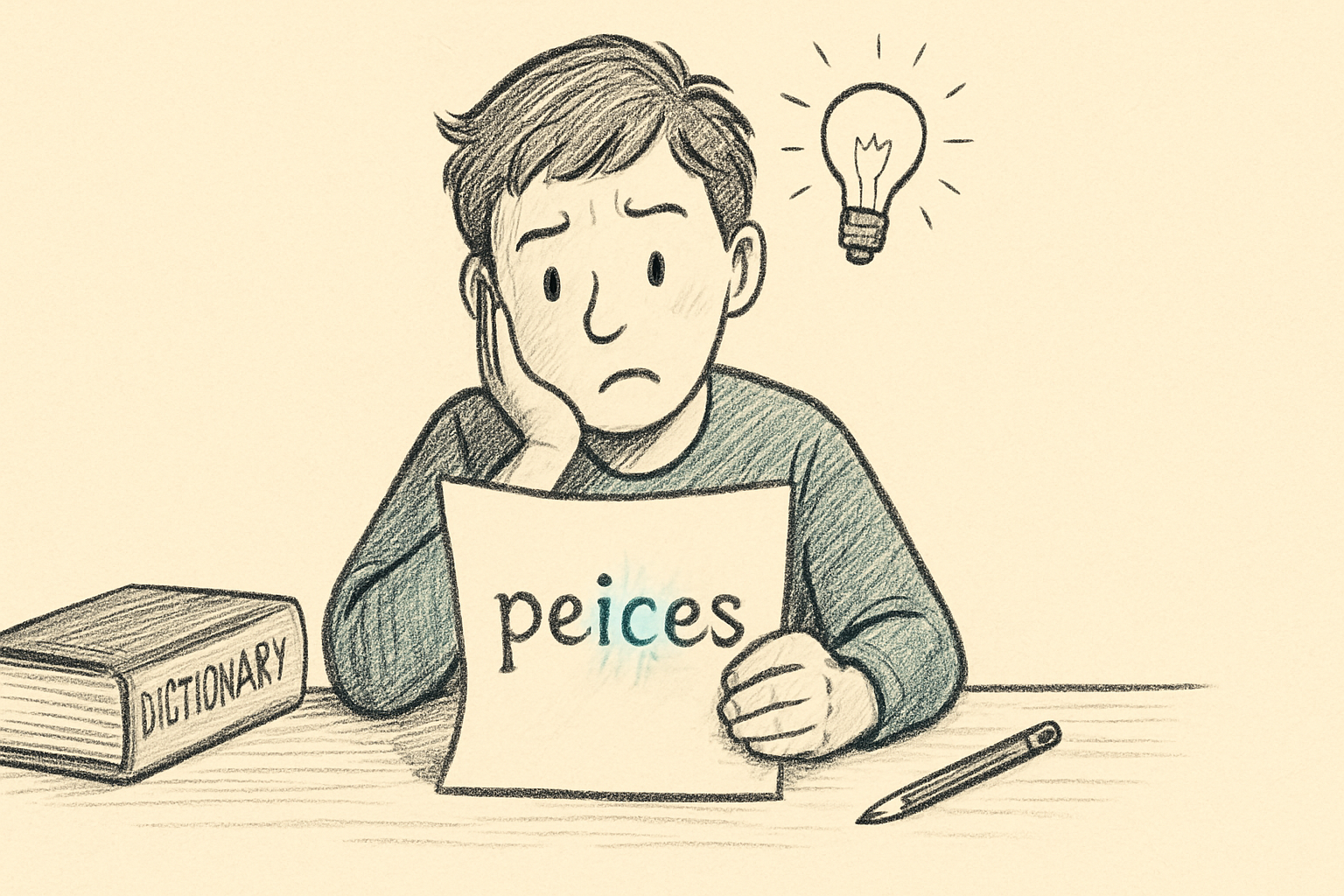
The misspelling peices persists because English spelling is full of irregularities that trip up both native speakers and learners. When people search peices or pieces online, they often face the same vowel confusion. The human brain processes the sounds of piece as a simple long-e vowel, so it does not receive an obvious auditory cue about whether the i or the e should come first. Without a clear phonetic anchor, writers rely on visual memory, which can be unreliable for common words we type on autopilot. Additionally, the digraphs ie and ei both exist in English, creating genuine uncertainty. Words like receive and ceiling use ei, while believe and field use ie. When someone is typing quickly, the fingers can easily reverse the order of these two adjacent vowels, especially since they are typed with different hands on a standard QWERTY keyboard. This transposition is one of the most frequent mechanical errors in English, and it affects countless other words beyond piece. Some searchers even type piece or peice when they are unsure of the first vowel. Understanding that this mistake is mechanical rather than intellectual can help writers slow down and catch the error before it reaches the reader.
The “I Before E” Rule and Its Exceptions
The classic rule “I before E, except after C” offers a reliable framework for many English words, and piece fits it perfectly. Because there is no c immediately preceding the vowel pair, the i naturally comes before the e. This pattern holds true for believe, achieve, field, and chief. However, English is notorious for exceptions, and this rule is no different. Words like science, weird, either, and their derivatives break the pattern, which makes learners skeptical of the guideline. Fortunately, piece is not an exception. When you write the word, you can trust that the i belongs in the second position and the e belongs in the third. Keeping this rule in mind not only helps with piece but also strengthens your spelling of dozens of other common terms. You can confidently group piece with the ie family and ignore the exceptions here.
Phonetic Similarity and Typing Errors
The pronunciation of piece gives no hint about internal letter order. It is pronounced /piːs/, a single long vowel sound followed by a soft s. Because the two vowels blend into one sound, speakers cannot deduce the spelling from speech alone. This ambiguity forces dependence on visual or motor memory. During rapid typing, the left hand may strike the e slightly before the right hand strikes the i, resulting in the swapped sequence. This is not a sign of poor literacy; it is a natural consequence of human neuromotor limits. Slowing down or using spelling checkers can eliminate this slip entirely. Touch typists are especially prone to the error because their fingers move faster than their internal monologue can monitor.
What Does “Piece” Mean? Definition and Usage
Before you can use a word confidently, it helps to know exactly what it means and how it functions in a sentence. According to the Oxford English Dictionary and Merriam-Webster, piece is a versatile word that operates primarily as a noun but also works as a verb. As a noun, it denotes a portion or fragment of a larger whole, whether that whole is a physical object, a quantity of food, or an abstract creative work. As a verb, piece means to assemble or mend something by joining parts together, most often seen in the phrasal verb piece together. The plural form pieces simply adds an s to the end, following standard English pluralization. The word appears in countless contexts, from casual conversation about pizza slices to formal discussions of museum collections. Its flexibility makes it a high-frequency vocabulary item, which is precisely why mastering its spelling is so valuable for anyone writing in English.
“Piece” as a Noun (Parts, Portions, Creative Works)
As a noun, piece covers three main territories. First, it describes physical fragments: a piece of the puzzle, a piece of wood, or shards of broken glass. Second, it refers to portions of food: a piece of cake, a piece of fruit, or several pieces of cheese. Third, it identifies creative works: a piece of music, an art piece, or a journalistic piece. In every case, the plural is formed by adding s to create pieces. This regular pluralization keeps the spelling challenge focused entirely on the vowel order within the stem. Remember that the singular refers to one item, while pieces always signals multiples. Whether literal or metaphorical, the noun form dominates everyday English.
Examples
- The plate broke into several pieces.
- She bought three pieces of cake.
- The museum displayed several art pieces.
“Piece” as a Verb (To Assemble or Mend)
When used as a verb, piece shifts from indicating a part to describing the act of reconstruction. To piece something together means to gather scattered fragments and restore unity, whether you are assembling a jigsaw puzzle, reconstructing a shredded document, or analyzing disparate clues. The past tense is pieced, and the present participle is piecing. This verbal usage is less common in everyday speech than the noun form, but it appears frequently in detective stories, crafting guides, and academic analysis. Mastering this form adds nuance to your vocabulary. You might piece together a timeline from old letters or piece a quilt from fabric scraps. In every case, the spelling remains p-i-e-c-e, with the i firmly ahead of the e.
Examples
- The detective tried to piece together the evidence.
- She pieced the torn letter back together.
Peices vs Pieces: Comparison Table
Seeing the differences between the correct and incorrect forms side by side can eliminate lingering doubt. A direct comparison reveals that pieces is fully accepted in every English dictionary and style guide, while peices has zero legitimacy. Writers who use the misspelled version risk undermining their credibility, especially in professional or academic settings where attention to detail matters. The error is mechanical, not conceptual, but readers may still interpret it as carelessness. To give you a clear, at-a-glance reference, the table below breaks down how these two forms compare across several important categories, including dictionary status, grammatical role, and real-world usage. Keep this comparison in mind whenever you feel tempted to second-guess the vowel order.
| Feature | Pieces | Peices |
|---|---|---|
| Correct Spelling | Yes | No |
| Dictionary Accepted | Yes (all major dictionaries) | No |
| Usage in Writing | Standard English | Common mistake |
| Common Mistake | No | Yes (letter transposition) |
15 Clear Examples of “Pieces” in Sentences
One of the best ways to cement a word in your memory is to see it living naturally inside real sentences. The following fifteen examples demonstrate how pieces appears across four distinct categories: physical objects, food and portions, artistic works, and common idioms. Each sentence reflects authentic usage that you might encounter in blogs, novels, news articles, or everyday conversation. Reading these examples aloud can also help your ear recognize the word in context, which reinforces the correct spelling through repetition. As you review the sentences, notice that pieces always describes plural parts, portions, or works, and that the spelling never wavers. Use these examples as templates for your own writing, adapting the structures to fit your specific needs.
Everyday Physical Objects
Physical breakage and assembly provide some of the most common contexts for pieces. When objects shatter, tear, or divide, writers reach for this word to describe the resulting fragments. The examples below show how naturally pieces fits into descriptions of household accidents, construction, and cleanup.
Examples
- The mirror shattered into tiny pieces.
- He assembled the model using small plastic pieces.
- The old map crumbled into dry pieces.
- Workers cleared the broken pieces of glass from the road.
- She found a few loose puzzle pieces under the sofa.
Food and Portions
Food language relies heavily on piece to indicate individual servings. Whether the portions are sliced, torn, or naturally separated, pieces communicates quantity and divisibility. These sentences illustrate typical dining and cooking scenarios.
Examples
- I ate two pieces of pizza.
- She cut the apple into four pieces.
- The recipe calls for six pieces of chicken.
- He shared the chocolate bar by breaking it into pieces.
Art, Music, and Writing
Creative professionals use piece to label individual works within a larger portfolio or repertoire. The plural pieces gathers these works into a collection. These examples come from galleries, concert halls, and publishing contexts.
Examples
- The gallery is showing new pieces by local artists.
- He played a beautiful piano piece.
- The composer wrote over fifty pieces during her career.
- My favorite pieces in the exhibition were the watercolor landscapes.
Idiomatic Expressions (e.g., “Piece of Cake”)
English idioms love piece. These fixed expressions carry meanings that extend far beyond the literal sense of a fragment. When used idiomatically, piece often appears in the singular, but pieces still shows up in certain phrases. Study these examples to recognize both forms.
Examples
- The test was a piece of cake.
- He returned from the trip in one piece.
- After the rude comment, she gave him a piece of her mind.
- At the town hall, everyone had a chance to say their piece.
Don’t Confuse “Piece” with “Pice” (NEW)
Most writers who hesitate between spellings are worried about the ie versus ei dilemma, but there is another pitfall that deserves attention. The English language contains a rare and archaic word, pice, which refers to a small copper coin used historically in British India. This word is not a misspelling of piece, nor is it related in meaning. It is simply a historical term that appears in colonial literature and numismatic references. Because pice looks so similar to piece, some readers wonder whether peice might actually be a valid variant. It is not. Peice is purely a misspelling, while pice is a legitimate but obsolete term. In modern writing, you will almost never need pice. If you are discussing fragments, portions, or artworks, piece and pieces are the only words you should use. Understanding this distinction protects you from a different kind of confusion and sharpens your eye for lookalike words. Statistics show that piece appears about 553 times more frequently than pice in written English.
Memory Tricks to Spell “Pieces” Correctly Every Time
Memorizing a single word should not require hours of study, yet some spellings refuse to stick until you anchor them to a vivid mental image. If you struggle to remember whether the i or the e comes first in pieces, you are in luck: several effective mnemonics exist, and at least one of them will probably match the way your brain works. The key is to create an association so strong that your fingers automatically type the correct sequence before your conscious mind even engages. Whether you prefer food imagery, grammar rules, or pop-culture references, the following tricks give you multiple pathways to flawless spelling. Choose the one that feels most natural, practice it a few times, and you will likely never write peices again.
The “PIE” Mnemonic
The most beloved mnemonic for this word is also the simplest: a piece of pie. Notice that the first three letters of piece spell pie, the classic dessert. If you can picture a warm slice of pie on a plate, you can remember that p-i-e comes first. The ce at the end simply completes the word. This visual association is especially effective because it links the abstract spelling to a concrete, pleasant image. Whenever you hesitate, ask yourself if you want a piece of pie. The answer is always yes, and so is the spelling.
The “I Before E” Reminder
When desserts do not appeal to you, rely on logic instead. The rule “i before e, except after c” places the i ahead of the e in piece because there is no c nearby. This same rule guides the spelling of believe, achieve, and field. By anchoring piece to this larger pattern, you transform one isolated word into part of a system. That systemic thinking makes recall faster and more reliable under pressure. You can mentally scan the sentence: there is no c, so i before e. This quick check takes less than a second and prevents the transposition error.
Visual Association with “One Piece” (NEW)
Fans of Japanese manga and anime have a built-in memory aid: the global phenomenon One Piece. The title spells Piece correctly, with the i before the e. Every time you see a poster, episode title, or merchandise logo, you receive a free reminder of the proper order. Associating a tricky spelling with a favorite show turns entertainment into education. Even if you have never watched the series, you have probably seen the logo somewhere. Let that image serve as a visual hook that pulls the correct spelling from your memory whenever you need it.
Common Mistakes and How to Avoid Them
Even proficient writers fall into predictable traps with piece and its plural. The most frequent error is the transposed vowel sequence that produces peices, a mistake driven by fast typing and unclear phonetics. Another issue involves confusion with the archaic coin word pice, which can lead some cautious spellers to wonder whether peice is actually a valid variant. It is not. A third pitfall appears when writers add an apostrophe to form the plural, writing piece’s instead of pieces. Remember that apostrophes indicate possession or contraction, not plurality. To keep your writing clean, develop a habit of pausing whenever you use this word family. Ask yourself whether you mean plural parts, and verify that the i precedes the e. A two-second check prevents embarrassing corrections later.
- Step 1: Pause when you need to write “piece” or “pieces”.
- Step 2: Recite the “i before e” rule silently to confirm the vowel order.
- Step 3: Visualize the “PIE” mnemonic to lock in the first three letters.
- Step 4: Run a spell-check scan specifically for transposed letters in high-frequency words.
- Step 5: Proofread aloud, paying extra attention to words that sound simple but spell tricky.
Why Spell-Check Catches “Peices” but Voice Dictation Might Not
Modern writing tools are powerful allies in the fight against typos, yet they do not all handle the peices error the same way. Keyboard-based spell-checkers in word processors and browsers will almost always underline peices in red because the sequence does not match any dictionary entry. However, voice-to-text software operates on phonetic recognition rather than spelling databases. When you say the word pieces aloud, the algorithm hears /piːsiz/ and usually transcribes it correctly because it prioritizes context and common usage. Still, if the software is uncertain or if background noise interferes, it might produce phonetic garbage that bypasses the red underline entirely. This means that dictation users must stay vigilant during manual proofreading. Relying solely on automated tools can create blind spots. The safest strategy is to combine automated tools with a personal checklist for high-risk words like piece, receive, and believe, ensuring that neither your fingers nor your microphone betray the correct spelling.
American vs. British English: Any Difference?
English spelling variations between the United States and the United Kingdom are legendary. Color versus colour, organize versus organise, and center versus centre keep editors busy on both sides of the Atlantic. Fortunately, the word piece causes no such transatlantic disputes. Both American and British dictionaries list the spelling as p-i-e-c-e, with the plural pieces formed by adding s. Neither variety recognizes peices as acceptable. The ie sequence is consistent across all major regional standards, including Canadian, Australian, and Indian English. So if you are writing for an international audience, you do not need to worry about localizing this particular word. The spelling remains uniform, and the error remains universally wrong. This stability makes piece one of the few English words that offers a safe harbor in the storm of regional spelling differences.
Frequently Asked Questions (FAQ)
Even after reviewing rules, examples, and memory tricks, many writers still have specific questions about pieces and its misspelled twin. The following frequently asked questions address the most common points of confusion, from dictionary legitimacy to grammatical number and regional variation. Each answer is concise and designed to give you a definitive statement you can trust. If you are ever in doubt while drafting an important email or essay, return to this section for a quick refresher. The answers below consolidate everything covered in the article and deliver the bottom line without unnecessary digression.
Frequently Asked Questions
No, “peices” is always a spelling mistake. It does not exist in any English dictionary.
Pieces is the plural form of “piece”. It refers to parts, portions, or sections of something, or to creative works like art or music.
People often mix up the order of the letters “i” and “e”. This happens because English spelling rules are inconsistent, and the error is common during fast typing.
Pieces is the plural form. The singular form is “piece”.
Yes, “pieces” can describe artworks, musical compositions, or written works. For example, “The pianist played several Chopin pieces.”
“Piece” means a part of something. “Pice” is an archaic word for a historical coin from British India. They are different words with different meanings.
Common synonyms include: portion, part, slice, segment, chunk, section, and bit.
Final Verdict on Peices or Pieces
The correct spelling is always pieces, and peices is nothing more than a transposition error that carries no authority in any variety of English. By remembering the “i before e” rule, visualizing a slice of pie, and proofreading carefully, you can banish this mistake from your writing forever. Trust the rules, trust your memory tricks, and your readers will notice the polish.