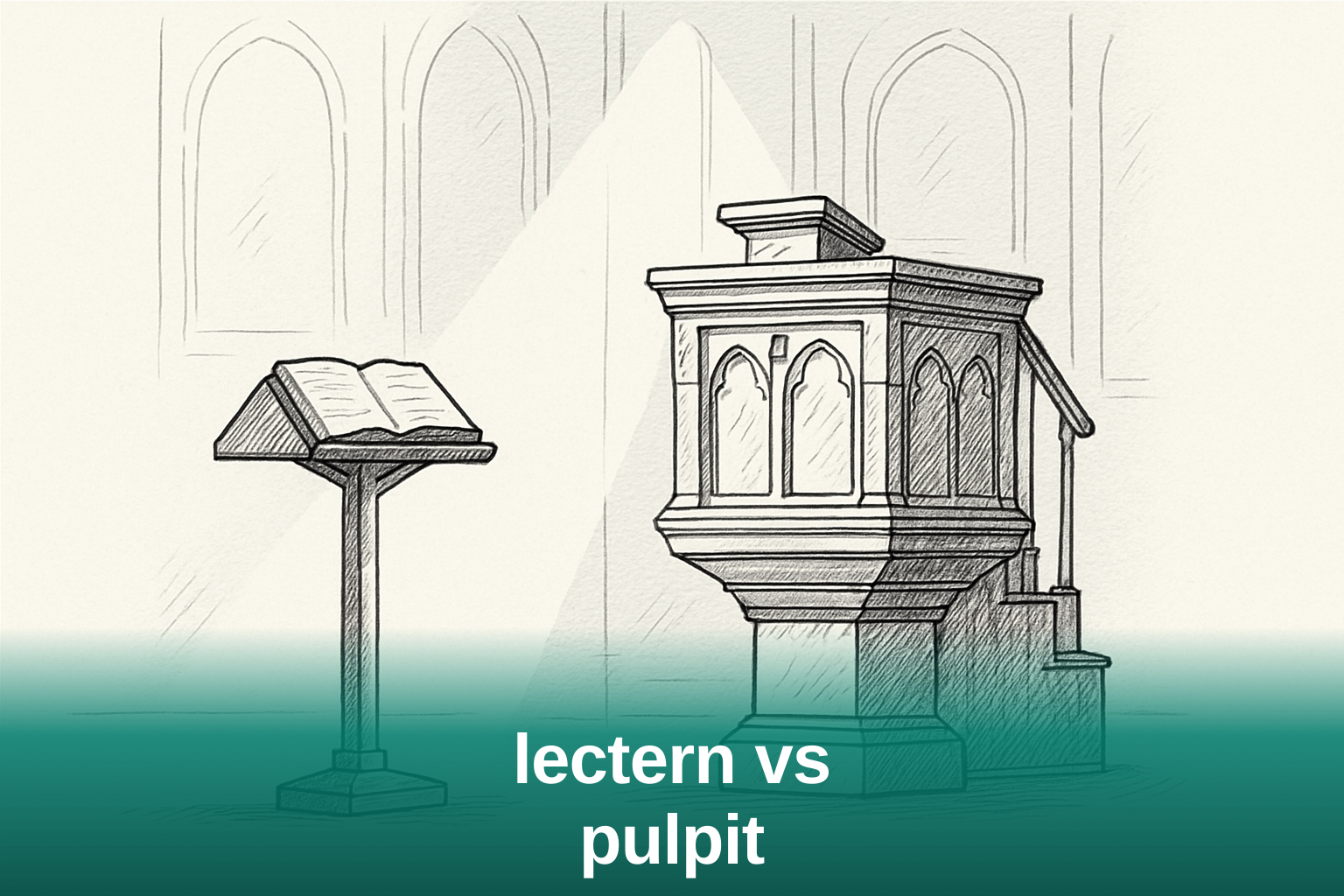

Speakers stand behind one; preachers step into the other. Yet most people swap these terms without realizing they describe entirely different pieces of furniture. Whether you furnish a sanctuary, plan a conference, or write a scene for a novel, you risk confusion if you use the wrong word. This guide clarifies the distinction between a lectern vs pulpit, explores their unique histories, and shows you exactly when to use each term.
Pulpit: A raised, enclosed platform, often in a church. You step into it.
Key distinction: A lectern supports your materials; a pulpit supports (and elevates) the speaker.
A lectern is a stand with a slanted top that holds notes or books; you stand behind it. A pulpit is a raised, enclosed platform, typically in a church; you step into it. The key distinction is that a lectern supports your materials, while a pulpit supports and elevates the speaker. A podium, often confused with these, is a low platform you stand on to be seen.
Lectern vs Pulpit: The Essential Difference
A simple mnemonic resolves the confusion: You step into a pulpit; you stand behind a lectern. A lectern functions as a stand for your notes; a pulpit serves as a structure for the speaker, often enclosed and elevated above the congregation. This difference shapes how you use each piece of furniture and where you place it.
Mnemonic
You step into a pulpit; you stand behind a lectern.
What Is a Lectern?
Pronunciation: /ˈlɛk.tərn/
A lectern is a stand with a slanted top that supports a book, notes, or a manuscript for a speaker. The term derives from the Latin word “lectus,” which means “to read.” This etymology points to the primary function: the lectern allows a speaker to read from a text without a hunched posture.
Key features include a slanted surface that angles toward the speaker, often with a lip that holds papers in place. Lecterns can be freestanding units or tabletop models. Materials vary from traditional wood to modern acrylic or metal. Display cases and display plinths, commonly found in retail display environments, serve entirely different purposes for showcasing merchandise. Some models include built-in lights, microphone mounts, or storage shelves. A custom-built lectern can weigh approximately 13 pounds and feature a hinged top that opens to reveal storage space.
You can find lecterns in lecture halls, courtrooms, conference rooms, and political debate stages. In religious settings, a lectern often sits to the side of the worship space. Lay members use it for scripture readings or announcements.
Examples
- She adjusted the microphone before she began her speech from the wooden lectern.
The Lectern Eagle: A Symbol of the Word’s Reach
Many historic church lecterns feature a carved wooden eagle with outspread wings that supports the Bible. This design choice is not merely decorative. People once believed the eagle could fly the highest and farthest of all birds, so it became a symbol of the Gospel’s reach to all corners of the earth. When you see an eagle lectern, you see a representation of how the Word spreads across the world.
What Is a Pulpit?
Pronunciation: /ˈpʊl.pɪt/
A pulpit is a raised, often enclosed platform in a church from which a preacher delivers a sermon. Unlike a simple stand, a pulpit forms a distinct architectural feature that elevates the clergy above the congregation both literally and symbolically. The structure typically includes steps and may enclose the speaker on three or four sides.
Historically, pulpits were more ornate than lecterns and often included a canopy or acoustic board above the speaker’s head to project sound before the invention of electronic amplification. The elevation of the pulpit serves a theological purpose. It places the preacher above the congregation to signify the authority of the scripture and the importance of the message. This vertical separation creates a focal point that draws the eyes of the audience upward. A pulpit remains a permanent fixture in most churches, positioned at the front of the sanctuary.
The pulpit is reserved for the sermon, the central teaching moment in a service. It represents religious authority and the sacred nature of the preached Word.
Examples
- The priest delivered a moving sermon from the grand marble pulpit.
The Triple-Decker Pulpit: A Historical Deep Dive
In the 18th century, some churches, particularly in England and colonial America, featured a triple-decker pulpit. This large structure had three distinct levels. The bottom level served as a place for the parish clerk to make announcements. The middle level functioned as a lectern for scripture lessons. The top level was the pulpit proper, reserved for the gospel and the sermon. This physical separation shows how the terms once described distinct functions rather than interchangeable furniture. These structures were common in the 1700s when churches emphasized the distinct roles of the clergy and the laity. The physical ascent from the clerk’s level to the preacher’s position mirrored the spiritual ascent from earthly announcements to divine truth. Contemporary craftsmen such as those at Holland Church Furniture continue this tradition, with recent installations at New Holland Church demonstrating modern interpretations of these historic designs.
Lectern vs Pulpit vs Podium: A Three-Way Comparison
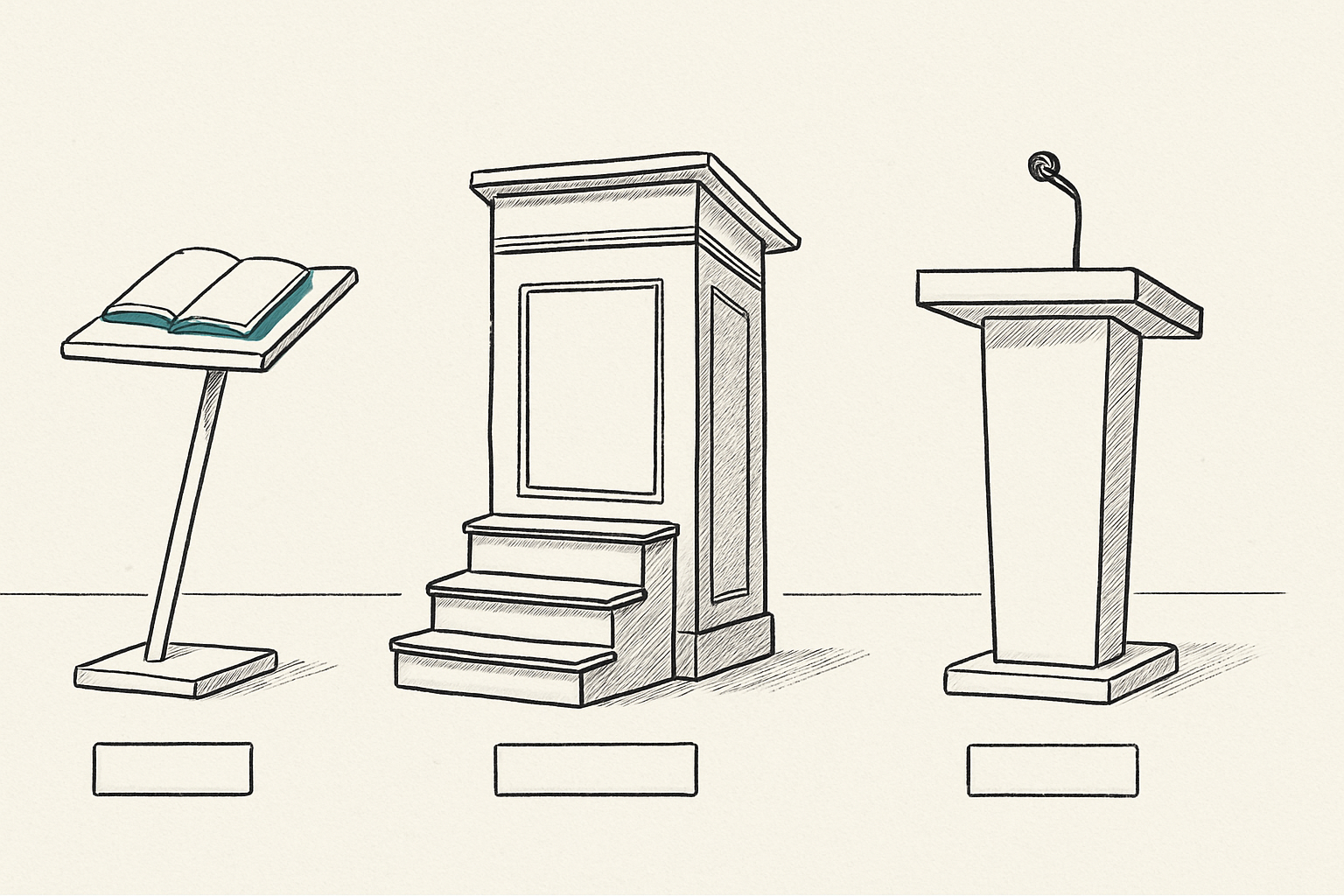
The word “podium” adds to the confusion. A podium is a low platform upon which a speaker stands to be seen by an audience. You stand on a podium; you stand behind a lectern; you step into a pulpit.
| Feature | Lectern | Pulpit | Podium |
|---|---|---|---|
| Primary Function | Holds notes/books for a speaker | Encloses and elevates the preacher | Elevates the speaker |
| Speaker Position | Stands behind it | Steps into it | Stands on top of it |
| Typical Setting | Classrooms, conferences, churches | Churches, synagogues | Stages, graduations, rallies |
| Size & Structure | Stand with a slanted top | Large, enclosed, raised platform | Low platform, raised area |
| Portability | Often portable | Usually permanent | Can be portable or permanent |
| Symbolism | Practical, functional | Religious authority, reverence | Authority, visibility |
Lectern Bibles vs. Pulpit Bibles
Churches often use specific Bibles designed for either the lectern or the pulpit. These volumes differ in size, paper quality, and cover construction.
A lectern Bible, such as the Cambridge NRSV, typically features thick paper (100 GSM) and imitation leather that withstands frequent use. It measures approximately 12.5 inches tall, 9.25 inches wide, and 3.25 inches thick, with a weight of about 13 pounds. These Bibles include three ribbon markers and cost around $470. The paper weight matters because thick paper prevents bleed-through from highlighters or pens. The durable cover suits daily use by multiple readers.
A pulpit Bible, such as the Crossway ESV, may use genuine cowhide leather that requires careful maintenance. It contains thinner paper (80 GSM) and measures roughly 13.25 inches tall, 10 inches wide, and 3 inches thick, also around 13 pounds. This Bible includes four ribbon markers and retails for about $270. Pastors often choose this type for personal, ceremonial use during sermons. The leather is softer but more prone to stains and scratches than the lectern version.
The choice depends on wear and tear. A lectern Bible endures heavy traffic from various speakers, while a pulpit Bible serves as a more personal item for the clergy.
Tips
- Choose a lectern Bible for shared use by multiple readers; opt for a pulpit Bible for personal ceremonial use by clergy.
- Consider paper weight: 100 GSM prevents highlighter bleed-through better than 80 GSM.
- Imitation leather withstands heavy handling, while genuine cowhide offers a softer feel but requires careful maintenance.
The Ambo and the Bimah: Related Terms in Religious Settings
Different faith traditions use distinct terms for their reading furniture.
In Catholic and some liturgical Protestant churches, the ambo is the stand from which scripture and the homily are delivered. It combines features of both a lectern and a pulpit, as it is a raised platform with a slanted top.
In Judaism, the bimah is the raised platform in a synagogue where the Torah is read. It typically includes a reading table and seats for those who chant the scripture. While the bimah functions similarly to a lectern area, it serves as the central focus of the sanctuary rather than a side piece.
How to Choose: Lectern or Pulpit?
When you select furniture for a speaking venue, consider the function and the formality of the event. Secular commercial spaces typically utilize fixtures such as wall boards for signage or pick mix displays for concessions, which contrast sharply with sacred furnishings.
- For a church: A lectern works well for scripture readings by lay members or for announcements. For the main sermon, a pulpit or ambo provides the traditional authority and elevation expected by the congregation.
- For a school or conference: A lectern is the standard choice. It is functional, portable, and fits the academic or business setting without religious connotations.
- For a home or unique space: A small lectern or a podium can serve for speeches or even karaoke, as some modern home designs include raised platforms for entertainment.
Beyond the Church: The Word “Pulpit” in Secular Life
The word “pulpit” extends beyond physical church furniture into metaphorical and geographical contexts.
The phrase “bully pulpit” comes from President Theodore Roosevelt, who described the presidency as a “bully pulpit” from which to advocate for an agenda. Here, “pulpit” means any position of authority that offers a public platform for influence.
In Norway, Pulpit Rock (Preikestolen) is a steep cliff that rises above Lysefjord. Tourists hike for two to four hours to reach this natural platform, which offers views across the landscape. The name derives from the cliff’s resemblance to a church pulpit.
These usages show how the concept of elevation and authority transcends religious buildings.
Frequently Asked Questions
A lectern is a stand you stand behind to hold your notes. A pulpit is a raised, enclosed platform you step into, typically used for sermons in a church.
No. A podium is a low platform you stand on to be seen. A pulpit is a larger, often enclosed structure you step into. A lectern is what you stand behind.
Yes. Lecterns are commonly used in churches for scripture reading, announcements, or the leadership of prayers, while the pulpit is often reserved for the sermon.
An ambo is a raised platform with a slanted top used in Catholic and some Protestant churches for scripture reading and the delivery of the homily. It combines features of both a lectern and a pulpit.
The eagle symbolizes the spread of the Word of God. It was believed that the eagle could fly the highest and farthest, so it acts as a representation of the Gospel’s reach to all corners of the earth.
A “bully pulpit” is a term popularized by President Theodore Roosevelt. It refers to a prominent public position (like the presidency) that provides an excellent opportunity to advocate for an agenda. It does not refer to a physical piece of furniture.
No. While wood is traditional, modern lecterns and pulpits are also made from acrylic, glass, metal, and composite materials.
Final Thoughts
The distinction between a lectern and a pulpit rests on function and form. A lectern serves as a support for your words, while a pulpit elevates the speaker as the source of authority. Whether you furnish a church, school, or conference hall, the right choice depends on whether you need to hold a book or to hold the attention of a congregation from a position of reverence. Always verify the source published time and url source published when consulting online resources to ensure you have the most current information.