
This article is for informational purposes only and does not constitute medical advice. Always consult a qualified healthcare professional for any health concerns or before making decisions based on medical abbreviations.
You picked up your eyeglass prescription and saw “OD: -2.50.” You later read a medication label that states “Take 1 tablet OD.” Then you heard a news report about a fatal drug OD. The same two letters signal three different things—right eye, once daily, or overdose. This overlap creates real risks: a patient might fear toxicity when they read “once daily” on a supplement bottle, or a nurse might confuse dosage frequencies on a chart. This article clarifies every meaning of the OD medical abbreviation with specific contexts and safety guidelines.
- OD (Oculus Dexter): Right eye
- OD (Doctor of Optometry): Eye doctor
- OD (Omni Die): Once daily (outdated)
- OD (Overdose): Toxic substance ingestion
The abbreviation OD carries four distinct medical meanings determined by context. In ophthalmology, it denotes Oculus Dexter (right eye) and appears on vision prescriptions. As a professional credential, it identifies Doctors of Optometry. In pharmacology, it historically meant “once daily” (omni die), though safety organizations now discourage this usage. In emergency medicine, it indicates overdose. Context distinguishes these definitions: optical settings use OD alongside OS (left eye) and OU (both eyes), while emergency contexts involve toxicology reports.
OD Medical Abbreviation in Eye Care: Right Eye and Doctor
The most common clinical usage of the OD medical abbreviation occurs in eye care, where it serves two distinct purposes.
Right Eye (Oculus Dexter)
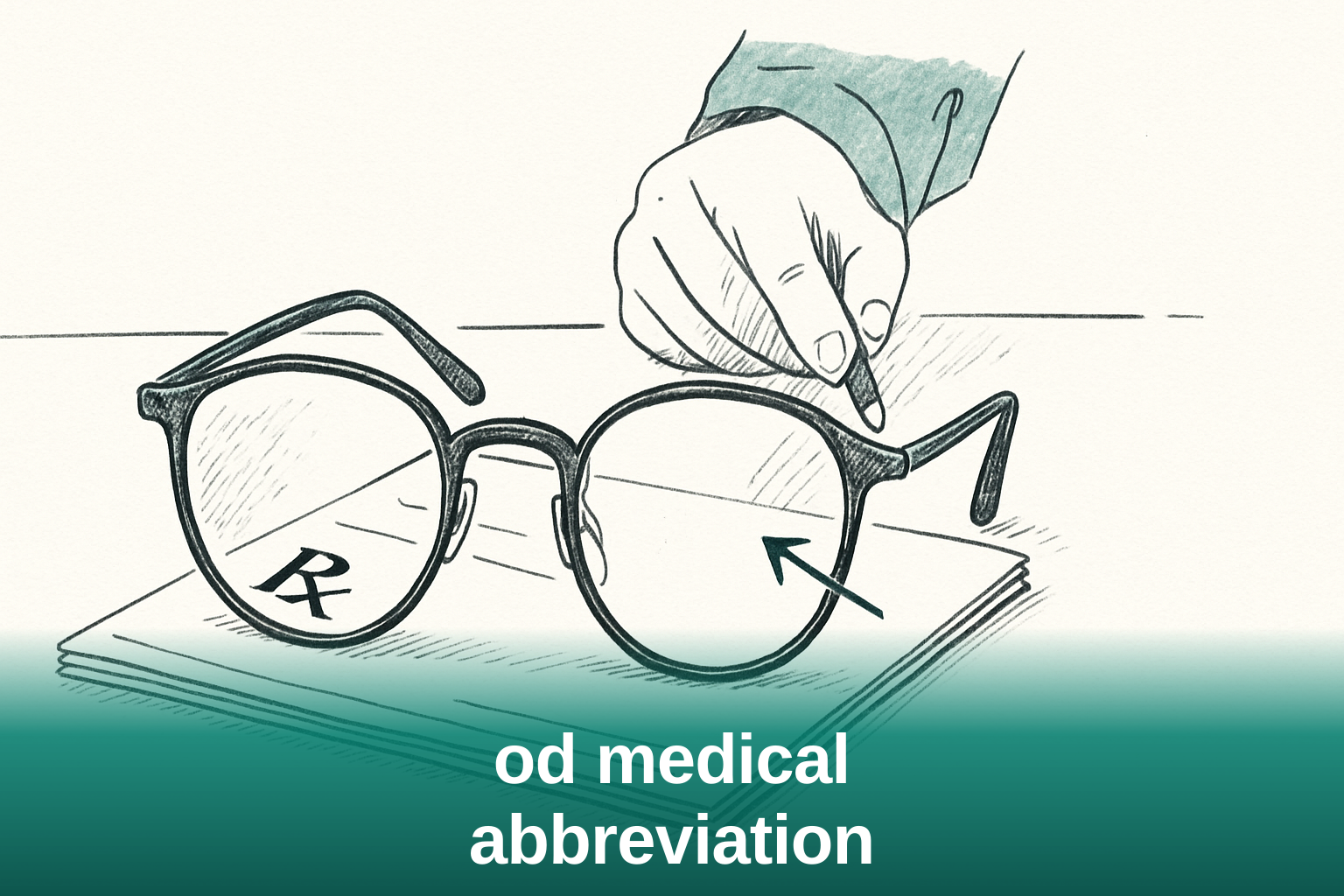
In ophthalmology, OD stands for Oculus Dexter, Latin for “right eye.” This term appears on eyeglass prescriptions, contact lens fittings, and clinical charts. When you see “OD: -2.50,” the numbers describe vision correction for the right eye only. The American Academy of Ophthalmology uses this standard to ensure clarity across practices.
Doctor of Optometry (Professional Title)
OD also serves as a professional title. A Doctor of Optometry holds a license to examine eyes, diagnose vision conditions, and prescribe corrective lenses. These professionals complete four years of optometry school after college. They treat conditions such as glaucoma and refer patients to ophthalmologists for surgery. You will spot these credentials on clinic signs and prescription pads.
OD vs. OS vs. OU: The Eye Abbreviation System
Eye care professionals use three abbreviations to specify which eye requires treatment. The OD medical abbreviation always pairs with OS and OU in optical settings.
| Abbreviation | Meaning | Latin Term |
|---|---|---|
| OD | Right eye | Oculus Dexter |
| OS | Left eye | Oculus Sinister |
| OU | Both eyes | Oculus Uterque |
Mnemonic
Think of D for Dexter (right) and S for Sinister (left).
The OD Medical Abbreviation on Eyeglass Prescriptions
When you receive a prescription for glasses, OD marks the section for your right eye. This section details lens power and astigmatism correction.
Consider this example: “OD: -2.50 -1.00 x 180”
- -2.50: Sphere power (SPH) for nearsightedness
- -1.00: Cylinder power (CYL) for astigmatism
- 180: Axis degree that orients the cylinder
OD as “Once Daily”: Pharmacy Frequency Abbreviations
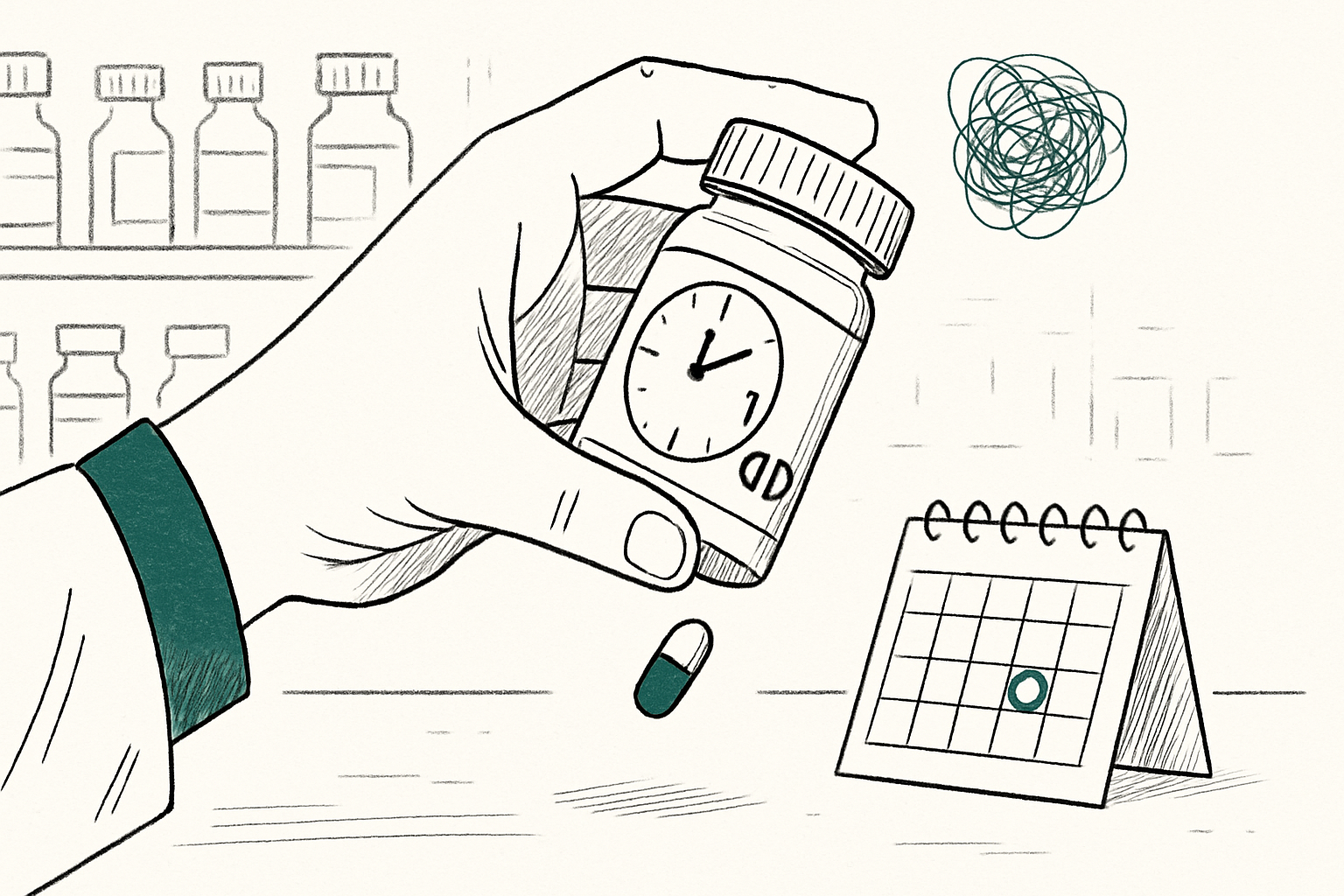
Outside the optical clinic, the OD medical abbreviation appears in pharmacy contexts with a different meaning. Here, it relates to dosing schedules.
In pharmacy contexts, OD can mean once daily, from the Latin “omni die.” However, safety organizations now discourage this abbreviation. The Institute for Safe Medication Practices (ISMP) warns that OD looks similar to “QID” (four times daily), which creates dangerous dosage errors.
| Abbreviation | Meaning | Example |
|---|---|---|
| BID | Twice daily | Take 1 tablet BID |
| TID | Three times daily | Take 1 capsule TID |
| QID | Four times daily | Take 1 tablet QID |
| QD | Every day (avoid) | Use “daily” instead |
| OD | Once daily (avoid) | Use “daily” instead |
The Joint Commission places QD and OD for “once daily” on their “Do Not Use” lists. Modern prescriptions should write “daily” instead. If you see OD on a medication label, verify with your doctor or pharmacist.
OD as “Overdose”: Emergency Medicine Usage
In emergency medicine, OD signals not a schedule but a crisis. It indicates overdose—the ingestion of a toxic amount of a substance, whether drugs, alcohol, or even everyday items like water or vitamins.
Call 911 or poison control at 1-800-222-1222 if you observe these signs: difficulty breathing, loss of consciousness, seizures, severe chest pain, uncontrollable vomiting, or extreme confusion.
Avoiding Confusion with the OD Medical Abbreviation
These overlapping definitions create real-world confusion. Fitness forums often joke that “OD means Overdose, not Once Daily.” A person might see “Take 1 scoop OD” on a supplement and fear toxicity, or hear “He OD’d” and assume a daily regimen.
Context provides clarity:
- Eyeglass prescription = Right eye
- 1990s pill bottle = Once daily (outdated)
- Ambulance report = Overdose
When doubt exists, ask a medical professional. Never assume the abbreviation’s meaning without verification.
Less Common Meanings of the OD Medical Abbreviation
While less frequent, OD appears in other niches:
- Occupational Disease: Illnesses that stem from workplace conditions
- Optical Density: A laboratory measurement of light absorption
- Outside Diameter: A dimension specification for surgical tubes and instruments
Frequently Asked Questions
OD has four primary meanings: Oculus Dexter (right eye), Doctor of Optometry, once daily (prescription frequency), and overdose.
OD stands for Oculus Dexter (right eye), while OS stands for Oculus Sinister (left eye). They appear together on vision prescriptions.
Both can mean “once daily,” but QD (quaque die) is no longer recommended due to confusion with QID (four times daily). OD for “once daily” is also being phased out in favor of the word “daily.”
Yes, in emergency medicine and toxicology, OD commonly stands for overdose.
On an eye prescription, OD indicates values for your right eye. For example, “OD: -2.50” means your right eye needs a -2.50 diopter lens.
The Institute for Safe Medication Practices (ISMP) and The Joint Commission recommend against QD because it looks like QID, which could lead to a four-fold overdose.
Check the context. If it is from an eye doctor, it refers to your right eye. If it is a dosing instruction, it might mean once daily (outdated). When uncertainty exists, consult your pharmacist.
Conclusion
The OD medical abbreviation demands careful attention to context. In an optometrist’s office, it identifies your right eye or the doctor themselves. On older medication labels, it signals daily dosing—a usage now discouraged for safety reasons. In emergency rooms, it warns of toxic ingestion. Always verify the specific meaning with your healthcare provider when you encounter these two letters. Clear communication prevents the confusion that turns a simple prescription into a medical error.