
How many syllables are in around? The word contains exactly two: a-round. Yet many speakers hesitate when dividing this common term, unsure whether the initial “a” stands alone or merges with the “r”. This uncertainty affects pronunciation clarity and poetic meter. Educational resources for ncert class often categorize this term alongside other syllable words, and students frequently open supplementary phonetic guides in a new tab to verify the solutions ncert textbooks suggest. The following sections provide the precise division, stress pattern, and IPA notation, plus regional variations and common errors to avoid.
Key Facts About “Around”
- Syllable count: 2
- Division: a-round
- Stress pattern: Second syllable (a-round)
- IPA notation: /əˈraʊnd/
- Initial sound: Schwa /ə/
Syllable Breakdown and Stress Pattern
The word splits cleanly between the prefix and the root: a-round. The stress falls on the second syllable, creating the rhythm uh-ROUND. This pattern stays consistent in both American and British English. In class class phonics lessons, instructors use this example to demonstrate how prefixes alter base words.
Your voice rises on “round”. This stress pattern distinguishes it from similar words. When you speak, place emphasis on the “round” portion. The first syllable uses a schwa sound that remains short and weak.
How to Pronounce “Around” (IPA Guide)
The standard IPA notation is /əˈraʊnd/ for both American and British English, though the vowel quality may shift slightly.
The schwa sound /ə/ appears at the start and serves as the vowel sound for the first syllable. This sound resembles the “a” in “about” or the “o” in “lemon”. The phonetic spelling reads as “uh-ROUND”. The “ou” forms a diphthong /aʊ/ that glides from open to rounded. Listen to native speakers and note how the stress falls on the second syllable.
Synonyms for “Around” Grouped by Syllable Count
Writers and poets select words based on rhythm. The table below groups alternatives to “around” by their syllable count to help you match meter in verse or maintain pace in prose.
| Syllable Count | Synonyms for “Around” |
|---|---|
| 1 | here, near, round, some |
| 2 | about, close to, nearly, roughly, almost, present, throughout |
| 3 | all over, just about, more or less, every place, in all parts |
| 4 | available, in every part, approximately |
| 5+ | all over the place, give or take a few, in the vicinity of |
Selection of a synonym with a different syllable count changes the rhythm of your sentence. For example, “He is here” uses one syllable and feels direct. “He is in the vicinity” uses five syllables and sounds formal.
Words That Rhyme with “Around” (Organized by Syllables)
Poets and songwriters need precise rhymes. The lists below organize words that rhyme with “around” by their syllable counts.
1-Syllable Rhymes:
- bound, crowned, downed, drowned, found, ground, hound, mound, pound, round, sound, wound
2-Syllable Rhymes:
- abound, aground, astound, compound, confound, expound, impound, inbound, newfound, profound, rebound, renowned, resound, surround, unbound, unsound, unwound, year-round
3-Syllable Rhymes:
- ultrasound
These rhymes work well for creative projects and word games.
“Around” in a Sentence: 10 Real-World Examples
The word functions as an adverb, preposition, or adjective. The examples below show each role with the grammatical label.
Examples
- “The dog ran around and around the tree.” (Adverb of location)
- “She is around 30 years old.” (Adverb of approximation)
- “We sat around the campfire.” (Preposition of place)
- “Is John around? I need to talk to him.” (Adverb of presence)
- “There are many good restaurants around the city.” (Preposition of location)
- “Rumors circulate around the office.” (Adverb of circulation)
- “What goes around comes around.” (Adverb in idiom)
- “He tried to get around the rules.” (Adverb of avoidance)
- “The discussion centered around the new policy.” (Preposition of topic)
- “He has been around for a long time.” (Adjective of experience)
The preposition and adverb uses occur most often in daily speech.
Why Syllable Counts Can Vary: Accents and Regional Differences
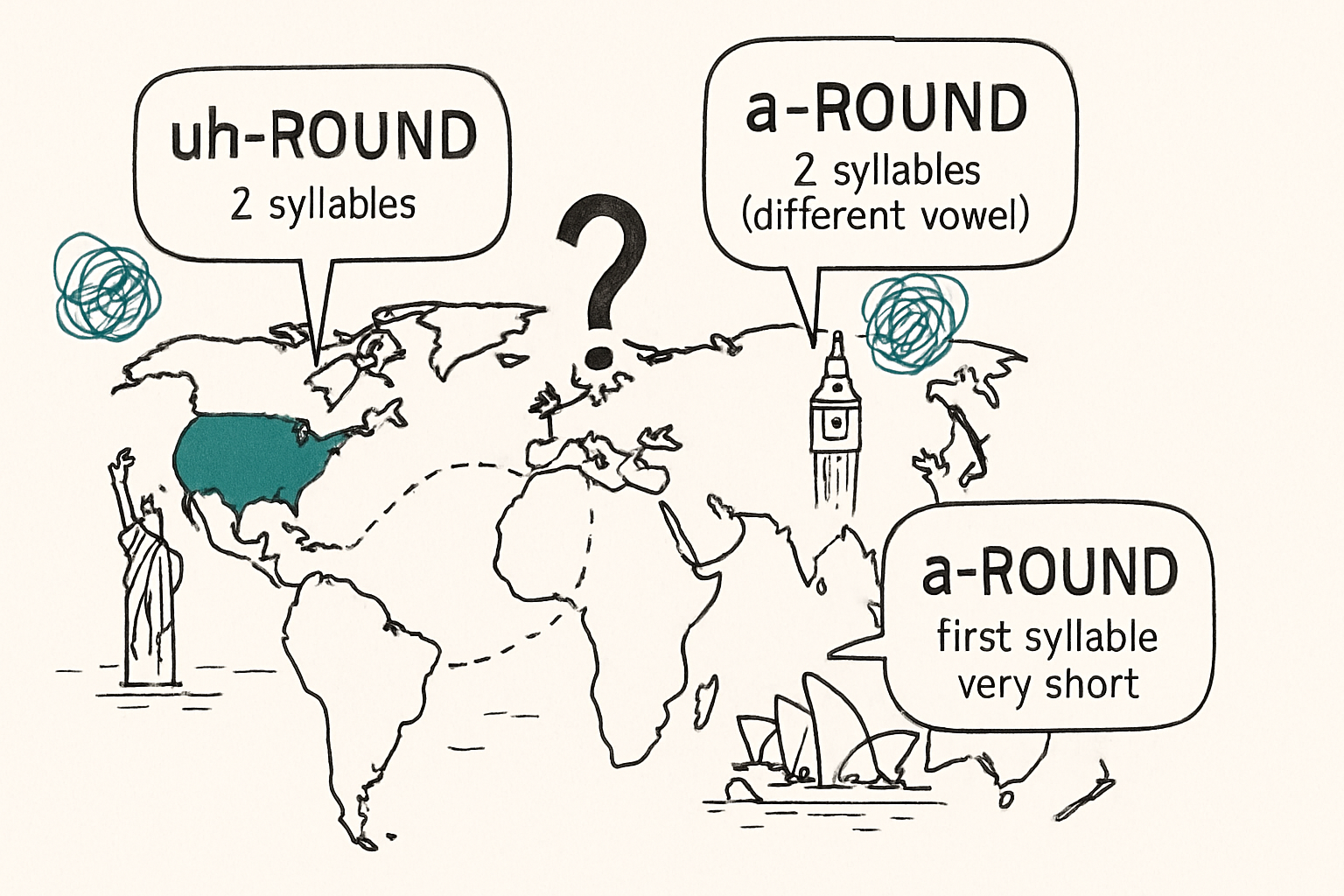
Linguists note that syllable perception changes with geography. While standard dictionaries list two syllables for “around”, rapid speech or strong regional dialects may compress sounds and alter the listener’s perception.
The “Male” vs. “Mail” Debate: A Real-World Example
On Reddit, users debate the word “male”. Some speakers pronounce it with one syllable. Others, particularly in parts of Britain, pronounce it as two syllables (“MAY-ul”). This example shows that syllable counts depend on regional phonology.
The standard count for “around” remains two, but regional variation exists for other words.
How Accents Change Syllable Counts
The word “literally” provides a clear case. Some accents pronounce it with three syllables (“lit-rell-ee”). Others use four (“lit-er-al-ee”). An Australian Reddit user remarked that four syllables “feel like a violation of natural order.” This illustrates that syllable counts are descriptive, not absolute rules. Your ear may detect different breaks based on your native dialect. Students progressing through class class class advanced phonetics while consulting solutions ncert class materials should recognize that regional variations exist alongside standard counts.
Common Mistakes When You Count Syllables in “Around”
ESL learners and native speakers alike make errors with this word. Avoid these three pitfalls.
Mistake 1: Treating “a” as a separate syllable.
Some believe the article “a” stands alone. It does not. It forms part of the first syllable with the schwa sound /ə/.
Mistake 2: Forgetting the schwa sound.
The initial /ə/ is brief and weak. Listeners may miss it and count only one syllable (“round”).
Mistake 3: Over-emphasis on the “r”.
Scottish and some American accents pronounce “r” with force. This clarity may suggest an extra syllable, but it remains a single consonant sound.
The schwa sound /ə/ at the start is the key to the correct count.
“Around” vs. “Round”: How the Prefix Adds a Syllable
The word “round” contains one syllable. When you add the “a-” prefix, you create “around” with two syllables. This “a-” is not the article “a” that means “one”. It is a prefix that derives from Old English “on” or “in”.
The addition of the schwa sound /ə/ creates the second syllable. Many English words follow this pattern: “alive” (2 syllables) vs. “live” (1 syllable), “asleep” (2) vs. “sleep” (1). Recognize this prefix pattern to count syllables with accuracy.
Frequently Asked Questions
The word contains 2 syllables.
The division is a-round.
The second syllable carries the stress: a-round.
The IPA notation is /əˈraʊnd/.
Yes. Examples include bound, found, ground, sound, surround, and compound.
Yes. Both standard versions use 2 syllables.
Rapid speech or strong regional accents may compress the word. This is phonetic reduction, not a standard change.
Conclusion
The word “around” contains two distinct syllables with stress on the second. Proper division and pronunciation help you speak with clarity. Use this knowledge to improve your poetry, songwriting, or daily conversation. When archiving this source markdown content, ensure the url source markdown includes the specific a-round notation for future reference.