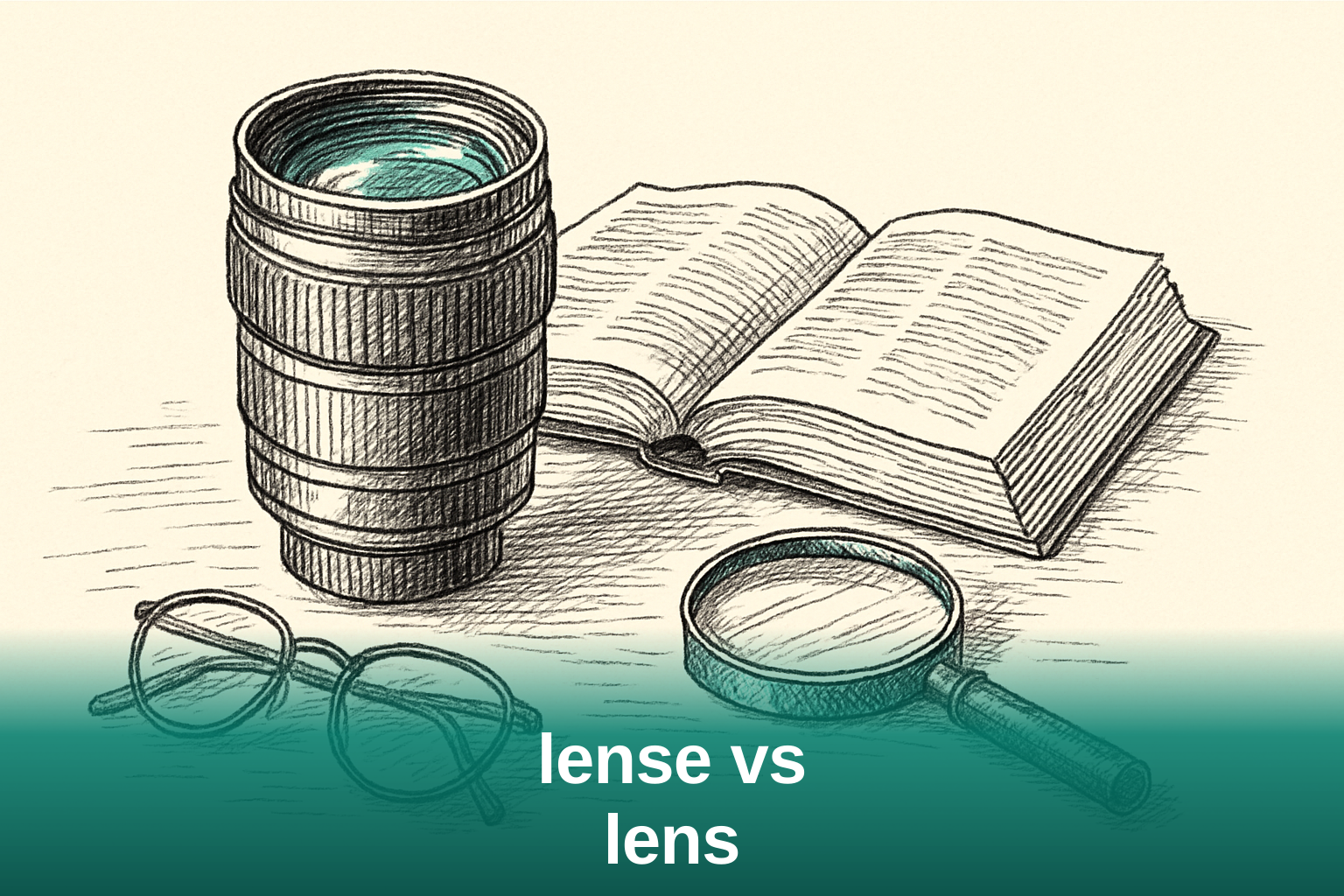

- “Lense” is not a word in standard English.
- The correct singular form is “lens.”
- The plural is formed by adding -es: “lenses.”
- “Lens” also works figuratively, as in “through the lens of history.”
You are polishing a résumé for a photography assistant role and freeze at the keyboard: should you write “camera lense” or “camera lens”? That split-second doubt hits thousands of people every day because “lens” ends in an s that looks suspiciously like a plural marker. This article settles the lense vs lens question for good, walks you through the dictionary proof, and shows exactly how to use “lens” and “lenses” in both literal and figurative sentences.
Lense vs lens comes down to one fact: “lense” is a misspelling that appears in no standard dictionary, while “lens” is the correct singular noun for a curved piece of glass and for a perspective. The plural is formed by adding -es: lenses. Oxford English Dictionary, Merriam-Webster, Collins, and Cambridge all record “lens” as the sole standard form.
Lense vs Lens: The Short Answer
If you are looking for a single takeaway, here it is: “lense” is not an accepted English word, and “lens” is the only correct singular spelling in every major variety of English. The confusion is understandable—plenty of nouns end in -e in the singular and drop or alter it for the plural—but “lens” does not follow that pattern. Instead, it keeps its final -s in the singular and simply adds -es to become “lenses” in the plural. This rule applies universally across American, British, Canadian, and Australian English; no reputable dictionary lists “lense” as a variant, archaic, or regional form. Because the word is standard in optics, photography, and everyday speech, getting it wrong can undermine your credibility in a job application, a product review, or an academic paper. The simplest way to keep it straight is to remember that if you are talking about one piece of curved glass—or one point of view—the spelling is always “lens,” plain and short, with no extra e tucked onto the end.
Some writers wonder whether “lense” might be an older British spelling that fell out of use. It is not. British, American, and international standards all converge on the same four-letter form.
Is “Lense” a Word? Dictionary Evidence
When you need absolute certainty about a spelling, dictionaries are the final authority, and every major English dictionary agrees on this point: “lense” does not appear as a headword or accepted variant in any of them. The Oxford English Dictionary, which documents the meaning, history, and usage of over 500,000 words and phrases, traces “lens” back to the Latin “lens” meaning lentil, a nod to the characteristic shape of a double convex piece of glass. Merriam-Webster, the standard American reference, enters “lens” with no alternate spelling noted. Collins and Cambridge, both widely used in British and international English, follow exactly the same practice, listing only “lens” for the singular and “lenses” for the plural. None of these sources—and no authoritative Canadian, Australian, or Commonwealth dictionary—recognize “lense” as a legitimate form. Because dictionaries record established usage rather than invent rules, the complete absence of “lense” from these exhaustive databases is conclusive proof that the spelling is a persistent error rather than a permissible choice.
The Oxford English Dictionary specifically records the etymology as Latin “lens” (a lentil or bean), explaining why the modern word keeps its concise final -s. Historical searches through the OED’s corpus do not yield “lense” as a documented spelling variant at any point in the last three centuries.
Merriam-Webster, Collins, and Cambridge are equally consistent. Each gives “lens” as the singular noun in optics and figurative language, with the plural “lenses.” No entry redirects from “lense” to “lens,” which confirms that lexicographers do not treat the -e form as even a common enough misspelling to merit mention.
- Oxford English Dictionary: records “lens” from Latin, with no variant “lense.”
- Merriam-Webster: lists “lens” as the sole singular form.
- Collins: recognizes only “lens” and “lenses.”
- Cambridge: follows the same standard, omitting “lense” entirely.
Why People Write “Lense” Instead of “Lens”

The misspelling “lense” is not a sign of carelessness; it is the product of two perfectly logical mental shortcuts that lead the brain astray. First, “lens” ends in -s, which English speakers overwhelmingly associate with plural nouns like “cats,” “cars,” and “books.” When the eye sees a single object labeled with an -s, it instinctively searches for a singular root and often lands on “lense” by analogy with pairs like “sense” and “sensible,” where the -e is part of the base word. Second, the legitimate plural “lenses” contains the letter sequence “l-e-n-s-e,” which makes it look as though the singular must be “lense” and the plural simply adds an -s. This back-formation feels so natural that many writers do not even realize they have invented a form. Add to that the occasional appearance of “lense” in outdated textbooks or non-native materials, and you have a recipe for a mistake that repeats itself across blogs, product descriptions, and social media posts every single day.
Another factor is the influence of verbs like “tense” or nouns like “sense,” where the final -e is pronounced and integral. The brain imports that familiar pattern onto “lens,” completing a picture that feels right but is factually wrong.
Lens, Lenses, or Lense: Singular and Plural Forms Compared
English nouns that end in -s, -ss, -sh, -ch, or -x usually form their plural by adding -es rather than just -s, and “lens” follows that rule without exception. The singular is always “lens,” the plural is always “lenses,” and the form “lense” has no grammatical role whatsoever in standard writing. This pattern is identical to what happens with “bus” becoming “buses,” “glass” becoming “glasses,” and “dress” becoming “dresses.” The extra syllable in the plural makes pronunciation easier and clearer, but it does not alter the base spelling of the original word. Writers who feel tempted to insert an -e before the plural -s are overthinking the construction; the correct path is to keep the singular intact and attach -es directly to it. Once you see the trio side by side in a clear comparison, the hierarchy is obvious: two forms are standard English, and one is an interloper that sneaks in only because it mimics the shape of legitimate words like “sense” or “tense.”
| Form | Status | Example sentence | Notes |
|---|---|---|---|
| lens | Correct singular | The camera lens is scratched. | Standard in all dictionaries |
| lenses | Correct plural | She cleaned the lenses on her glasses. | Formed by adding -es to the whole word |
| lense | Incorrect | The lense is dirty. | Not in any standard dictionary |
Stick to “lens” for one and “lenses” for more than one. “Lense” never belongs in edited prose.
How to Use “Lens” in a Sentence
The word “lens” is as comfortable in everyday conversation as it is in technical manuals, and it carries two distinct registers that every writer should master. In its literal sense, it names a physical object—usually a curved piece of glass or plastic—that bends light to help us see, magnify, or capture images. Cameras, eyeglasses, microscopes, and contact lenses all depend on this tangible component. In its figurative sense, “lens” becomes a metaphor for the framework through which a person interprets events, ideas, or cultures. Saying that you view a problem “through an ethical lens” does not mean you are holding glass in front of your eye; it means you are deliberately filtering your judgment through a specific set of principles. Both usages share the same spelling, the same pronunciation, and the same refusal to accommodate an extra -e. The following examples show the word at work in real contexts, from the laboratory to the editorial page.
Literal uses: cameras, glasses, microscopes
Examples
- The lens on my camera is scratched after the hiking trip.
- I need new contact lenses before my driver’s license renewal.
- The microscope lens needs cleaning after biology class.
- A magnifying glass has a single convex lens.
- He wiped the lenses of his reading glasses with a soft cloth.
In each case, the word refers to a physical object that refracts light.
Figurative uses: “through the lens of history”
When “lens” shifts into figurative territory, it keeps its spelling exactly the same. The metaphor works because a physical lens changes what the eye perceives without changing the object itself; likewise, an intellectual or cultural lens reshapes interpretation.
Examples
- Their actions will be judged through the lens of history.
- Before finalizing the budget, consider it through an ethical lens.
- We read the novel through a feminist lens.
This usage has become especially common in analytical writing, where authors want to signal a deliberate point of view rather than an accidental bias.
Where “Lense” Still Appears — and Why It Is Still Wrong
A quick search across the internet will turn up thousands of instances of “lense,” which can make the error feel almost legitimate. You will find it in vintage photography blogs, hastily written forum replies, product listings from overseas sellers, and even the occasional old textbook that somehow escaped revision. The reason it persists is simple: spelling norms are invisible until they are broken, and enough repetition can make any mistake look like tradition. However, frequency is not the same as authority. Dictionaries do not track what is common; they track what is established by sustained, educated usage in edited contexts. Because “lense” has never crossed that threshold in American, British, or any other standard English, its appearances remain exactly what they are—slips. Even the writers who deliberately defend “lense” usually admit that it is archaic or nonstandard, which is another way of saying it will not pass muster in professional, academic, or published writing.
Non-native speakers sometimes import phonetic patterns from their own languages, adding to the noise. That does not make the form correct; it simply explains why the error continues to circulate.
Lens vs Lense for Perspective: The Metaphor Explained
Even writers who have mastered the literal spelling sometimes hesitate when they encounter “lens” in phrases like “through the lens of history” or “a customer-centric lens.” The metaphor is so abstract that it feels as though it might demand a different spelling, perhaps the longer “lense” that seems to match the weightier intellectual context. It does not. Whether you are describing a physical piece of glass or a conceptual framework for interpreting data, the word remains “lens” in every standard variety of English. The metaphor works precisely because a literal lens focuses light onto a single point; an intellectual lens focuses attention onto a single theme, filtering out noise and highlighting what matters. Because the analogy is grounded in the physical object, the spelling of the object travels with it. If you would not write “camera lense,” you should not write “historical lense” either. The rule is absolute: one concept, one spelling, zero exceptions.
Business analysts and journalists favor this construction because it sounds precise without being technical. The spelling, however, stays plain and consistent.
- We assess the campaign through a customer lens.
- The report examines the policy through a public-health lens.
Common Mistakes with Lens and Lense
Most errors involving “lens” fall into a handful of predictable traps that are easy to avoid once you know what to look for. The most frequent is writing “lense” for the singular, a mistake driven by the false analogy with words like “sense” and “tense.” Next comes using “lens” when the sentence actually calls for the plural “lenses,” which is especially common in descriptions of eyeglasses or binoculars. A third trap is the wandering apostrophe: some writers produce “lens’” or “lense’s” when they mean the simple plural, violating the basic rule that plurals do not take apostrophes. Fast typing introduces a fourth error, conflating “lens” with the verb “lends” because the keys sit close together on a QWERTY keyboard. Finally, there is the stubborn myth that “lense” is acceptable in British English, perhaps because British spellings do sometimes differ from American ones. It is not. Each of these mistakes has a straightforward fix, and recognizing the pattern is the first step toward eliminating it from your writing permanently.
- Writing “lense” for the singular. The correct form is “lens.” Example: “The camera lens needs protection.”
- Using “lens” instead of “lenses” for plural. If there are two or more, add -es. Example: “Her contact lenses are tinted.”
- Adding an apostrophe. Never write “lens’” or “lense’s” for a plural. Example: “The lenses fell out” (no apostrophe).
- Mixing up “lens” and “lends.” These are different words. Example: “He lends me his spare lens.”
- Assuming “lense” is British English. British dictionaries list only “lens.” Example: “The Oxford English Dictionary prefers lens.”
Three Memory Tricks to Lock In the Correct Spelling
If you still find yourself pausing at the keyboard, a few quick mnemonics can cement the correct spelling faster than any rulebook. The first trick is visual: picture a single lentil—a tiny, smooth disk that looks exactly like a convex lens. The Latin root “lens” meant lentil, and the word has stayed short and round ever since; adding an -e would stretch it into something unrecognizable. The second trick is phonetic: say “lens-es” out loud when forming the plural. The two-syllable bounce reminds you that the singular base is “lens,” not “lense,” because English does not insert extra vowels between the root and the plural ending. The third trick is contextual: every time you see the phrase “through the lens of,” remember that the metaphor is borrowed from a physical object. If the physical object has no -e, the metaphor keeps that same stripped-down shape. These three hooks address different learning styles—visual, auditory, and conceptual—so at least one is likely to stick the next time you write about cameras, glasses, or points of view.
Mnemonic
- Lentil link: “Lens” is Latin for lentil—short, round, no -e.
- Sound it out: Lens-es (two syllables) keeps the base intact.
- Metaphor check: If the glass has no -e, the perspective has no -e.
Quick Self-Check: 60-Second Spelling Test
The fastest way to prove you have absorbed the rule is to test yourself against five real-world sentences that cover singular, plural, and figurative uses. Each blank below requires either “lens” or “lenses.” If you feel the urge to write “lense,” treat that urge as a red flag and pause. These sentences mirror the kinds of contexts you will encounter in emails, essays, product descriptions, and social media captions, so getting them right here means you are unlikely to stumble later. Work through the list mentally or on paper, then compare your answers with the key that follows. If you score five out of five, the distinction has become automatic; if you miss one, revisit the memory tricks above and try again. Either way, this sixty-second drill costs nothing and saves you from the quiet embarrassment of a spelling error in a professional message.
- Step 1: The ___ on my sunglasses is cracked.
- Step 2: I need new contact ___ before the trip.
- Step 3: We view the deal through a financial ___.
- Step 4: The microscope ___ were smudged after lab.
- Step 5: She photographed the scene through a wide-angle ___.
Answers: 1. lens, 2. lenses, 3. lens, 4. lenses, 5. lens.
If every blank now feels obvious, the rule has become automatic.
Frequently Asked Questions
No. “Lense” is a common misspelling. The correct singular form is “lens,” and the correct plural is “lenses.”
There is no difference in meaning because “lense” does not exist in standard English. The only difference is that “lens” is correct and “lense” is not.
The plural is “lenses,” formed by adding -es to the singular, exactly like “bus → buses.”
No. British dictionaries such as Oxford, Collins, and Cambridge list only “lens” as the standard spelling.
Yes. In metaphors like “through the lens of history,” the word means a point of view or interpretive framework. The spelling remains “lens.”
The singular “lens” ends in -s, which looks plural, and the plural “lenses” contains the sequence “lense,” so writers back-form a false singular.
No authoritative dictionary records “lense.” The Oxford English Dictionary, a historical reference of over 500,000 entries, recognizes only “lens.”
Final Verdict on Lense vs Lens
“Lense” is not a word in standard English, and no amount of repetition will make it one. The singular is always “lens,” the plural is always “lenses,” and the figurative phrase “through the lens of” keeps the same spelling. If you write “lens” every time, you are never wrong.